Understanding Property Trusts in Singapore
Learn legal and beneficial ownership, trustee duties, ABSD (Trust), HDB implications and RES exam traps.
ExamDecoded illustrated study guide
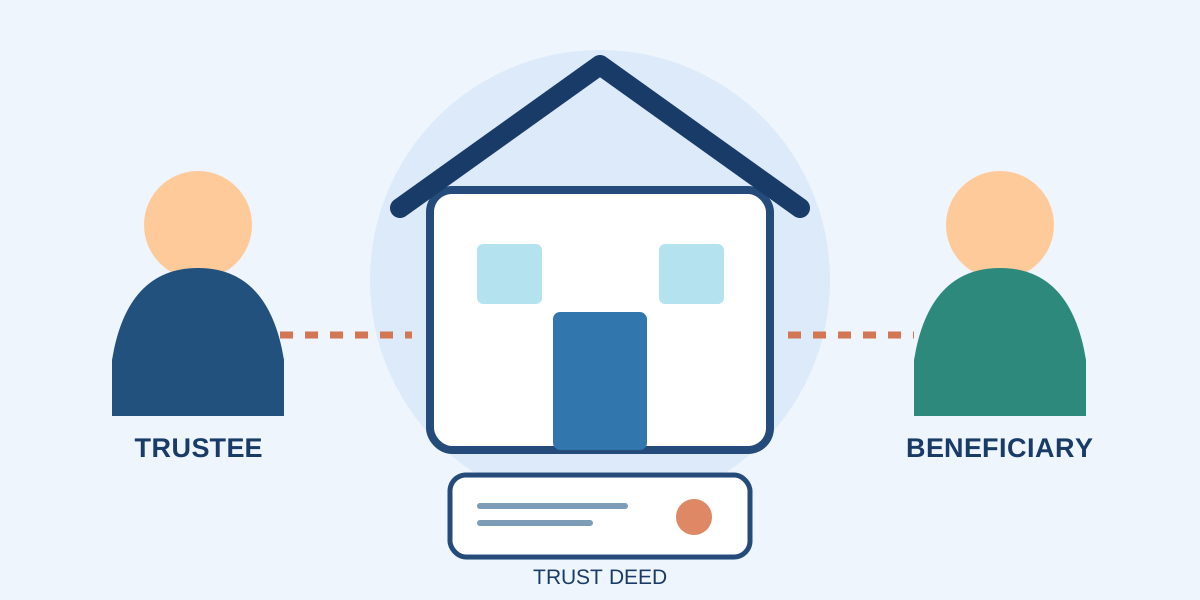
A property trust separates legal ownership from beneficial ownership. The trustee holds and manages the property for the beneficiary under the trust terms. In Singapore, trusts do not automatically eliminate stamp duty or HDB ownership restrictions. Residential property acquired into a living trust generally attracts 65% ABSD (Trust) upfront; qualifying remission must be applied for separately.
What is a property trust?
Imagine a parent buying a condominium to hold for a child. The parent may be registered as trustee while the child holds the beneficial interest. The trustee must act according to the trust deed and fiduciary duties, rather than treating the property as personal wealth.
A trust is a legal relationship, not simply a way to put someone else’s name on the property. Its terms and the actual beneficial interests matter.
The three parties in a trust
| Party | Role |
|---|---|
| Settlor | Person who establishes the trust and settles assets into it. |
| Trustee | Holds legal title and administers the assets according to the trust. |
| Beneficiary | Person entitled to the benefits or beneficial interest specified by the trust. |
One person can occupy more than one role, depending on the arrangement. The beneficiary is not called the “trustor”: that term generally refers to the settlor.
Legal ownership versus beneficial ownership
Legal ownership identifies who holds title and deals with the property in the trustee capacity. Beneficial ownership concerns who is entitled to the economic benefit or equitable interest under the trust. These rights need not be held by the same person.
What does a trustee do?
A trustee must administer the trust according to its terms, act in the beneficiaries’ interests, avoid unauthorised conflicts and keep appropriate accounts. Duties may include maintaining the property, collecting rent, paying expenses and accounting for trust funds. Powers to sell, mortgage or distribute property must be checked against the trust deed and law.
A separate account and accurate records are sensible safeguards. Trustee remuneration and reimbursement depend on the governing terms and applicable law; the trustee cannot simply take trust income as personal income.
Types of trusts and beneficiaries
| Concept | Meaning |
|---|---|
| Bare trust | Trustee holds for a beneficiary with an absolute beneficial interest, subject to relevant legal capacity and other requirements. |
| Discretionary trust | Trustees have discretion over distributions within the trust terms. |
| Revocable trust | Terms permit revocation as specified; not every trust is revocable. |
| Irrevocable trust | Cannot simply be cancelled at will, although legal variation or other mechanisms may be available. |
| Contingent beneficiary | Entitlement depends on a specified event or condition. |
Trusts do not automatically terminate when a child turns 21. Termination depends on the trust terms and applicable law. Beneficiaries’ information, accounting and enforcement rights also depend on the nature of their interests and circumstances.
Buying Singapore residential property under trust: ABSD
For a residential property transferred into a living trust, the general ABSD (Trust) rate is 65% upfront. A qualifying trust for identifiable individual beneficiaries may receive remission by refund. IRAS requires the upfront duty to be paid and an application within six months after execution of the instrument.
The remission, if granted, is the difference between the 65% paid and the ABSD applicable to the beneficial owner with the highest applicable rate. Qualifying interests must satisfy IRAS’s definition, including an identifiable individual whose beneficial ownership is not revocable, variable or subject to a condition subsequent. Contingent or discretionary interests generally do not qualify under that definition.
Worked example: $1 million condominium
Assume a qualifying living trust purchases a $1 million residential property. The initial ABSD (Trust) is $650,000 (65% × $1 million), in addition to any applicable BSD. If remission is approved and the relevant beneficial-owner ABSD rate is 0%, the ABSD (Trust) refund may be $650,000. This is an illustration, not an assurance of eligibility.
Does trust ownership affect future HDB eligibility?
Yes, potentially. HDB expressly treats property held on trust with an applicant or spouse as beneficiary as an ownership or property interest for relevant eligibility assessments. Property in Singapore or overseas can matter. Do not assume a child’s beneficial interest is invisible merely because a parent is registered as trustee.
Eligibility depends on the flat type, application route, ownership history and prevailing HDB conditions. Check the applicable HFE and property-disposal requirements rather than applying a single blanket rule.
Can a trust protect assets from bankruptcy?
A genuine trust may separate beneficial ownership from the settlor’s personal assets, but it is not guaranteed creditor protection. Transactions at undervalue, unfair preferences and other relevant transactions may be challenged under Singapore insolvency law. The timing, purpose and facts matter. It is inaccurate to say that property transferred into a child’s trust is always safe from creditors.
Can the trustee mortgage the property?
Not automatically. The trust deed, trustee powers, beneficiary interests, legal capacity and lender requirements must be examined. Financing a property held for a minor can be difficult, but the absolute statement that no bank loan is ever possible is too broad.
Can the settlor cancel the trust or the beneficiary renounce it?
The answer depends on the trust terms and the nature of the interest. A settlor cannot assume an irrevocable trust may be cancelled simply because they created it. A beneficiary’s renunciation of an interest in residential property held on bare trust may trigger stamp duty consequences under section 22C of the Stamp Duties Act, including BSD and potentially ABSD for the settlor and SSD for the beneficiary if within the applicable holding period.
What happens when the child becomes an adult?
There is no universal automatic transfer at age 21. A trustee-to-beneficiary transfer without a change in beneficial ownership may have different stamp duty treatment from a transaction that changes beneficial interests. IRAS identifies certain transfers without a change in beneficial ownership as no longer liable to fixed or nominal duties; document-specific assessment is still important.
What should a trust deed cover?
It should clearly identify the settlor, trustee and beneficiaries; describe the property and beneficial interests; specify trustee powers, investment and distribution rules, accounting duties, replacement of trustees, and any conditions for termination or variation. Professional drafting is particularly important where a minor, multiple beneficiaries or residential property is involved.
Singapore restrictions and practical risks
HDB property is subject to its own statutory restrictions, and foreign ownership of restricted residential property may require approval under the Residential Property Act. A trust does not override these rules. Consider financing, stamp duties, ongoing administration, beneficiary eligibility, future disputes and succession arrangements.
RES exam revision: Key differences
| Question | Remember |
|---|---|
| Who holds legal title? | Trustee. |
| Who enjoys beneficial interest? | Beneficiary, according to the trust terms. |
| ABSD (Trust) upfront? | Generally 65% for living trusts of residential property. |
| Automatic ABSD exemption for child? | No; qualifying remission is a separate application. |
| Does trust interest count for HDB? | It may count under HDB’s ownership/interest rules. |
| Automatic end at age 21? | No; examine the trust terms and law. |
Test your understanding
Answer all five RES-style questions, then submit to see explanations.
Final takeaway
A trust divides legal and beneficial ownership, but does not bypass Singapore’s stamp duty, housing eligibility or insolvency rules. For RES questions, identify the parties, determine the nature of the beneficial interest, then apply the correct property and tax rules.
References and further reading
- IRAS — Additional Buyer’s Stamp Duty and ABSD (Trust).
- IRAS — Remission of ABSD (Trust).
- IRAS — Fixed and nominal duties.
- IRAS — Renunciation of beneficial interest.
- HDB — Eligibility and property interests.
- SLA — Foreign ownership of property.
- Singapore Statutes Online — Insolvency, Restructuring and Dissolution Act 2018.
Reviewed against Singapore official sources, September 2026. Educational RES revision only; not legal or tax advice. Check prevailing rules and obtain professional advice for an actual trust or transaction.