1.1 Real Estate Markets and Submarkets
Understand why property behaves differently from other goods, how Singapore property is classified, and what moves its prices and rents.
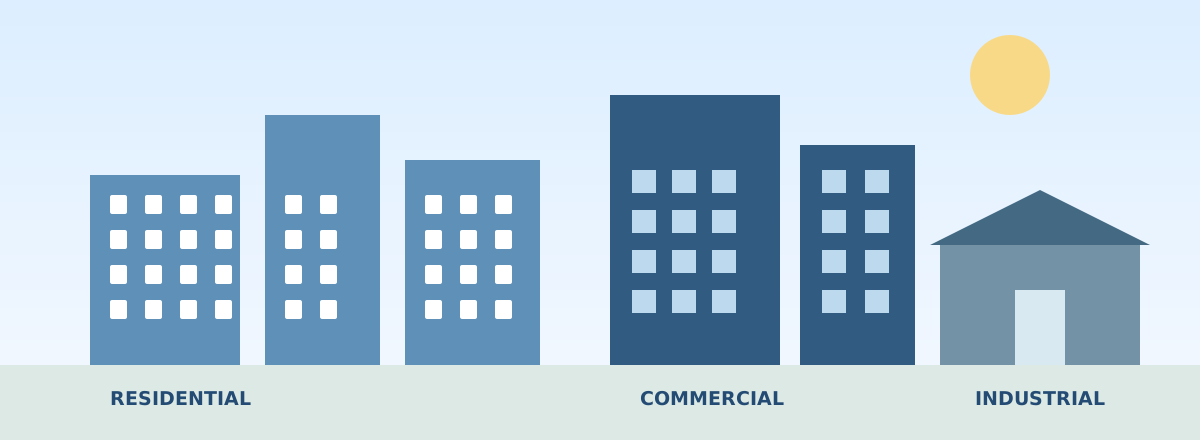
An original ExamDecoded illustration showing distinct property submarkets.
Real estate is fixed in location, long-lasting and different from one property to another. A property market brings buyers, sellers, landlords and tenants together, but it is not one uniform market: an HDB resale flat, an office and a factory serve different needs. Demand, available supply, financing, location and economic conditions influence prices and rents.
Course reference: This original explanation follows the topic coverage in the supplied Real Centre Network Paper One course book, Unit 1.1 (edition updated 18 December 2020). It is not a reproduction of the book or a substitute for the applicable CEA examination syllabus. Historical figures and regulations in old notes must be checked against current official sources.
What you will learn
- Physical and economic characteristics of real estate.
- Direct property ownership, REITs and property stocks.
- Property classifications, title, tenure, zoning and use.
- Demand and supply, the property cycle and the business cycle.
- How submarkets and market data help compare properties.
- How the first two postal-code digits relate to historical postal districts.
1. Why real estate is different
| Characteristic | Meaning and example |
|---|---|
| Immobile | A flat cannot be moved from Woodlands to Orchard when demand changes. |
| Heterogeneous | Even two flats in one block may differ by floor, orientation, layout and condition. |
| Durable | Land persists, while buildings need upkeep and may become obsolete. |
| Indivisible | A property generally cannot be traded one square metre at a time like a commodity. |
| Illiquid and costly to transact | Finding a buyer and completing a sale take time; duties, legal and other transaction costs may apply. |
| Short-run supply is inelastic | New buildings cannot appear immediately when demand rises; construction and planning take time. |
2. Property as an investment
An investment uses resources in the expectation of future income or appreciation, but returns are uncertain. Property investors may receive rental income and experience capital gains or losses. They also face vacancy, maintenance, financing and market risks.
| Investment | What you hold | Key distinction |
|---|---|---|
| Direct real estate | An interest in a specific property | Owner bears property-specific management and transaction considerations. |
| REIT units | Units in a trust holding income-producing real estate assets | Exposure to a portfolio through a traded investment; you do not directly own a chosen building. |
| Property stocks | Shares in a property-related company | Exposure to the company's business and performance, not direct title to its properties. |
Consider both potential return and risk; neither rental income nor appreciation is guaranteed.
3. The real estate market and its submarkets
The property market allocates scarce land and property interests through transactions and prices. Unlike a centralised stock exchange, property transactions are dispersed, properties are not identical, and information can be incomplete or delayed.
HDB, private landed and non-landedCommercial
Offices and shopsIndustrial
Factories and warehousesOther uses
For example, hotels and places of worship
A submarket is a smaller group of properties whose participants and pricing conditions are meaningfully related. It may be defined by property type, geography, tenure, use or the characteristics of buyers and occupiers. For example, the market for small strata office units in a central location differs from the market for suburban industrial premises.
4. Classifying Singapore properties
Look at more than the building's appearance. The course notes ask learners to distinguish the title or interest (for example, land or strata title), tenure, physical form, planning zoning and permitted use. These are related but not interchangeable.
| Broad category | Examples | What to check |
|---|---|---|
| Public residential | HDB flats | Applicable HDB rules and eligibility. |
| Private landed | Detached, semi-detached, terrace and strata landed housing | Title, tenure and applicable land-use controls. |
| Private non-landed | Apartments and condominiums | Strata interest, tenure and development details. |
| Commercial | Shop and office units | Approved use and planning requirements. |
| Industrial | Factory, warehouse and business park premises | Industrial zoning and approved activities. |
Specific ownership restrictions, planning thresholds and property rules change over time; verify them from the relevant agency rather than relying on figures in older course notes.
5. Demand, supply and prices
Demand is the quantity buyers or tenants are willing and able to take at different prices. Supply is the quantity offered. When demand strengthens faster than supply can respond, prices or rents may face upward pressure; when available supply rises relative to demand, the opposite pressure may arise. Actual outcomes depend on the wider market.
- Income, employment and population
- Interest rates and access to financing
- Expectations and buyer sentiment
- Location, accessibility and amenities
- Government policies
- Available land and existing stock
- Development pipeline and completions
- Construction costs and capacity
- Planning and land-use controls
- Owners' willingness to sell or lease
Micro factors relate to a specific property or locality, such as a nearby MRT station or a building's condition. Macro factors affect the wider economy or market, such as interest rates, employment and government policy.
6. Property cycle and business cycle
The property market can pass through recovery, expansion, slowing and contraction. The wider business cycle can influence household incomes, business space needs and financing conditions. However, property markets do not move in perfect synchronisation with the economy: supply takes time to build, and different submarkets may behave differently.
This is a simplified learning model, not a forecast or a claim about the current market stage.
7. Reading Singapore market information
Compare data for the same property segment, geography, period and measure. A transaction count, price index, rental index and available stock describe different things. The course material discusses supply, transaction statistics and property indices.
| Source | Useful information |
|---|---|
| URA | Private residential and commercial property statistics, planning information. |
| HDB | Public housing resale and rental information. |
| JTC | Industrial property market statistics. |
| SingPost | Postal code lookup. |
8. Postal sectors and old districts
Singapore uses six-digit postal codes. The first two digits identify a postal sector; historical postal districts remain common shorthand in property listings. A sector-to-district reference is needed to convert a postal code to its old district. For example, postal sectors 22 and 23 correspond to the historical District 09 grouping in the supplied notes.
Do not treat the first two digits themselves as the district number. Check the current address and reference table before using a district label in a listing.
Quick revision
- Real estate is immobile, heterogeneous, durable and relatively illiquid.
- REIT units and property shares are not direct ownership of a particular property.
- Title, tenure, zoning and actual use answer different questions.
- Submarkets differ by type, location and participant characteristics.
- New property supply responds slowly in the short run.
- Property cycles and business cycles are connected but not identical.
- Interpret statistics using consistent segments and time periods.
Check your understanding
Try these original practice questions before revealing the answers.
Further reading and source notes
This learning page is an independently written summary based on the scope of the supplied course PDF, not a reproduction of its proprietary content. The supplied book is dated 2020; for exam applicability consult the current CEA syllabus and agency publications. Figures, rules and market conditions may change.