4.3 Collective sale of private properties
A collective sale is a sale of the strata development or qualifying property collectively rather than an ordinary sale of one unit.
A collective sale is a sale of the strata development or qualifying property collectively rather than an ordinary sale of one unit. The Land Titles (Strata) Act sets consent and procedural requirements; the applicable threshold depends on the development’s age and circumstances.
What you will learn
- What is a collective sale
- Statutory consent thresholds
- Collective sale committee
- Sale process
- Minority-owner safeguards
- Completion and transaction consequences
Core concepts at a glance
| Concept | What to know |
|---|---|
| What is a collective sale | A collective sale is a sale of the strata development or qualifying property collectively rather than an ordinary sale of one unit. |
| Statutory consent thresholds | The Land Titles (Strata) Act sets consent and procedural requirements; the applicable threshold depends on the development’s age and circumstances. |
| Collective sale committee | Owners act through the collective-sale process and committee, subject to statutory duties, prescribed procedures and the collective sale agreement. |
| Sale process | Marketing, tender or other permitted sale processes must comply with the statutory framework and agreed process. |
| Minority-owner safeguards | Dissenting owners have statutory protections and objection routes; majority consent does not mean procedure can be ignored. |
| Completion and transaction consequences | Owners should consider mortgage redemption, SSD, tenancy, CPF and completion consequences with the relevant professionals. |
1. What is a collective sale
A collective sale is a sale of the strata development or qualifying property collectively rather than an ordinary sale of one unit.
In the context of collective sale procedures, this concept must be applied to the facts of a specific transaction, not learned as a standalone definition. Understand the statutory collective sale framework, ownership thresholds, sale committee process, valuation and distribution questions, and potential application to the Strata Titles Boards or courts.
Practical example: An owner disagrees with an en bloc sale supported by a majority. Consider the statutory process and the rights of dissenting owners. The correct analysis identifies the relevant parties, documents, governing authority and timing before advising on next steps.
Exam distinction: A majority by headcount is not necessarily the same as the applicable statutory consent threshold. Explain the reason for your answer and state what evidence or approval would be needed to confirm it.
2. Statutory consent thresholds
The Land Titles (Strata) Act sets consent and procedural requirements; the applicable threshold depends on the development’s age and circumstances.
In the context of collective sale procedures, this concept must be applied to the facts of a specific transaction, not learned as a standalone definition. Understand the statutory collective sale framework, ownership thresholds, sale committee process, valuation and distribution questions, and potential application to the Strata Titles Boards or courts.
Practical example: An owner disagrees with an en bloc sale supported by a majority. Consider the statutory process and the rights of dissenting owners. The correct analysis identifies the relevant parties, documents, governing authority and timing before advising on next steps.
Exam distinction: A majority by headcount is not necessarily the same as the applicable statutory consent threshold. Explain the reason for your answer and state what evidence or approval would be needed to confirm it.
3. Collective sale committee
Owners act through the collective-sale process and committee, subject to statutory duties, prescribed procedures and the collective sale agreement.
In the context of collective sale procedures, this concept must be applied to the facts of a specific transaction, not learned as a standalone definition. Understand the statutory collective sale framework, ownership thresholds, sale committee process, valuation and distribution questions, and potential application to the Strata Titles Boards or courts.
Practical example: An owner disagrees with an en bloc sale supported by a majority. Consider the statutory process and the rights of dissenting owners. The correct analysis identifies the relevant parties, documents, governing authority and timing before advising on next steps.
Exam distinction: A majority by headcount is not necessarily the same as the applicable statutory consent threshold. Explain the reason for your answer and state what evidence or approval would be needed to confirm it.
4. Sale process
Marketing, tender or other permitted sale processes must comply with the statutory framework and agreed process.
In the context of collective sale procedures, this concept must be applied to the facts of a specific transaction, not learned as a standalone definition. Understand the statutory collective sale framework, ownership thresholds, sale committee process, valuation and distribution questions, and potential application to the Strata Titles Boards or courts.
Practical example: An owner disagrees with an en bloc sale supported by a majority. Consider the statutory process and the rights of dissenting owners. The correct analysis identifies the relevant parties, documents, governing authority and timing before advising on next steps.
Exam distinction: A majority by headcount is not necessarily the same as the applicable statutory consent threshold. Explain the reason for your answer and state what evidence or approval would be needed to confirm it.
5. Minority-owner safeguards
Dissenting owners have statutory protections and objection routes; majority consent does not mean procedure can be ignored.
In the context of collective sale procedures, this concept must be applied to the facts of a specific transaction, not learned as a standalone definition. Understand the statutory collective sale framework, ownership thresholds, sale committee process, valuation and distribution questions, and potential application to the Strata Titles Boards or courts.
Practical example: An owner disagrees with an en bloc sale supported by a majority. Consider the statutory process and the rights of dissenting owners. The correct analysis identifies the relevant parties, documents, governing authority and timing before advising on next steps.
Exam distinction: A majority by headcount is not necessarily the same as the applicable statutory consent threshold. Explain the reason for your answer and state what evidence or approval would be needed to confirm it.
6. Completion and transaction consequences
Owners should consider mortgage redemption, SSD, tenancy, CPF and completion consequences with the relevant professionals.
In the context of collective sale procedures, this concept must be applied to the facts of a specific transaction, not learned as a standalone definition. Understand the statutory collective sale framework, ownership thresholds, sale committee process, valuation and distribution questions, and potential application to the Strata Titles Boards or courts.
Practical example: An owner disagrees with an en bloc sale supported by a majority. Consider the statutory process and the rights of dissenting owners. The correct analysis identifies the relevant parties, documents, governing authority and timing before advising on next steps.
Exam distinction: A majority by headcount is not necessarily the same as the applicable statutory consent threshold. Explain the reason for your answer and state what evidence or approval would be needed to confirm it.
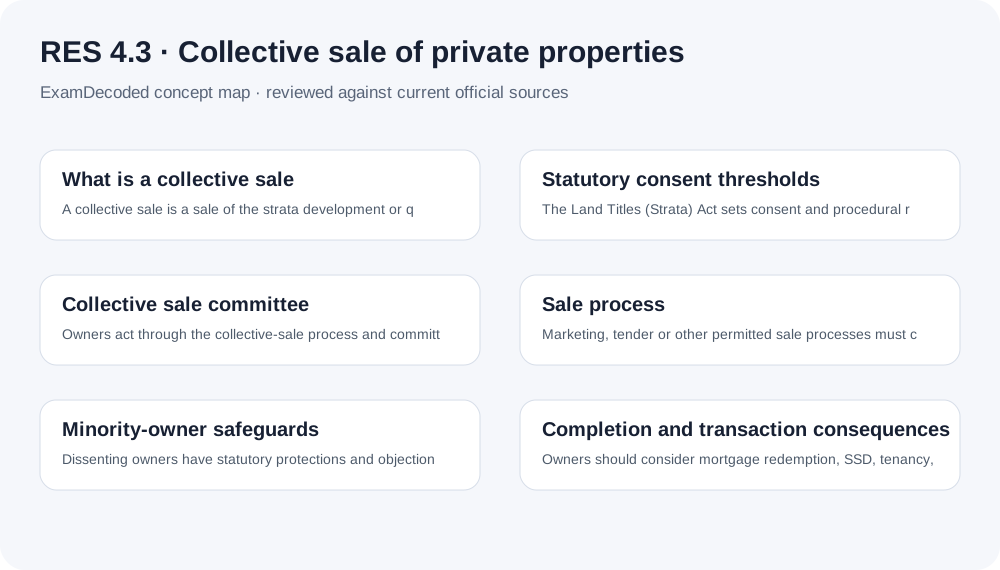
Visual guide: connect the concepts
Use this map to connect the main rules before attempting scenario questions.
Apply it to an exam scenario
Identify the property type, parties, transaction stage and the exact rule being tested. Then check whether the facts trigger an eligibility condition, disclosure duty, approval, tax, financing limit or professional obligation.
Applying an old rate or rule simply because it appeared in older course notes.
Remember: For policy-driven topics, the date of the transaction can change the answer.
Quick revision
- What is a collective sale: A collective sale is a sale of the strata development or qualifying property collectively rather than an ordinary sale of one unit.
- Statutory consent thresholds: The Land Titles (Strata) Act sets consent and procedural requirements; the applicable threshold depends on the development’s age and circumstances.
- Collective sale committee: Owners act through the collective-sale process and committee, subject to statutory duties, prescribed procedures and the collective sale agreement.
- Sale process: Marketing, tender or other permitted sale processes must comply with the statutory framework and agreed process.
- Minority-owner safeguards: Dissenting owners have statutory protections and objection routes; majority consent does not mean procedure can be ignored.
- Completion and transaction consequences: Owners should consider mortgage redemption, SSD, tenancy, CPF and completion consequences with the relevant professionals.
Practice MCQs
These questions test application rather than memorising a paragraph.
Official resources & currency
Reviewed: 7 October 2026. Key official references: Official source 1 · Official source 2. Because property rules change, re-check the relevant authority for your examination sitting and transaction date.