
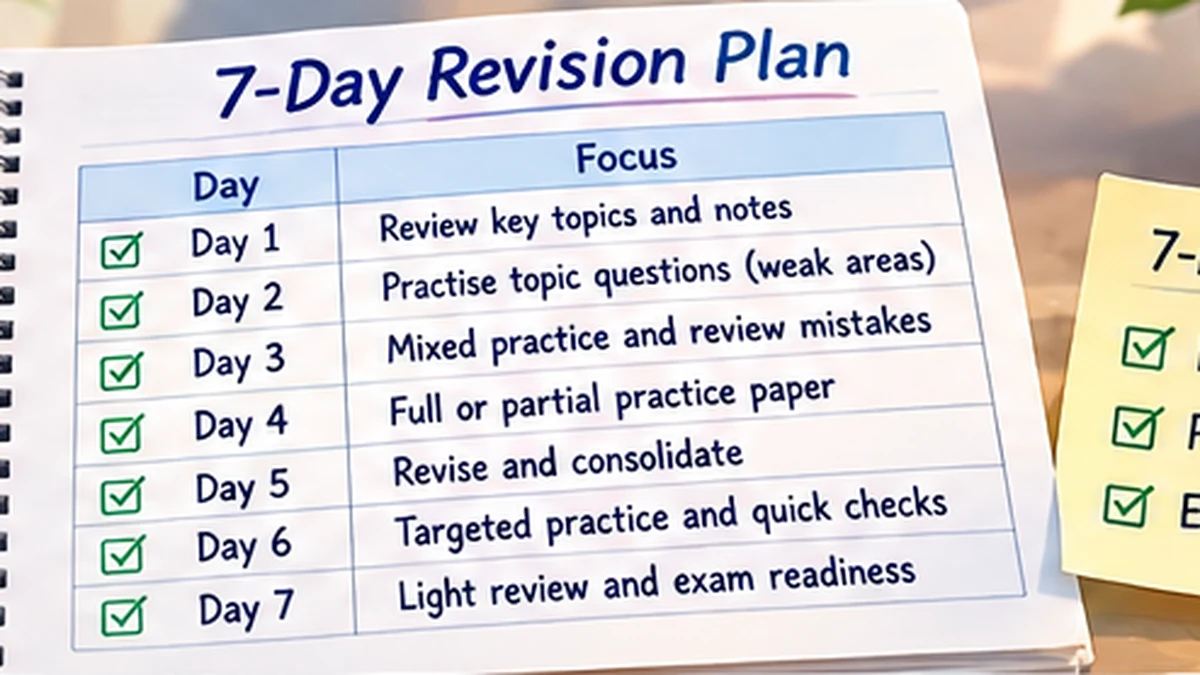
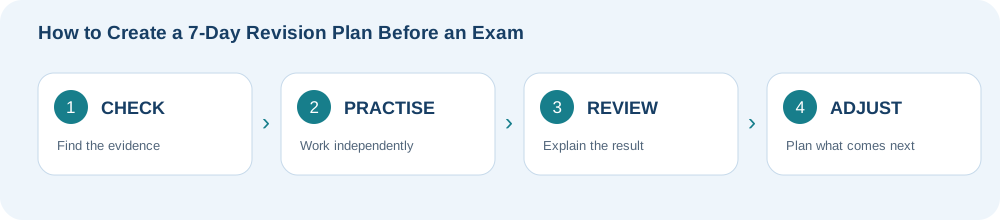
Seven days left? Build a focused plan that balances weak topics, timed practice, review and rest. A reliable routine is to check your current understanding, practise independently, review what happened and adjust your next task. Use the matching ExamDecoded tool to keep your plan practical.
Start with a realistic picture
A week before an exam, you cannot treat every chapter as if you were beginning a full term of study. Your aim is to use the remaining time well: secure important knowledge, practise applying it and reduce avoidable mistakes.
Write down your actual available sessions, including school, work, tuition, travel and sleep. A plan based on imaginary free time will collapse quickly. Leave room for breaks and unexpected tasks.
Identify the highest-value gaps
Look at recent practice papers, teacher feedback and your error log. Which topics repeatedly cost marks? Which mistakes are caused by missing knowledge, and which are due to timing or reading? Choose a manageable number of priorities.
Do not abandon everything you already know. Include brief retrieval checks of secure topics so they remain accessible, but direct most corrective effort toward weaknesses that can realistically improve within the week.
Use a daily structure
A useful study block includes three parts: recall what you already know, practise a specific skill and review the result. For example, in a 45-minute block, spend 5 minutes retrieving, 25 minutes on questions and 15 minutes checking and correcting.
Adjust the length to the learner and subject. The important point is to reserve time for correction. A schedule filled entirely with answering questions may produce lots of marks but few useful lessons.
Day 1: Diagnose and plan
Review the scope and recent results. Attempt a short mixed diagnostic set if you lack current evidence. Identify the two or three most important weaknesses and assign sessions for them.
Avoid spending the entire day decorating a planner. A simple topic list and clear tasks are enough. Finish Day 1 with at least one focused revision session.
Day 2: Repair a major weakness
Choose one high-priority concept or method. Review an explanation, demonstrate it without notes and attempt varied questions. Check each mistake and write a specific correction.
If you still cannot solve representative questions, keep the next review close. If you can solve them reliably, move toward mixed practice rather than repeating identical examples.
Day 3: Mix and retrieve
Combine questions from topics revised earlier in the week with a few secure topics. Try recalling key methods before opening notes. Mixed questions test whether you can identify the right approach without chapter labels.
Use a short review of previous mistakes to see whether the corrections are holding. If a problem returns, schedule another focused check rather than simply adding more full papers.
Day 4: Attempt a timed section or paper
Choose a suitable timed set or full paper based on readiness. Work under realistic conditions if your goal is to test exam performance. Record the timing and flag questions you guessed or could not finish.
Do not judge the day only by the score. The attempt is valuable because it provides evidence about pacing, accuracy and the ability to apply knowledge across topics.
Day 5: Review and correct
Review the timed attempt carefully. Classify lost marks and redo important questions before looking at full solutions. Choose one or two follow-up tasks that address the biggest causes.
If a whole paper is too much to review in one session, split the review. A careful correction is more useful than rushing to complete another paper just to increase your count.
Day 6: Consolidate and check
Return to the main weak areas and attempt fresh questions. Use short retrieval checks for formulas, definitions, structures or common mistakes. If timing remains a problem, practise one short timed section.
Avoid introducing a large amount of unfamiliar material without a clear reason. Focus on reliable methods, recurring errors and tasks you can complete with enough time to check them.
Day 7: Prepare, do not overload
Keep revision lighter. Review concise summaries and a short error checklist, prepare permitted materials and confirm practical arrangements. Protect sleep and leave enough time to settle before the exam.
A last-minute marathon may feel reassuring but can increase fatigue. If you discover one final gap, make a short focused check rather than rewriting your entire plan. The goal is to arrive ready to use what you know.
Adapt the plan to your situation
A learner with two subjects on consecutive days needs a different allocation from someone with one paper at the end of the week. Move more demanding practice earlier, place short recall sessions around other commitments and adjust when a topic takes longer than expected.
Use the Weekly Study Planner to put specific tasks into available slots. Keep the plan flexible: if Tuesday reveals a bigger weakness, change Wednesday accordingly. A useful schedule responds to evidence rather than forcing you to follow every box.
A quick self-check before your next session
Before you start, ask whether your chosen task is supported by a recent result, whether you can finish it in the time available and how you will know if it helped. If you cannot answer those questions, make the task smaller and more concrete. A short, well-defined practice set followed by a careful correction often gives clearer feedback than an ambitious session with no review.
After the session, write down one observation and one next step. You might discover that you can answer straightforward questions but struggle when the topic is mixed with others, or that you know the method but miss conditions in the wording. Those observations are more useful than a simple tick beside “revision completed”.
How to involve a parent, teacher or study partner
If someone is helping you, show them the evidence rather than asking them to decide based only on confidence. A marked paper, a short explanation of the mistake and a realistic next action make it easier to give useful feedback.
Support should not mean taking over the work. Ask the learner to explain the method and try a similar question independently. If they cannot, return to the underlying idea and try again later. The goal is greater independence, not a perfect-looking revision tracker.
What success looks like
Improvement does not always appear immediately as a dramatic score increase. It may first show up as fewer repeated errors, a better explanation, more reliable topic recognition or a shorter correction process. These are signs that the learning routine is becoming more effective.
Continue checking with unfamiliar questions and realistic conditions when appropriate. If the same error returns, that is feedback to adjust the plan, not a reason to abandon it. Small, repeated cycles of checking and correction are what make a study system useful over time.
Put It Into Practice
Choose one task from this guide and apply it during your next study session. Use your results to decide whether to continue, change approach or return to an earlier step. A useful study technique should help you make a decision, not simply add another activity to your checklist.
- What evidence tells me where I need to improve?
- Can I explain the next action in one clear sentence?
- When will I check whether the change worked?
Common Questions
Do I need to follow this method exactly?
No. The examples are practical starting points, not strict rules. Adjust the length of sessions, the questions and the review schedule to your assessment and current understanding. The important principle is to use feedback from independent practice.
What if I have very little time?
Choose one high-value task that you can complete and review properly. Avoid spending the whole session planning or copying notes. Even a short set of carefully checked questions can tell you what to do next.
How do I know whether it is working?
Look for fewer repeated mistakes, better explanations and improved performance on unfamiliar questions. Where possible, compare attempts under similar conditions rather than relying on a single score.
Can this work for PSLE and other examinations?
Yes, but adapt the details to the syllabus and question format. Maths methods, Science explanations, language comprehension and professional examination questions require different forms of practice and feedback.
Good revision is a cycle of checking, practising, reviewing and adjusting. Use the next session to address what the evidence tells you, rather than repeating the same activity automatically.
Related ExamDecoded Guides
Turn This Guide Into Action
Use the Weekly Study Planner to organise your next step and revisit your progress.