What Can a Landlord Do When a Tenant Refuses to Pay Rent in Singapore?
A current Singapore guide to rental arrears, Small Claims Tribunals, Writs of Distress, Possession and Seizure and Sale — with RES exam traps and examples.
ExamDecoded illustrated study guide
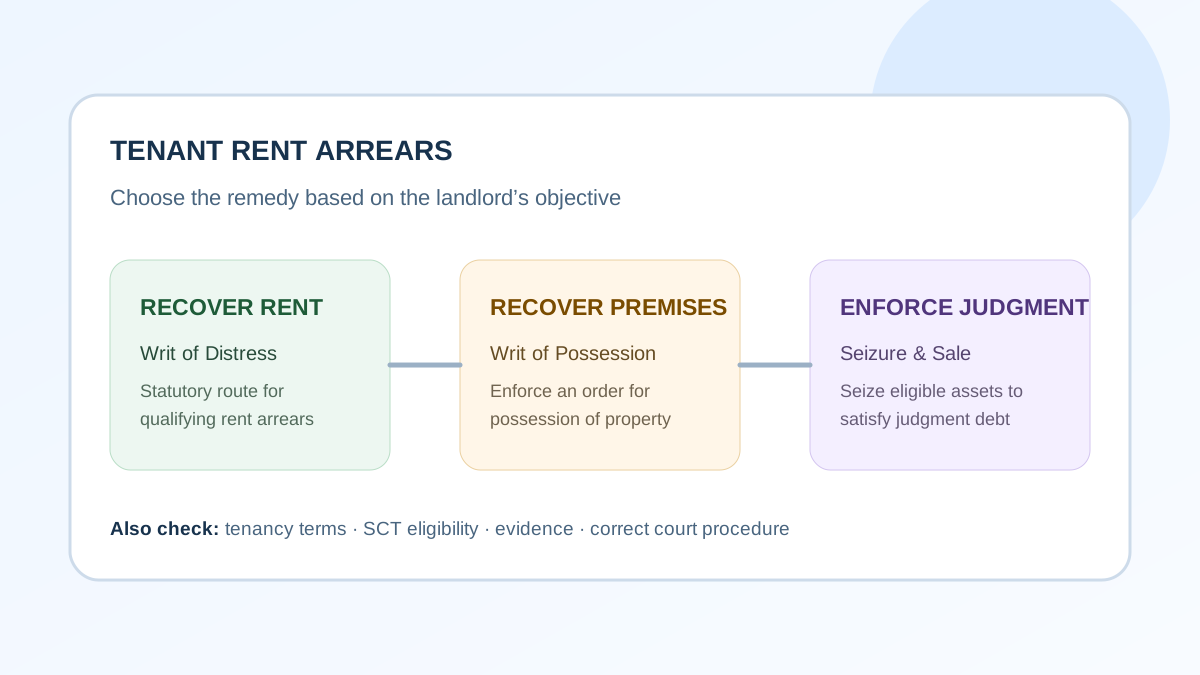
When a tenant stops paying rent, the landlord should first check the tenancy agreement, document the arrears and decide what outcome is wanted: payment, possession, or both. In Singapore, possible routes include an eligible claim at the Small Claims Tribunals (SCT), a civil claim followed by enforcement, a Writ of Distress for qualifying rent arrears, a Writ of Possession to enforce an order for possession, and a Writ of Seizure and Sale to enforce a money judgment. These remedies are not interchangeable.
First: do not jump straight to eviction
The source material is broadly right that unpaid rent can lead to formal recovery action, but several parts need updating. A landlord does not simply choose a writ as the first step in every case. Some writs are enforcement mechanisms after an order or judgment, while a Writ of Distress has its own statutory procedure under the Distress Act 1934.
Before acting, read the tenancy agreement carefully. Check the rent due date, any grace period, late-payment provisions, security deposit terms, termination or re-entry clauses, notice requirements and dispute-resolution provisions. Keep the tenancy agreement, payment records, messages, invoices and a clear rental-arrears schedule.
A practical Singapore decision path
| Landlord’s objective | Possible route | Key point |
|---|---|---|
| Recover qualifying rent arrears from property at the premises | Writ of Distress | Special statutory remedy under the Distress Act 1934; not the same as enforcing an ordinary money judgment. |
| Recover possession after obtaining an enforceable possession order | Writ of Possession | Enforcement officers may take possession if the judgment debtor does not comply. |
| Enforce a money judgment against assets | Writ of Seizure and Sale (WSS) | Used to seize and sell eligible assets/property to satisfy a judgment debt. |
| Lower-value qualifying residential tenancy dispute | Small Claims Tribunals | May hear eligible residential tenancy disputes where the tenancy does not exceed 2 years and the claim falls within the SCT limits. |
Option 1: Small Claims Tribunals for eligible residential tenancies
This is an important route missing from the older material. The Singapore Courts state that the SCT can hear eligible disputes involving residential tenancy agreements not exceeding 2 years. The usual claim limit is $20,000, or up to $30,000 where both parties sign a Memorandum of Consent. A claim generally must be filed within 2 years of the event giving rise to it.
For an eligible landlord claim involving unpaid rent, the SCT may also make an order for delivery of vacant possession. If an SCT order is not complied with, enforcement proceedings may follow.
Option 2: Writ of Distress — a special remedy for rent arrears
The Distress Act 1934 remains in force in Singapore. Under section 5, a landlord or an authorised agent may apply without notice for an order for a Writ of Distress to recover rent due or payable for a period of not more than 12 completed months of the tenancy immediately preceding the application.
The writ directs the Sheriff to distrain movable property found on the named premises, subject to statutory exclusions and protections. The Act expressly provides that a landlord may not distrain for rent except in the manner provided by the Act. In other words, a landlord should not treat “distress” as permission to personally enter the premises and seize whatever appears valuable.
A useful correction to the source material is that a Writ of Distress is not limited only to cases where the landlord wants the tenancy to continue. The Act allows arrears to be distrained for even after the tenancy has ended if the statutory conditions are satisfied — for example, where the tenant remains in occupation or the tenant’s goods remain on the premises.
Option 3: Writ of Possession — recovering the premises
A Writ of Possession is aimed at recovering immovable property, not simply collecting unpaid rent. Where a court has ordered a party to give possession and that party does not comply, the judgment creditor may seek enforcement through a Writ of Possession. The Singapore Courts explain that the Sheriff or bailiffs can then take possession of the property on behalf of the judgment creditor.
Under the current court procedure, leave of court is generally required before filing a Writ of Possession, unless an exception applies. The court’s process also includes a Notice of Eviction and an appointed execution date.
Option 4: Writ of Seizure and Sale — enforcing a money judgment
A Writ of Seizure and Sale (WSS) is another enforcement mechanism. If a judgment debtor has failed to comply with an order or judgment to pay money, a WSS may allow the Sheriff or bailiffs to seize and sell eligible assets or property to satisfy the judgment debt.
This differs from a Writ of Distress. Distress is a landlord-specific statutory remedy for rent; a WSS enforces a judgment debt. The current Singapore Courts guidance also lists categories of property that cannot be seized under a WSS.
What about the security deposit?
Whether a landlord can apply the security deposit against unpaid rent depends primarily on the tenancy agreement and the circumstances. A deposit should not be treated as a substitute for reading the agreement. The landlord should document any deduction and account for the deposit according to the contractual terms.
Can the landlord just change the locks?
This is where landlords should be especially careful. Even if the tenancy agreement contains termination or re-entry provisions, physically excluding an occupier, handling belongings or entering premises can raise separate legal issues. The safer study principle is: establish the right to terminate, then use the proper process to recover possession where required.
The current Singapore Courts procedure for a Writ of Possession shows why self-help and court enforcement should not be confused: the Sheriff or bailiffs execute the writ, and forced entry—where permitted in the enforcement process—is handled under court procedure.
Before choosing a remedy: 5 things a landlord should check
Before deciding on court or tribunal action, it helps to organise the case around the tenancy documents and the outcome the landlord actually wants. This also gives RES candidates a more practical way to analyse rental-arrears questions.
| Check | Why it matters |
|---|---|
| 1. How much rent is outstanding? | Prepare a clear arrears schedule showing the due dates, amounts paid and balance outstanding. |
| 2. What does the tenancy agreement say? | Check payment dates, grace periods, late-payment terms, security deposit provisions, termination clauses, notice requirements and any dispute-resolution clause. |
| 3. Does the landlord want payment, possession, or both? | The objective affects the remedy. Recovering rent is different from recovering possession of the premises. |
| 4. Is the dispute eligible for the SCT? | For qualifying residential tenancies of not more than 2 years, the Small Claims Tribunals may be a relevant and more proportionate forum, subject to its jurisdictional requirements. |
| 5. Is there already a court or tribunal order? | A Writ of Possession and Writ of Seizure and Sale are enforcement mechanisms. Do not confuse obtaining a legal order with enforcing one. |
Worked examples: which route might matter?
RES exam approach
- Identify the breach: Is rent actually due and unpaid under the tenancy?
- Read the contract: What do the termination, deposit, notice and re-entry clauses say?
- Identify the desired remedy: Money, possession, or both?
- Choose the correct route: SCT where eligible, civil proceedings, distress, or enforcement of an existing order.
- Do not mix up the writs: Distress = statutory rent recovery; Possession = recover immovable property; WSS = enforce a money judgment against assets.
Quick comparison
| Remedy | Primary purpose | Easy memory cue |
|---|---|---|
| Writ of Distress | Recover qualifying rent arrears through statutory distress | D = Due rent |
| Writ of Possession | Enforce recovery of the premises | P = Property back |
| Writ of Seizure and Sale | Enforce a judgment debt by seizure/sale | S = Seize to satisfy judgment |
| SCT | Resolve qualifying lower-value disputes, including certain residential tenancies | SCT = qualifying small claim |
Test your understanding
Answer five RES-style questions, then submit to see the explanations.
Final takeaway
For RES purposes, start with the landlord’s objective. Unpaid rent does not make every remedy interchangeable. A Writ of Distress targets qualifying rent arrears under the Distress Act; a Writ of Possession enforces recovery of property; and a WSS enforces a money judgment. For eligible residential tenancies, the SCT may provide a more direct route for qualifying disputes.
Official Singapore references
- Singapore Statutes Online — Distress Act 1934
- Singapore Courts — File a small claim
- Singapore Courts — Cases eligible for a small claim
- Singapore Courts — File a Writ of Possession
- Singapore Courts — Writ of Seizure and Sale
Reviewed against current Singapore legislation and Singapore Courts guidance in October 2026. Educational RES revision only; not legal advice. Actual remedies depend on the tenancy terms, facts, jurisdiction and procedural requirements.
Revise the underlying syllabus topic in the structured lesson.