1.6 State Lands Act 1920
Understand State grants, lease conditions, differential premium, temporary occupation licences and reversion.
The party making a promise. A payment that may arise when the State permits specified changes in land use or intensity under State title conditions. A separate statutory framework for compulsory acquisition.
What you will learn
- State grants and covenants
- Changes to State land
- Compulsory acquisition
1. State grants and covenants
| Concept | Explanation |
|---|---|
| Covenantor | The party making a promise. |
| Covenantee | The party receiving the promise. |
| Special conditions | Conditions endorsed on State grants or leases. |
| Implied covenants | Obligations supplied by legislation in addition to express conditions. |
2. Changes to State land
| Concept | Explanation |
|---|---|
| Differential premium | A payment that may arise when the State permits specified changes in land use or intensity under State title conditions. |
| Temporary occupation licence (TOL) | Permission to occupy State land temporarily; it is not the same as a grant of an estate. |
| Reversionary interest | The State’s interest when a State lease comes to an end. |
3. Compulsory acquisition
| Concept | Explanation |
|---|---|
| Land Acquisition Act | A separate statutory framework for compulsory acquisition. |
| State Lands Act | Concerns State land grants, leases and related conditions; do not confuse the two Acts. |
Visual guide: State land: identify the legal instrument
A topic-specific diagram to help you connect the concepts, rather than memorise isolated keywords.
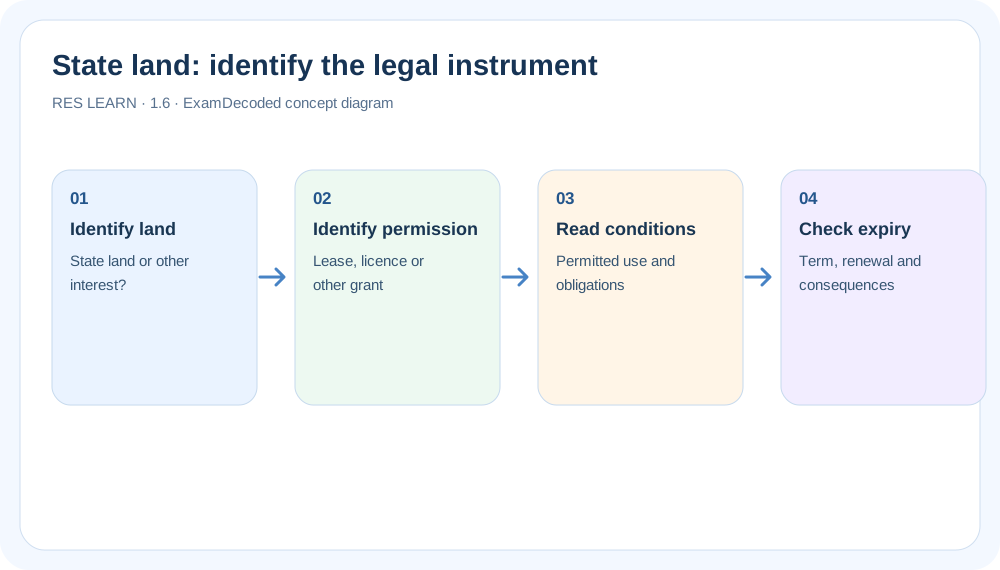
How to read this diagram
- Identify land: State land or other interest?.
- Identify permission: Lease, licence or other grant.
- Read conditions: Permitted use and obligations.
- Check expiry: Term, renewal and consequences.
Apply it to a Singapore property scenario
A request to change a title restriction may involve State consent and a premium; planning permission alone is not necessarily sufficient.
A TOL does not turn its holder into the freehold owner of State land.
Quick revision
- Covenantor: The party making a promise.
- Differential premium: A payment that may arise when the State permits specified changes in land use or intensity under State title conditions.
- Land Acquisition Act: A separate statutory framework for compulsory acquisition.
Practice MCQs
Choose one answer per question, then check your score and read the explanations.
Check permitted use, restrictions and whether additional authority consent is needed before advising a client on a proposed transaction or redevelopment.
State land dealings are governed by statutory powers and the conditions of the relevant grant or lease. A state lease does not mean the occupier may use the site for any purpose.
Official resources
For current Singapore legislation and agency guidance, refer to Singapore Statutes Online, Singapore Land Authority. Check the requirements applicable to your examination sitting.