2.6 Mortgage
A mortgage gives a lender security over land to support repayment of a debt.
A mortgage gives a lender security over land to support repayment of a debt. The borrower providing security is the mortgagor; the lender is the mortgagee.
What you will learn
- Mortgagor and mortgagee
- Security interest
- Equity of redemption
- Default and remedies
- Priority
- Discharge
Core concepts at a glance
| Concept | Explanation |
|---|---|
| Mortgagor and mortgagee | The borrower providing security is the mortgagor; the lender is the mortgagee. |
| Security interest | A mortgage is security, not an ordinary sale of the property. |
| Equity of redemption | The borrower has a right to redeem according to the applicable law and mortgage terms. |
| Default and remedies | Enforcement rights depend on the instrument and legal requirements. |
| Priority | Competing registered interests and mortgages raise priority questions. |
| Discharge | After repayment, the security should be formally discharged as required. |
1. Mortgagor and mortgagee
The borrower providing security is the mortgagor; the lender is the mortgagee.
A mortgage secures a debt against property. The borrower ordinarily retains an interest in the property while the lender has security rights governed by the mortgage and applicable law.
2. Security interest
A mortgage is security, not an ordinary sale of the property.
Default does not automatically make the lender the owner. Enforcement and sale rights depend on the legal instrument, statutory requirements and the circumstances.
3. Equity of redemption
The borrower has a right to redeem according to the applicable law and mortgage terms.
4. Default and remedies
Enforcement rights depend on the instrument and legal requirements.
5. Priority
Competing registered interests and mortgages raise priority questions.
6. Discharge
After repayment, the security should be formally discharged as required.
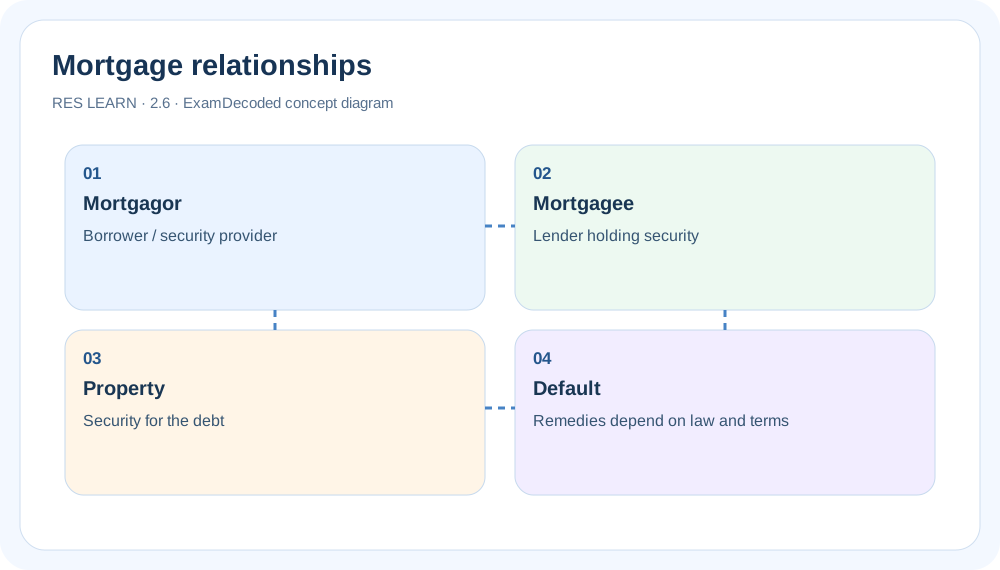
Visual guide: Mortgage relationships
A topic-specific diagram to help you connect the concepts, rather than memorise isolated keywords.
How to read this diagram
- Mortgagor: Borrower / security provider.
- Mortgagee: Lender holding security.
- Property: Security for the debt.
- Default: Remedies depend on law and terms.
Apply it to a Singapore property scenario
A borrower pays off the housing loan but the mortgage remains on title.
How to approach it: A formal discharge may still be necessary; repayment alone should not be confused with the register update.
The mortgagee is always the property owner.
Remember: A mortgage secures the loan; distinguish security from ownership.
Quick revision
- Mortgagor and mortgagee: The borrower providing security is the mortgagor; the lender is the mortgagee.
- Security interest: A mortgage is security, not an ordinary sale of the property.
- Equity of redemption: The borrower has a right to redeem according to the applicable law and mortgage terms.
- Default and remedies: Enforcement rights depend on the instrument and legal requirements.
- Priority: Competing registered interests and mortgages raise priority questions.
- Discharge: After repayment, the security should be formally discharged as required.
Practice MCQs
Choose one answer per question, check your score and review the explanations.
Official resources
For current Singapore legislation and agency guidance, refer to Singapore Statutes Online, CEA. Check the requirements applicable to your examination sitting.
Mortgage scenario: security is not the debt itself
Scenario: A buyer borrows money from a bank and grants a mortgage over the property. The buyer later sells the property.
How to reason through it: Separate the borrower’s repayment obligation from the lender’s security interest. The sale process must address the outstanding secured loan and the discharge or release of the mortgage, rather than assuming the mortgage disappears when buyer and seller sign a contract.
Check your understanding: Exam trap: a mortgage is a security interest; it is not the same as a caveat, a lease or the ownership title itself.
Educational illustration only. Confirm current requirements with the relevant Singapore authority and the transaction documents.