2.8 Trust
A trust separates legal ownership from beneficial interests.
A trust separates legal ownership from beneficial interests. The settlor creates the arrangement; the trustee holds or manages property for beneficiaries.
What you will learn
- Settlor, trustee, beneficiary
- Legal versus beneficial title
- Express trusts
- Resulting and constructive trusts
- Trustee duties
- Transactions
Core concepts at a glance
| Concept | Explanation |
|---|---|
| Settlor, trustee, beneficiary | The settlor creates the arrangement; the trustee holds or manages property for beneficiaries. |
| Legal versus beneficial title | The registered legal owner may not be the person entitled to the beneficial benefit. |
| Express trusts | A trust may be intentionally created with identifiable terms and subject matter. |
| Resulting and constructive trusts | Other trust interests may arise by operation of law in relevant circumstances. |
| Trustee duties | Trustees must comply with fiduciary duties and the trust terms. |
| Transactions | Identify whether the trustee has power to deal with the land and what approvals apply. |
1. Settlor, trustee, beneficiary
The settlor creates the arrangement; the trustee holds or manages property for beneficiaries.
A trust separates legal title held by the trustee from beneficial interests enjoyed by beneficiaries. Trustees must act according to the trust terms and applicable fiduciary duties.
2. Legal versus beneficial title
The registered legal owner may not be the person entitled to the beneficial benefit.
Do not assume the person named on the title is necessarily the sole beneficial owner; conversely, a claimed trust must be supported by evidence and law.
3. Express trusts
A trust may be intentionally created with identifiable terms and subject matter.
4. Resulting and constructive trusts
Other trust interests may arise by operation of law in relevant circumstances.
5. Trustee duties
Trustees must comply with fiduciary duties and the trust terms.
6. Transactions
Identify whether the trustee has power to deal with the land and what approvals apply.
Visual guide: Trust relationships
A topic-specific diagram to help you connect the concepts, rather than memorise isolated keywords.
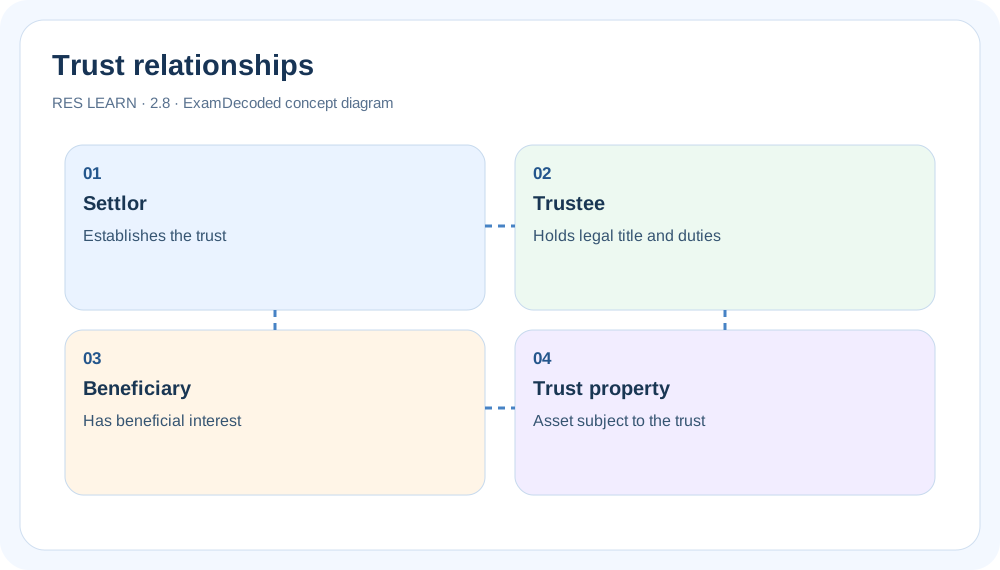
How to read this diagram
- Settlor: Establishes the trust.
- Trustee: Holds legal title and duties.
- Beneficiary: Has beneficial interest.
- Trust property: Asset subject to the trust.
Apply it to a Singapore property scenario
A parent is registered as owner but holds a property on trust for another person.
How to approach it: Do not assume registered legal title and beneficial ownership are identical.
Every beneficial owner must appear as registered proprietor.
Remember: Legal and beneficial interests can differ.
Quick revision
- Settlor, trustee, beneficiary: The settlor creates the arrangement; the trustee holds or manages property for beneficiaries.
- Legal versus beneficial title: The registered legal owner may not be the person entitled to the beneficial benefit.
- Express trusts: A trust may be intentionally created with identifiable terms and subject matter.
- Resulting and constructive trusts: Other trust interests may arise by operation of law in relevant circumstances.
- Trustee duties: Trustees must comply with fiduciary duties and the trust terms.
- Transactions: Identify whether the trustee has power to deal with the land and what approvals apply.
Practice MCQs
Choose one answer per question, check your score and review the explanations.
Official resources
For current Singapore legislation and agency guidance, refer to Singapore Statutes Online, CEA. Check the requirements applicable to your examination sitting.
Trust scenario: identify who owns which interest
Scenario: A parent transfers property to a trustee to hold for a child. The trustee is named as legal owner, while the child is intended to receive the benefit under the trust terms.
How to reason through it: Ask three different questions: who holds legal title, who enjoys the beneficial interest, and what powers or duties are imposed by the trust instrument? The answers need not point to the same person.
Check your understanding: Exam trap: being the registered proprietor does not necessarily mean enjoying the property for one’s own benefit. Tax treatment must be checked separately against current IRAS rules.
Educational illustration only. Confirm current requirements with the relevant Singapore authority and the transaction documents.