3.1 Regulation of real estate agency industry
CEA administers the regulatory framework for estate agency work in Singapore.
CEA administers the regulatory framework for estate agency work in Singapore. Only licensed estate agents and registered salespersons may carry out regulated estate agency work, subject to the Act and regulations.
What you will learn
- CEA and the regulatory framework
- Estate Agents Act and estate agency work
- Licensing and salesperson registration
- Professional conduct and client care
- Estate agency agreements and dispute resolution
- CPD, enforcement and discipline
Core concepts at a glance
| Concept | What to know |
|---|---|
| CEA and the regulatory framework | CEA administers the regulatory framework for estate agency work in Singapore. |
| Estate Agents Act and estate agency work | Only licensed estate agents and registered salespersons may carry out regulated estate agency work, subject to the Act and regulations. |
| Licensing and salesperson registration | A salesperson practises through a licensed estate agent and must satisfy CEA registration requirements. |
| Professional conduct and client care | Duties include acting ethically, avoiding conflicts, safeguarding client interests and complying with applicable codes and practice guidance. |
| Estate agency agreements and dispute resolution | Written agreements clarify appointment, scope, commission and dispute-resolution arrangements. |
| CPD, enforcement and discipline | Professional obligations continue after initial registration; CPD and disciplinary rules support ongoing competence and accountability. |
1. CEA and the regulatory framework
CEA administers the regulatory framework for estate agency work in Singapore.
The Council for Estate Agencies (CEA) is the statutory regulator for Singapore’s real estate agency industry. Its work includes licensing estate agency businesses, registering individual salespersons, maintaining a public register, setting professional standards, and handling regulatory complaints and enforcement. It is not the same as HDB, URA or SLA: those bodies administer housing, planning and land-related regimes respectively.
When a consumer wants to check whether an agent is legitimate, the CEA Public Register is the appropriate starting point. The consumer should check the individual’s registration and the estate agent with which the individual is associated. This distinction is especially important when advertisements use brand names or informal titles.
2. Estate Agents Act and estate agency work
Only licensed estate agents and registered salespersons may carry out regulated estate agency work, subject to the Act and regulations.
The Estate Agents Act 2010 establishes the legal framework for regulated estate agency activities. Whether an activity falls within estate agency work depends on what the person actually does, such as introducing parties or negotiating a property transaction in the relevant business context; simply calling the activity “consultancy” or “referral” does not settle the question.
The Act works alongside subsidiary regulations and CEA’s professional codes. A question may test three different layers: whether the person is authorised to practise, whether their conduct complies with the applicable duties, and what regulatory consequences follow from a breach. Always identify which layer the scenario asks about.
3. Licensing and salesperson registration
A salesperson practises through a licensed estate agent and must satisfy CEA registration requirements.
A real estate agency business requires a licence, whereas an individual salesperson requires registration. The salesperson conducts estate agency work through a licensed estate agent, with supervision and compliance arrangements in place. Passing the RES examination is part of the pathway to registration, not permission to practise independently.
Before accepting instructions, confirm the salesperson’s current registration and the estate agent’s licence. Registration conditions, renewal and eligibility requirements may change, so check CEA’s published requirements rather than relying on an old checklist.
4. Professional conduct and client care
Duties include acting ethically, avoiding conflicts, safeguarding client interests and complying with applicable codes and practice guidance.
Professional duties go beyond closing a deal. Salespersons should act with integrity, exercise due diligence, disclose relevant conflicts of interest, avoid misleading claims, and communicate material information fairly. A client’s request to conceal a defect or exaggerate a property feature does not remove the salesperson’s professional obligations.
For exam scenarios, separate facts the salesperson has verified from statements merely supplied by a seller or landlord. Where a question involves legal interpretation, tax advice or loan approval, the salesperson should recognise the limits of their role and refer the client to an appropriate professional.
5. Estate agency agreements and dispute resolution
Written agreements clarify appointment, scope, commission and dispute-resolution arrangements.
A written estate agency agreement records who appoints the estate agent, the scope and duration of the appointment, commission arrangements and other important terms. Prescribed forms and CEA guidance help clarify expectations and reduce misunderstandings. The parties should understand what services are included and when commission becomes payable.
Disputes about service or commission are not identical to disciplinary complaints. Contractual disputes may involve negotiation or the applicable dispute-resolution arrangements, while allegations of regulatory misconduct may fall within CEA’s remit. A scenario can involve both issues at once.
6. CPD, enforcement and discipline
Professional obligations continue after initial registration; CPD and disciplinary rules support ongoing competence and accountability.
Continuing Professional Development (CPD) is intended to keep practitioners competent after registration. The framework and its requirements have changed over time, so examine the CPD cycle and CEA rules applicable to the date in the question rather than memorising figures from old notes.
CEA has inspection, investigation and disciplinary functions under the regulatory framework. A regulatory breach can lead to disciplinary or other consequences depending on the conduct and applicable legal provision. Distinguish an administrative registration issue, a disciplinary breach and a criminal offence: they are not interchangeable.
Visual guide: connect the concepts
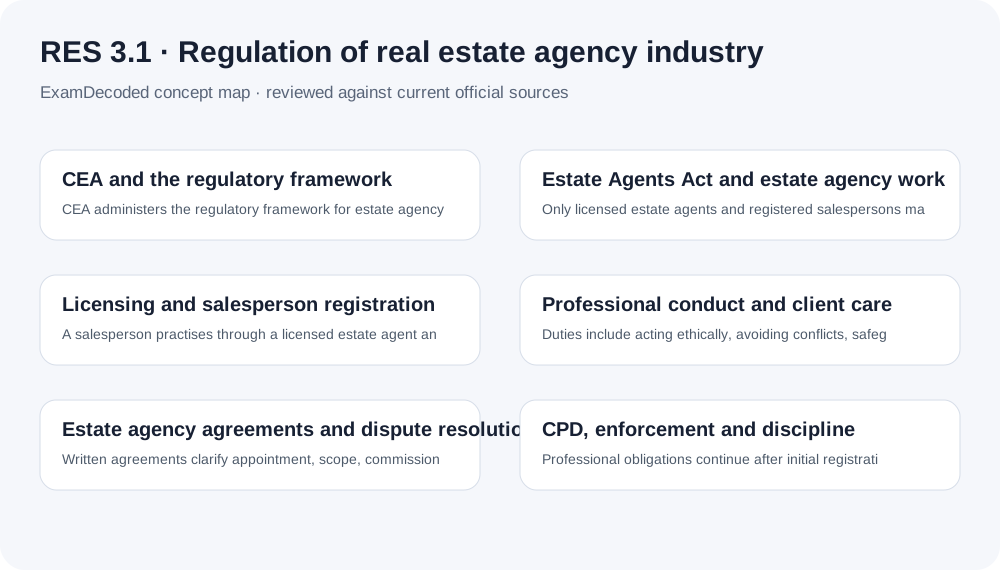
Use this map to connect the main rules before attempting scenario questions.
Apply it to an exam scenario
Identify the property type, parties, transaction stage and the exact rule being tested. Then check whether the facts trigger an eligibility condition, disclosure duty, approval, tax, financing limit or professional obligation.
Applying an old rate or rule simply because it appeared in older course notes.
Remember: For policy-driven topics, the date of the transaction can change the answer.
Quick revision
- CEA and the regulatory framework: CEA administers the regulatory framework for estate agency work in Singapore.
- Estate Agents Act and estate agency work: Only licensed estate agents and registered salespersons may carry out regulated estate agency work, subject to the Act and regulations.
- Licensing and salesperson registration: A salesperson practises through a licensed estate agent and must satisfy CEA registration requirements.
- Professional conduct and client care: Duties include acting ethically, avoiding conflicts, safeguarding client interests and complying with applicable codes and practice guidance.
- Estate agency agreements and dispute resolution: Written agreements clarify appointment, scope, commission and dispute-resolution arrangements.
- CPD, enforcement and discipline: Professional obligations continue after initial registration; CPD and disciplinary rules support ongoing competence and accountability.
Practice MCQs
These questions test application rather than memorising a paragraph.
Official resources & currency
Reviewed: 7 October 2026. Key official references: Official source 1 · Official source 2 · Official source 3. Because property rules change, re-check the relevant authority for your examination sitting and transaction date.