3.2 Role and functions of salespersons and their requisite knowledge and skills
A salesperson should understand the transaction from initial engagement through marketing, negotiation, documentation and completion.
A salesperson should understand the transaction from initial engagement through marketing, negotiation, documentation and completion. Clarify objectives, budget, timing, property requirements and material constraints before recommending a course of action.
What you will learn
- Transaction workflow
- Client needs and expectations
- Due diligence and verification
- Market and property information
- Negotiation and documentation
- Professional boundaries
Core concepts at a glance
| Concept | What to know |
|---|---|
| Transaction workflow | A salesperson should understand the transaction from initial engagement through marketing, negotiation, documentation and completion. |
| Client needs and expectations | Clarify objectives, budget, timing, property requirements and material constraints before recommending a course of action. |
| Due diligence and verification | Verify ownership, property particulars, restrictions and other material information using reliable sources rather than assumptions. |
| Market and property information | Use current official and market information, and distinguish verified facts from estimates or opinions. |
| Negotiation and documentation | Communicate offers accurately, keep records and help clients understand documents without straying into legal or financial advice reserved for other professionals. |
| Professional boundaries | A salesperson facilitates and advises within the estate agency role; lawyers, bankers, valuers and tax professionals may be needed for specialist matters. |
1. Transaction workflow
A salesperson should understand the transaction from initial engagement through marketing, negotiation, documentation and completion.
In the context of professional transaction management, this concept must be applied to the facts of a specific transaction, not learned as a standalone definition. A salesperson should verify authority to act, understand the client’s objectives, document instructions and coordinate with lawyers, banks and authorities without giving specialist legal advice.
Practical example: An owner says a unit is approved for restaurant use. Check the authorised use rather than relying solely on the owner’s statement. The correct analysis identifies the relevant parties, documents, governing authority and timing before advising on next steps.
Exam distinction: An introduction alone does not necessarily establish entitlement to commission; examine the appointment and effective cause. Explain the reason for your answer and state what evidence or approval would be needed to confirm it.
2. Client needs and expectations
Clarify objectives, budget, timing, property requirements and material constraints before recommending a course of action.
In the context of professional transaction management, this concept must be applied to the facts of a specific transaction, not learned as a standalone definition. A salesperson should verify authority to act, understand the client’s objectives, document instructions and coordinate with lawyers, banks and authorities without giving specialist legal advice.
Practical example: An owner says a unit is approved for restaurant use. Check the authorised use rather than relying solely on the owner’s statement. The correct analysis identifies the relevant parties, documents, governing authority and timing before advising on next steps.
Exam distinction: An introduction alone does not necessarily establish entitlement to commission; examine the appointment and effective cause. Explain the reason for your answer and state what evidence or approval would be needed to confirm it.
3. Due diligence and verification
Verify ownership, property particulars, restrictions and other material information using reliable sources rather than assumptions.
In the context of professional transaction management, this concept must be applied to the facts of a specific transaction, not learned as a standalone definition. A salesperson should verify authority to act, understand the client’s objectives, document instructions and coordinate with lawyers, banks and authorities without giving specialist legal advice.
Practical example: An owner says a unit is approved for restaurant use. Check the authorised use rather than relying solely on the owner’s statement. The correct analysis identifies the relevant parties, documents, governing authority and timing before advising on next steps.
Exam distinction: An introduction alone does not necessarily establish entitlement to commission; examine the appointment and effective cause. Explain the reason for your answer and state what evidence or approval would be needed to confirm it.
4. Market and property information
Use current official and market information, and distinguish verified facts from estimates or opinions.
In the context of professional transaction management, this concept must be applied to the facts of a specific transaction, not learned as a standalone definition. A salesperson should verify authority to act, understand the client’s objectives, document instructions and coordinate with lawyers, banks and authorities without giving specialist legal advice.
Practical example: An owner says a unit is approved for restaurant use. Check the authorised use rather than relying solely on the owner’s statement. The correct analysis identifies the relevant parties, documents, governing authority and timing before advising on next steps.
Exam distinction: An introduction alone does not necessarily establish entitlement to commission; examine the appointment and effective cause. Explain the reason for your answer and state what evidence or approval would be needed to confirm it.
5. Negotiation and documentation
Communicate offers accurately, keep records and help clients understand documents without straying into legal or financial advice reserved for other professionals.
In the context of professional transaction management, this concept must be applied to the facts of a specific transaction, not learned as a standalone definition. A salesperson should verify authority to act, understand the client’s objectives, document instructions and coordinate with lawyers, banks and authorities without giving specialist legal advice.
Practical example: An owner says a unit is approved for restaurant use. Check the authorised use rather than relying solely on the owner’s statement. The correct analysis identifies the relevant parties, documents, governing authority and timing before advising on next steps.
Exam distinction: An introduction alone does not necessarily establish entitlement to commission; examine the appointment and effective cause. Explain the reason for your answer and state what evidence or approval would be needed to confirm it.
6. Professional boundaries
A salesperson facilitates and advises within the estate agency role; lawyers, bankers, valuers and tax professionals may be needed for specialist matters.
In the context of professional transaction management, this concept must be applied to the facts of a specific transaction, not learned as a standalone definition. A salesperson should verify authority to act, understand the client’s objectives, document instructions and coordinate with lawyers, banks and authorities without giving specialist legal advice.
Practical example: An owner says a unit is approved for restaurant use. Check the authorised use rather than relying solely on the owner’s statement. The correct analysis identifies the relevant parties, documents, governing authority and timing before advising on next steps.
Exam distinction: An introduction alone does not necessarily establish entitlement to commission; examine the appointment and effective cause. Explain the reason for your answer and state what evidence or approval would be needed to confirm it.
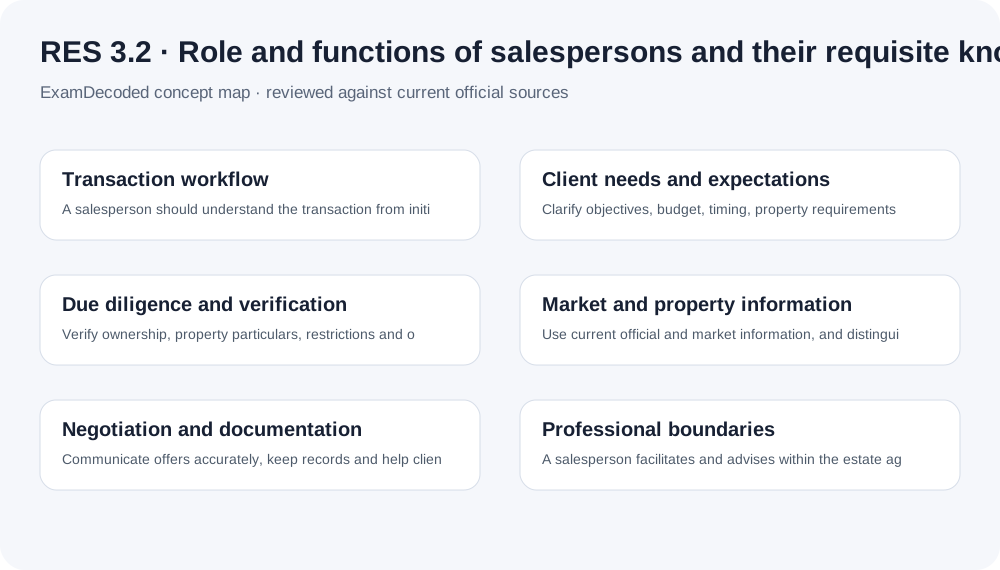
Visual guide: connect the concepts
Use this map to connect the main rules before attempting scenario questions.
Apply it to an exam scenario
Identify the property type, parties, transaction stage and the exact rule being tested. Then check whether the facts trigger an eligibility condition, disclosure duty, approval, tax, financing limit or professional obligation.
Applying an old rate or rule simply because it appeared in older course notes.
Remember: For policy-driven topics, the date of the transaction can change the answer.
Quick revision
- Transaction workflow: A salesperson should understand the transaction from initial engagement through marketing, negotiation, documentation and completion.
- Client needs and expectations: Clarify objectives, budget, timing, property requirements and material constraints before recommending a course of action.
- Due diligence and verification: Verify ownership, property particulars, restrictions and other material information using reliable sources rather than assumptions.
- Market and property information: Use current official and market information, and distinguish verified facts from estimates or opinions.
- Negotiation and documentation: Communicate offers accurately, keep records and help clients understand documents without straying into legal or financial advice reserved for other professionals.
- Professional boundaries: A salesperson facilitates and advises within the estate agency role; lawyers, bankers, valuers and tax professionals may be needed for specialist matters.
Practice MCQs
These questions test application rather than memorising a paragraph.
Official resources & currency
Reviewed: 7 October 2026. Key official references: Official source 1 · Official source 2. Because property rules change, re-check the relevant authority for your examination sitting and transaction date.