
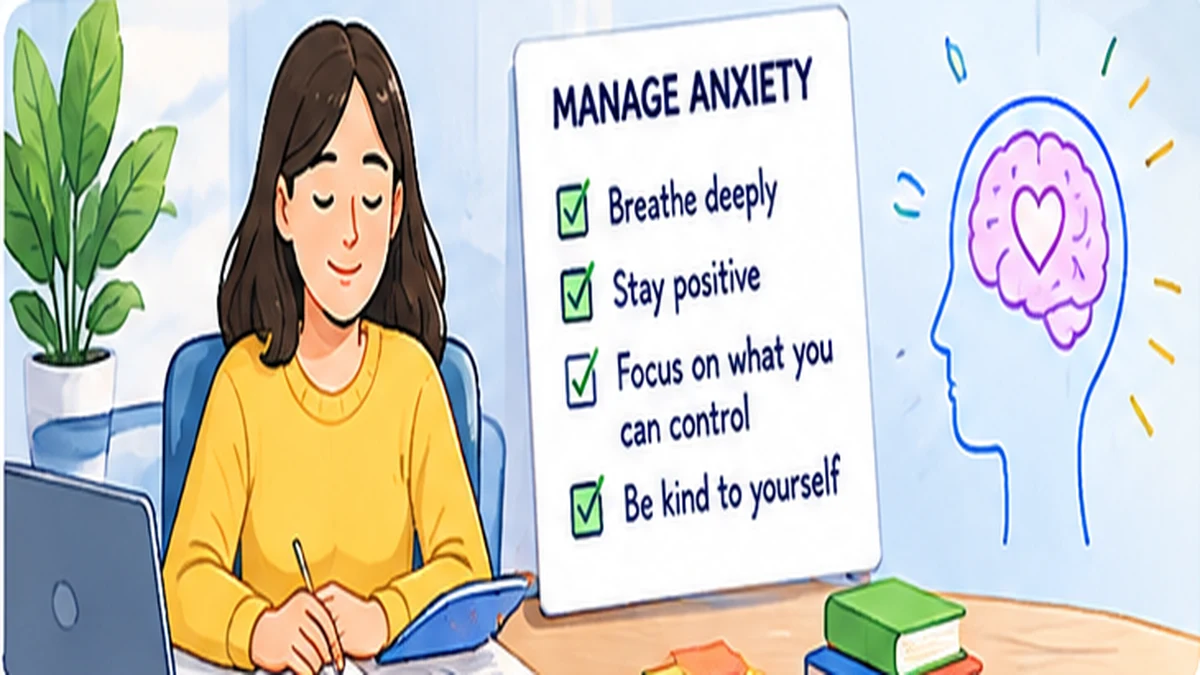
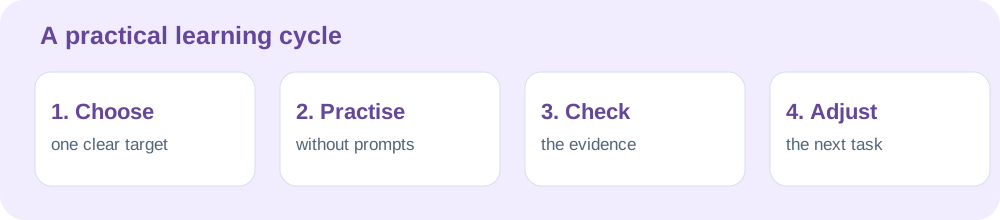
Use preparation routines and simple in-exam strategies when nerves affect concentration. Choose one clear task, practise independently, check the evidence and make a realistic adjustment for the next session.
Understand what exam anxiety can look like
Before an assessment, students may notice racing thoughts, tense muscles, a faster heartbeat or difficulty concentrating. Some nervousness is common, especially when the result matters. The aim is not to eliminate every anxious feeling but to have a practical response that allows you to begin and continue the paper.
Anxiety can also appear as avoidance: endlessly rewriting notes, checking the same answer repeatedly or refusing to attempt a practice paper. Notice what happens in your own case. If worry is persistent, severe or interferes with sleep, school or everyday activities, talk with a trusted adult, teacher or qualified health professional.
Prepare a predictable routine the day before
Check your exam timing, permitted materials and travel arrangements in advance. Pack essentials early and set a realistic bedtime. Avoid using the final evening to learn several unfamiliar topics. A short review of key ideas may be useful, but a last-minute marathon often adds fatigue and uncertainty.
Write down a simple morning plan: wake up, eat if appropriate, leave with enough time and arrive without rushing. Preparation cannot guarantee a particular score, but it removes preventable decisions on exam day. If a worry keeps returning, write it down alongside one action you can take rather than repeatedly imagining the worst outcome.
Start the paper with a repeatable sequence
When the paper begins, read the instructions, check the number of sections and identify the available time. Start with a question you can approach confidently if the exam format allows. Read the command words and required units carefully. A familiar starting routine gives you something specific to do even when you feel nervous.
If you suddenly cannot remember an answer, move to the next step rather than interpreting the blank moment as failure. Underline the known information, write a relevant formula or list the key concepts. Partial retrieval can help you restart. If the question remains unclear, mark it for later and protect time for the rest of the paper.
Use a brief reset when panic interrupts thinking
Pause for a few seconds, place both feet on the floor and relax your shoulders. Breathe slowly and comfortably without forcing deep breaths. Direct your attention to one visible part of the task: the question number, a keyword or the first line of working. The purpose is to return to the paper, not to perform a perfect relaxation exercise.
Use a short internal instruction such as 'Read, choose a step, continue.' Avoid trying to predict the final grade while you are still answering questions. The paper is made of individual tasks. Your next useful action is more important than the score you fear you might receive.
Manage difficult questions and the clock
A difficult question can make time feel as if it is disappearing. Decide in advance how long you will spend before moving on, taking the marks and paper format into account. Show working where appropriate, circle the question number and continue. Return during the checking period if time remains.
For example, if a two-mark question is consuming much longer than planned, leaving a clear attempt and returning later may protect several easier marks elsewhere. Do not repeatedly erase a plausible answer without new evidence. Follow the examination instructions for guessing, partial credit and permitted working.
Practise the response before exam day
Use a short timed practice to rehearse both content and coping actions. Before starting, check the time, read instructions and choose a pacing rule. If you become stuck, practise marking the question and moving on. Afterwards, review whether you used the routine, not only whether your answers were correct.
Start with manageable practice conditions and increase realism gradually. Students who experience strong anxiety may benefit from discussing an individual plan with school staff or a qualified professional. Practice should build familiarity, not become another test of whether you can stay perfectly calm.
Practical exercise: write an exam-day response card
On a small card, write three actions for before the paper and three for a difficult moment during it. Example before: check materials, arrive early, read instructions. Example during: relax shoulders, underline the question, choose one step or move on. Rehearse the sequence during your next practice paper.
After the practice, ask: 'Did I return to the task? Did I protect time for the rest of the paper? What part of the routine needs changing?' Those questions turn a vague goal such as 'be less nervous' into observable behaviour.
Common Questions
How often should I use this approach?
Use it whenever you work on handle exam anxiety before and during a paper. Start with a manageable session, review what happened and adjust the routine to the subject and assessment.
What if the first attempt does not work?
Look at the specific point of difficulty rather than repeating the whole session unchanged. Choose one smaller task, check a worked example or ask for targeted feedback, then try a fresh question independently.
How will I know I am improving?
Look for evidence: more accurate answers on comparable questions, clearer explanations without notes, fewer repeated errors or better pacing. A completed checklist alone is not proof of learning.
Separate ordinary nerves from persistent distress
Brief worry before a test may ease once the student starts answering. However, frequent panic, avoidance, disrupted sleep or distress that interferes with daily life deserves attention beyond study tips. Speak to a trusted adult, school counsellor or qualified healthcare professional rather than trying to solve everything through more practice papers.
During an exam, focus on actions within your control: reading instructions, choosing a first step, managing time and moving on when stuck. Afterwards, review both the academic errors and whether the coping routine helped you return to the task.
Example: a blank moment in Science
A student cannot recall the explanation for condensation. They relax their shoulders, identify the change of state and write that water vapour cools and changes into liquid water. If they still cannot complete the response, they mark the question and move on. This protects the remaining time without assuming the entire paper is lost.