
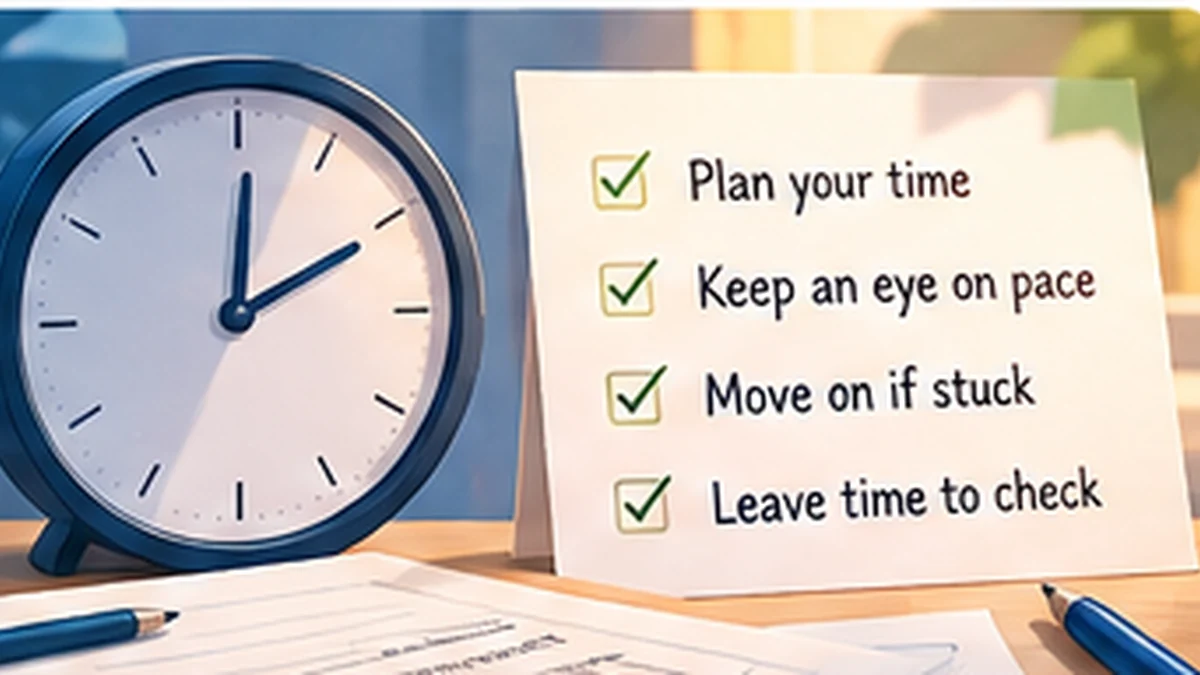
Plan checkpoints for each section, use a move-on rule for difficult questions and reserve time for targeted checking. Practise your pacing before exam day.
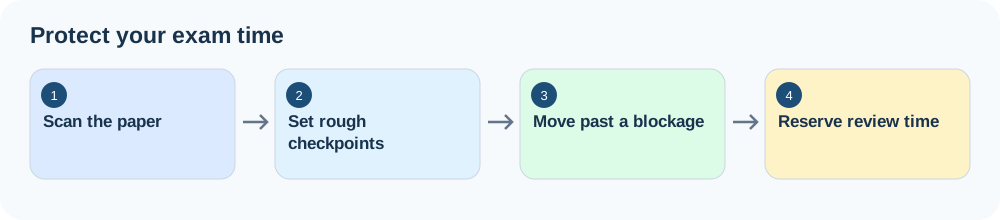
Plan realistic checkpoints, make decisions about difficult questions and reserve time to check your work. This guide shows how to use the strategy during ordinary revision and how to check whether it is improving your exam preparation.
1. Time management starts before the first question
Good pacing is not simply writing faster. It means understanding the paper’s structure, choosing a sensible order and deciding how long to spend before moving on. Students can know the material but still lose marks when one difficult question consumes the time needed for easier questions later. A simple plan reduces that risk. The exact strategy should follow your paper’s rules, including whether sections must be completed in a fixed order.
Before the exam, practise with the permitted duration and the actual number and type of questions. Notice which sections routinely take longer than expected. Use that evidence to plan rather than guessing from the total number of pages.
2. Calculate a realistic time budget
Start with the total permitted time. Subtract a small buffer for reading instructions, checking answers and transferring responses where required. Allocate the remaining time to sections based on the mark distribution and complexity, not only the number of questions. A one-mark MCQ and a multi-step open-ended question should not automatically receive the same time allowance.
Illustrative example: a 90-minute paper might use 5 minutes for instructions, 30 minutes for a shorter-question section, 45 minutes for longer questions and 10 minutes for checking. These are sample allocations only; adjust them to the actual exam format and your practice results.
3. Set checkpoints instead of watching the clock constantly
Write down a few checkpoints before starting, such as the time you want to finish each section. Checking the clock after every question can break concentration. Checking at planned milestones helps you notice whether you are behind while there is still time to adjust. If the exam permits a watch or clock, use it according to the venue rules.
For a 90-minute paper starting at 9:00, your sample checkpoints might be 9:35 for the first section, 10:20 for the second and 10:30 to finish checking. If you reach the first checkpoint late, shorten time spent on low-confidence questions rather than panicking.
4. Use a sensible first pass
For papers that allow flexible question order, begin with questions you can answer reliably without spending too long. Mark questions that need more thought and return later. This helps you secure accessible marks and gives you a clearer view of the remaining workload. Do not skip an entire section if the paper requires a fixed sequence or if later questions depend on earlier information.
If you recognise a familiar short question, answer it efficiently. If a complex question is taking longer than planned, write any useful working, mark its number and continue. Returning with a fresh perspective may help.
5. Decide when to move on
Set a personal stopping rule during practice. For example, after a reasonable attempt, if you have no viable next step, leave space and move on. This does not mean abandoning challenging questions immediately; it means preventing one question from consuming an unfair share of your total time. The decision should reflect marks available, partial-credit opportunities and how many questions remain.
Suppose a four-mark problem is still unresolved after several minutes. You may be able to show a relevant formula or intermediate step before moving on. Check your examination rules and marking conventions; partial marks are not guaranteed for every question.
6. Handle multi-step questions carefully
Long questions need time for understanding, planning and checking. Read the final task first, identify the given information and break the problem into steps. If you are stuck, determine whether the obstacle is a missing concept, an unfamiliar representation or an arithmetic slip. You may gain more by changing your approach than by repeating the same calculation.
A word problem involving percentages and ratio may require you to calculate a new quantity before applying a ratio. Write the intermediate result with its unit, then check whether it answers the final question or only prepares the next step.
7. Protect time for checking
Checking should be targeted. Revisit questions you flagged as uncertain, verify units and signs, and ensure all required answer spaces are completed. For MCQs, confirm that answers have been transferred correctly if a separate answer sheet is used. Do not spend the entire checking period redoing one already-correct question while leaving obvious omissions elsewhere.
Create a final-minute routine: scan for unanswered questions; check negative wording; verify units and calculations; confirm that every requested part has an answer. Adapt the order to the mistakes recorded in your error log.
8. What to do when you fall behind
If you are behind a checkpoint, pause briefly to reassess rather than speeding up indiscriminately. Count the remaining questions and marks. Prioritise clear, achievable responses and avoid spending too long polishing answers that already meet the requirements. If your paper allows it, return to difficult questions after completing the rest.
Imagine 20 minutes remain and six questions are unfinished. Instead of trying to perfect the first one, scan all six, answer the most approachable and return to the hardest with any remaining time.
9. Practise timing in stages
You do not need to time every question while learning a new method. Start with untimed accuracy, then time a small mixed set, then attempt a section under realistic conditions and finally complete a full paper. Review both your score and the time taken. If accuracy collapses under timing, your target may be method fluency rather than simply writing faster.
Use the Exam Countdown Timer for a timed practice session, or a standard clock. Record where you lost time and compare it with the actual cause of errors after the paper.
10. Build a personal pacing plan
After two or three timed attempts, compare how long different question types take. Identify where you consistently slow down, whether because of reading, calculations, indecision or checking. Choose one adjustment and test it in the next paper. Avoid changing your whole strategy after a single unusual result.
For example, if comprehension questions repeatedly take longer than planned, practise locating evidence efficiently. If you spend too long on difficult MCQs, use a move-on rule. Pair this guide with How to Review a Practice Paper Properly.
Put It Into Practice: Your Next Study Session
Choose one recent question or topic where your performance was weaker than expected. Apply the steps from this guide, check your result against a reliable source and write one specific follow-up action. Repeat the check on a different day or with a new question so that improvement reflects genuine understanding rather than familiarity.
- What was the exact problem I wanted to improve?
- Which strategy did I test, and what evidence did it produce?
- What is the smallest useful follow-up task I can schedule?
Common Questions
Should I spend equal time on every question?
Not necessarily. Consider marks, complexity and your paper’s structure.
What if I am behind schedule?
Reassess remaining marks and questions; prioritise achievable answers and return later when allowed.
How much time should I leave to check?
Use your practice results to set a realistic buffer. There is no single amount for every paper.
Should every practice paper be timed?
No. Learn difficult methods untimed first, then gradually add timing.
Progress comes from choosing the right next action, practising it independently and reviewing the evidence. Use this guide as a repeatable routine, not a one-time checklist.