
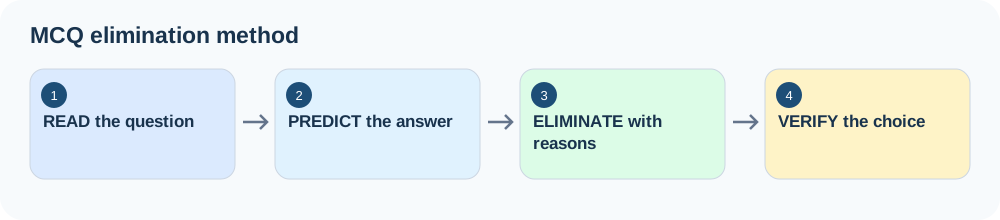
Read → Predict → Eliminate → Verify. Identify exactly what the question asks, think of the expected answer when possible, eliminate options for specific reasons, then check that your final selection matches the evidence.
You read an MCQ and recognise an option. It contains words you've seen in your notes, so you choose it. But the answer is wrong. The problem may not be your knowledge: a familiar-looking option isn't necessarily the one that answers this question.
Good MCQ technique is about finding the option that best satisfies the question—not merely one that looks right.
1. Understand the Question Before Looking at the Options
Is the question asking for a fact, a cause, a calculation, an inference or an incorrect statement? Pay attention to NOT, EXCEPT, MOST, LEAST, BEST and ONLY. Restate the task in your own words before selecting anything.
“Which statement is NOT correct?” means you are looking for the incorrect statement—not the first true statement you recognise.
2. Predict an Answer Before Reading the Options
Where possible, decide what a correct answer should contain before looking at the choices. If asked why a wet shirt dries faster on a windy day, think about wind carrying water vapour away and supporting evaporation. Then compare the options against that reasoning. Some questions require comparing statements instead, so prediction is a useful tool, not an inflexible rule.
3. Eliminate With a Specific Reason
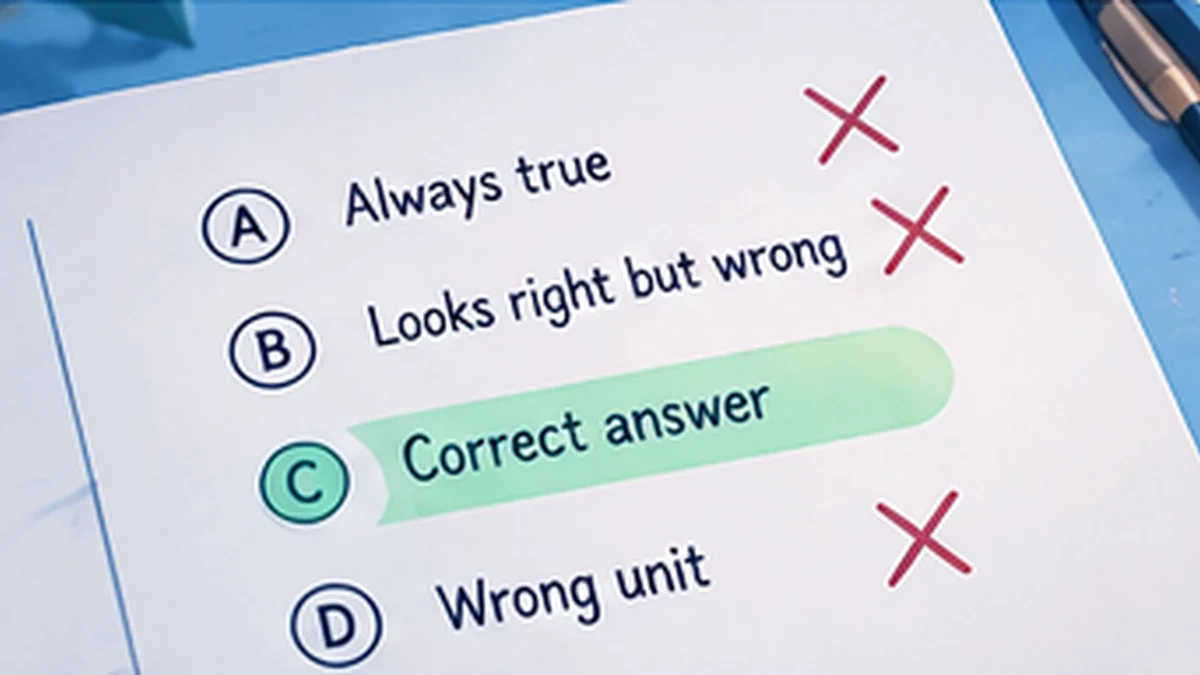
Don't reject an option because it “looks wrong”. State the reason: it contradicts the passage, has the wrong unit, reverses cause and effect, fails a condition, answers a different question or contains a factual error.
| Option | Rectangle: 8 cm × 5 cm. What is its area? | Reason |
|---|---|---|
| A | 13 cm² | Adds length and width. |
| B | 26 cm² | Calculates perimeter. |
| C | 40 cm² | Correct: 8 × 5 with area units. |
| D | 40 cm | Correct number, wrong unit. |
4. Recognise Common Distractor Patterns
A distractor is an incorrect answer designed to appear plausible. Look for these patterns when comparing options:
| Pattern | What it looks like | How to test it |
|---|---|---|
| True but irrelevant | Correct fact, wrong question | Return to the stem. |
| Half-right | Correct beginning, wrong detail | Check every part. |
| Reversed logic | Cause/effect or increase/decrease swapped | Check the direction. |
| Familiar wording | Repeats source words but changes meaning | Compare meaning, not words. |
| Wrong scope | General truth that fails this specific case | Check conditions. |
| Wrong unit | Correct number, incorrect unit | Check the requested quantity. |
Half-right example: “Evaporation occurs at the surface of a liquid and only takes place at 100°C.” The first part is true, but the second is false. The entire option is therefore incorrect.
5. Test Absolute Words—Don't Automatically Reject Them
Always, never, all, only, every and none are signals to examine a strong claim. They are not automatically wrong: “All squares have four equal sides” is true. Ask whether the evidence supports the strength of the claim.
6. Handle NOT and EXCEPT Questions Differently
Mark the negative word. Then label each option as fitting or not fitting the statement. For example, in “Which is NOT a renewable energy source?”, solar, wind and hydroelectric energy are renewable; coal is the answer because it is not renewable.
7. Compare the Final Two Options Directly
If two choices seem reasonable, identify the precise difference. A passage says Mei wanted to join a competition but decided not to because she needed more examination preparation time. “She was not interested” is contradicted by the passage; “She wanted to focus on her examinations” matches the stated reason. The difference is lack of interest versus another priority.
8. Adapt Your Elimination to the Subject
- Comprehension: Find textual support and check changes in meaning, speaker or cause.
- Maths: Estimate where useful; verify operations, copied values and units.
- Science: Match the concept to the conditions and diagram.
- RES and professional exams: Pay attention to definitions, exceptions and eligibility conditions.
Elimination helps you apply knowledge. It cannot replace learning the subject.
9. Check Combined Options Carefully
For “all of the above”, every component must be true. One false component rules it out; two true components do not prove the third is true. For “none of the above”, check whether any listed answer satisfies the question.
10. Ignore Answer-Letter Patterns
Several B answers in a row do not mean the next answer must be different. Neither option length nor familiar wording establishes correctness. Judge each question independently.
11. Move On When Necessary
If you are stuck after a reasonable attempt, eliminate what you can, mark the question if allowed, record a provisional answer where appropriate and return later. Protect time for questions you can answer.
12. Know Your Exam's Guessing Rules
When there is no wrong-answer penalty, attempting every question is generally worthwhile. With negative marking, the decision depends on the scoring rules and how many options you have confidently eliminated. Check your specific examination rules in advance.
13. Change an Answer for a Reason
Change an answer when you find new evidence, notice a missed keyword, correct a calculation or remember a relevant concept—not merely because you feel uncomfortable. Your first answer is not automatically right or wrong.
14. Review the Wrong Options You Chose
| Question | Why my choice looked right | Why it was wrong |
|---|---|---|
| Q4 | Repeated passage wording | Changed the meaning |
| Q9 | First half was correct | Second half was false |
| Q15 | Calculation looked right | Wrong unit |
Find your recurring pattern and practise that specific skill. See How to Create an Error Log and How to Avoid Careless Mistakes.
Try the Elimination Challenge
A passage says: “The library extended its opening hours during the examination period so students could have more time to revise.” Why were the hours extended?
Before You Submit: The MCQ Checklist
- Did I notice NOT, EXCEPT, MOST or LEAST?
- Have I considered every option?
- Can I explain why eliminated options are wrong?
- Does my final answer meet every relevant condition?
- Does the selected letter match my intended answer?
Common Questions
Should I guess if I don't know?
Check the marking rules. Without a wrong-answer penalty, answer rather than leave a blank. With negative marking, consider the scoring rules and remaining options.
What if two options look correct?
Identify their exact difference and check which one is supported by the question or source.
Are answers with “always” or “never” wrong?
Not necessarily. Test the strength of the claim rather than rejecting it automatically.
Should I change my first answer?
Change it if new evidence or corrected reasoning supports the change.
A wrong option can contain correct information or familiar wording. Don't ask only, “Which looks right?” Ask: “Which option answers this exact question—and what evidence supports it?”
Related Guides
Put this guide into practice with these free resources.
Apply It in Your Next Practice
Explain why each wrong option fails, not just why the correct one works.
An elimination exercise with a reason
Consider this simplified Science question: “Which statement best describes evaporation?” A. It happens only at boiling point. B. It can happen at the surface of a liquid below boiling point. C. It happens only in sunlight. D. It changes a gas into a liquid.
Answer: B. A is too restrictive; evaporation does not require boiling. C confuses a possible source of heat with a requirement. D describes condensation. The important skill is not just choosing B but explaining why the other statements fail.
Try it: For your next five MCQs, write a two- or three-word reason beside each rejected option. If you cannot explain a rejection, mark the question as uncertain even when your final answer is correct. Review that concept rather than trusting a lucky elimination.