
Read for the task, not just the topic. Identify the command word, important conditions and required answer, then check that your response matches all three.
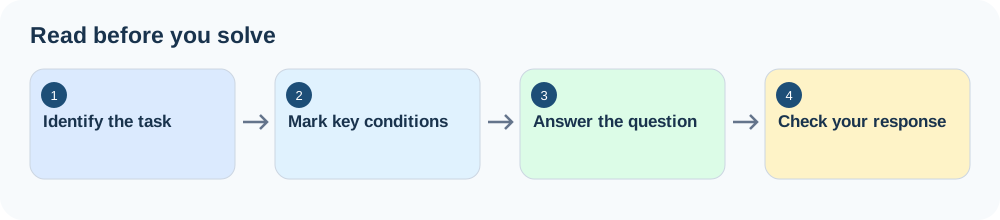
Recognise command words, negatives, conditions and hidden requirements before choosing a method or writing an answer. This guide shows how to use the strategy during ordinary revision and how to check whether it is improving your exam preparation.
1. Why small words can change the whole question
Many exam errors begin before the calculation or explanation. A student sees a familiar topic, predicts the likely answer and overlooks one condition that changes what is required. Words such as “not”, “except”, “only”, “after”, “difference” and “best” can reverse the task. Reading carefully does not mean reading every sentence extremely slowly. It means identifying the words that control what counts as a correct response.
Compare “Which material conducts electricity?” with “Which material does not conduct electricity?” The topic is identical, but the correct choice may be the opposite. Marking the negative word prevents an avoidable mistake.
2. Start with the command word
The command word tells you the type of response expected. “State” may require a concise fact. “Explain” generally requires a reason or relationship. “Compare” requires relevant similarities or differences. “Calculate” asks you to work out a value, often with units. Exact marking expectations vary by subject and paper, so use your school’s marking guidance rather than assuming one fixed definition always applies.
For a Science question asking “Explain why the plant wilted”, writing only “lack of water” may not provide the relationship the question expects. An explanation should connect the relevant condition to what happened to the plant, using accurate scientific reasoning.
3. Find the object of the question
Ask what the question is actually about. A word problem may mention several quantities, but the requested answer may be only one of them. Circle the quantity or outcome being sought, then check that your final response matches it. Students sometimes calculate a correct intermediate result and stop because the number looks reasonable. The question’s final sentence often reveals the required output.
A Maths question might give the total price of three items and ask for the change from a payment. Finding the total cost is only a step; you must still subtract it from the amount paid.
4. Underline conditions that restrict the answer
Conditions describe which cases are allowed and which are excluded. They may include time limits, measurement units, assumptions, quantities, age ranges or words such as “at least” and “no more than”. Treat these as part of the problem rather than background detail. When the question includes a diagram or table, read its labels and footnotes too.
“More than 20” excludes 20, while “at least 20” includes 20. In a graph question, the vertical axis might use thousands rather than individual units. Missing either detail can make otherwise correct working lead to the wrong answer.
5. Use a three-pass reading routine
On the first pass, identify the topic and the final task. On the second, mark the command word, constraints and relevant data. On the third, check that your planned method addresses the actual task. For a short MCQ, this may take only a few seconds. For a multi-step word problem, it is worth taking longer. The aim is deliberate accuracy, not a rigid ritual that consumes too much exam time.
Try the routine on “A tank is half full. After 12 litres are added, it is three-quarters full. Find the tank’s capacity.” The requested value is capacity, not the water added. The fractions describe the change, so 12 litres represents one-quarter of the tank.
6. Handle negative and exception questions
Questions containing “NOT”, “EXCEPT”, “incorrect” or “least likely” are especially easy to misread when you recognise a familiar answer. Before viewing the options, restate the instruction: “I am looking for the option that does not fit.” Then evaluate each option against that instruction. Do not select the first true statement if the question asks for the false one.
In an MCQ that asks “Which statement is NOT supported by the passage?”, three options may be supported. You need the unsupported option. See MCQ Strategies for a fuller elimination method.
7. Read diagrams, tables and units as part of the text
A labelled diagram is not decoration. The arrows, axes, scales, keys and units can contain information that the paragraph does not repeat. Before calculating, check whether the figure is drawn to scale, whether a value is measured in minutes or hours and whether the graph begins at zero. Do not infer an exact measurement from a picture unless the question allows it.
Suppose a speed question gives 90 minutes but asks for kilometres per hour. Converting 90 minutes to 1.5 hours is necessary before using speed equals distance divided by time. The arithmetic may be correct yet the unit conversion may be wrong.
8. Check the marks and response format
The mark allocation can sometimes indicate the amount of work or explanation expected, although it is not a perfect guide. Look for instructions such as “give two reasons”, “show your working”, “use evidence from the passage” or “answer in complete sentences”. A response that gives one valid point when two are required may be incomplete.
If a question says “Give two differences”, number your two distinct differences. Do not write four vague statements and hope the examiner chooses the correct pair. Where a paper requires working, show the relevant steps clearly.
9. Use a final answer check
Before moving on, reread the exact instruction and compare it with your answer. Did you respond to the right person, object, time period or quantity? Did you include the requested number of points? Did you use the right unit? This check should target the mistakes you commonly make rather than involve rereading the whole question repeatedly.
Create a short personal checklist: “task, conditions, units, number of points”. If you often miss negatives, add “NOT/EXCEPT” to the top. Record recurring reading errors in your Error Log.
10. Practise careful reading without slowing everything down
Choose five questions from different topics. For each, write the command word and final task before solving. Then compare your interpretation with the marking guide. If you got the calculation right but answered the wrong question, count that as a reading error and practise identifying the final task. As the routine becomes familiar, use it more quickly under realistic timing.
For a comprehension question, highlight the phrase that specifies “from paragraph 3” before searching for evidence. For a Maths question, write “find capacity” or “find change” beside the working. These tiny notes can prevent larger errors.
Put It Into Practice: Your Next Study Session
Choose one recent question or topic where your performance was weaker than expected. Apply the steps from this guide, check your result against a reliable source and write one specific follow-up action. Repeat the check on a different day or with a new question so that improvement reflects genuine understanding rather than familiarity.
- What was the exact problem I wanted to improve?
- Which strategy did I test, and what evidence did it produce?
- What is the smallest useful follow-up task I can schedule?
Common Questions
Should I underline every word?
No. Mark only the command word, conditions, important data and final task.
What if the wording is unfamiliar?
Restate the task in simpler words without changing its meaning, then identify the relevant concept.
Does reading carefully waste time?
A short, targeted check can prevent longer rework. Practise the routine so it becomes efficient.
What should I check before moving on?
Confirm that you answered the exact task, included required points and used correct units.
Progress comes from choosing the right next action, practising it independently and reviewing the evidence. Use this guide as a repeatable routine, not a one-time checklist.