
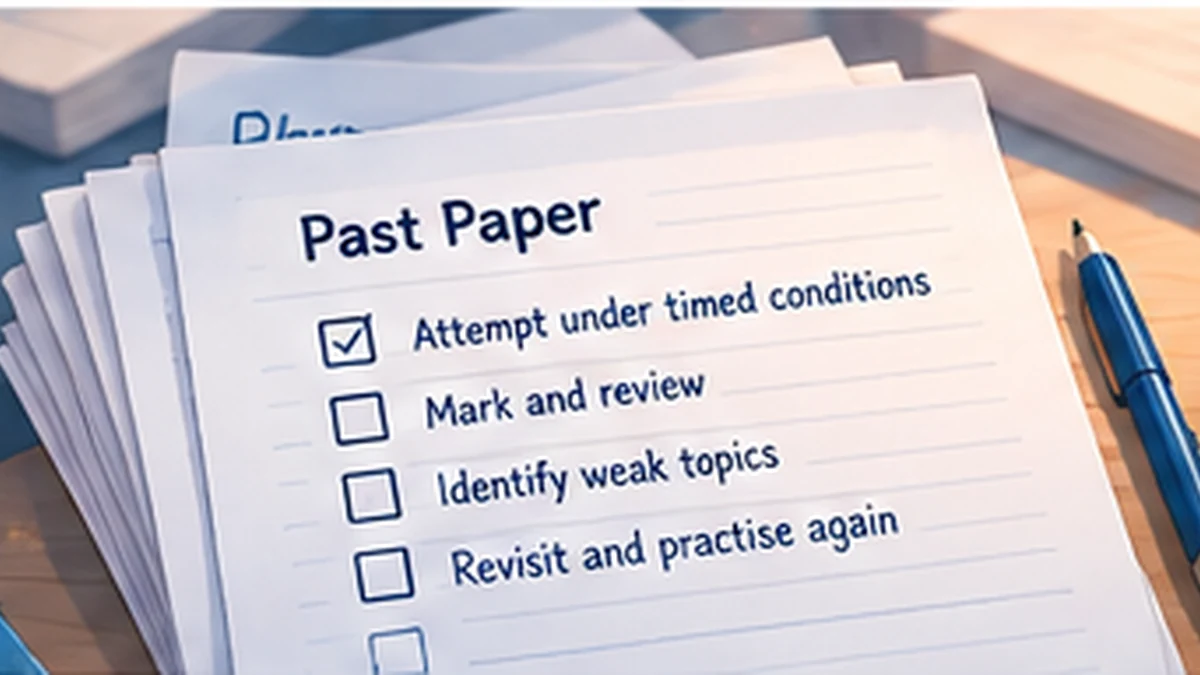
A score tells you how a paper went, not what to do next. Mark → classify → correct → act → retry. Identify wrong and uncertain answers, find the cause, attempt corrections independently and plan a specific follow-up. A paper is not fully useful until its lessons shape your next study session.
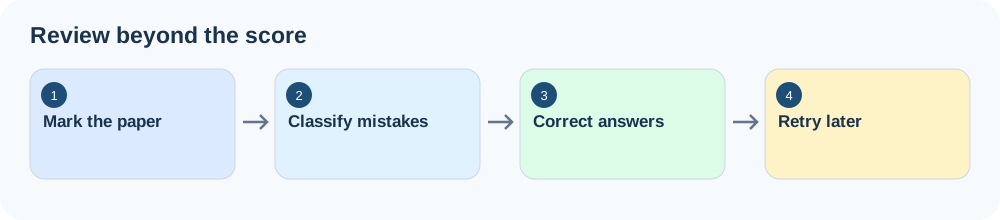
Finishing a practice paper can feel productive. But if you only check the score and move on, you may carry the same weaknesses into the next attempt. A proper review reveals which mistakes matter, why they happened and how to prevent them from recurring.
Why the Score Is Only the Starting Point
Two students with the same score may need very different revision plans. One may misunderstand key concepts; another may know the content but lose marks through misreading, incorrect methods or poor pacing. The score alone cannot tell you which problem to fix.
Allow Enough Time for Review
Review can take nearly as long as the paper itself, sometimes longer when there are many errors. You do not need to finish everything in one sitting, but avoid reducing review to a rushed check of the answer key. Review on the same day if practical, or within a day or two while you still remember your reasoning.
Step 1: Mark First, Then Examine the Explanations
Identify correct, incorrect and uncertain answers before reading full solutions. Flag correct guesses too: they may hide a gap. For written answers, compare your response against the mark scheme and note where marks were earned or missed.
Step 2: Classify Each Important Error
| Cause | What it means | Next response |
|---|---|---|
| Knowledge gap | You did not know or remember the content. | Revise and practise the concept. |
| Method error | You chose or applied an unsuitable approach. | Relearn the method; try new questions. |
| Question reading | You missed a condition, keyword or instruction. | Practise identifying the question requirements. |
| Careless execution | You copied, calculated or recorded incorrectly. | Introduce a specific checking habit. |
| Time pressure | You rushed or did not finish. | Review question order and pacing. |
Use consistent labels so you can recognise patterns across several papers. See How to Create an Error Log for Exam Revision.
Step 3: Attempt the Correction Yourself
Before copying a worked solution, reread the question and try again. If you still cannot solve it, study the explanation, close it and attempt a similar question later. The aim is to check whether you can apply the correct reasoning independently.
For essays and open-response questions
Compare your answer with the mark scheme point by point. Identify missing evidence, concepts, structure or detail. A model answer is most useful when you can explain which specific element your response lacked—not just that it sounded better.
Worked Example: A Forces Question
Suppose a student incorrectly uses F = ma to calculate a non-zero resultant force for an object moving at constant velocity.
- Mark: The answer is incorrect, although the student attempted it confidently.
- Classify: Method error. The student did not recognise that constant velocity means zero acceleration and hence zero resultant force.
- Correct: Reread the condition and explain the relationship before checking the solution.
- Record: “Assumed a non-zero resultant force despite constant velocity.”
- Act: Try four or five questions mixing constant-velocity and accelerating scenarios.
This is more useful than simply copying the correct answer.
Step 4: Record the Lesson, Not the Entire Paper
Keep a concise record of the topic, cause, correct principle and next action. Prioritise recurring errors and uncertain answers. Your error log should make future revision easier, not become another lengthy assignment.
Step 5: Schedule the Next Action
Finish the review with an actionable task: “Redo five reverse-percentage questions”, “Review this rule tomorrow” or “Retry a similar comprehension question on Friday”. A vague instruction such as “Study harder” does not tell you what to do.
Free Practice Paper Review Template
Use this Excel workbook to record your corrections and plan follow-up practice. It includes sample entries, dropdowns for results and error causes, retry tracking and an automatically updating summary.
Start Here · Paper Review · Summary
How to Use the Template
- Mark your paper and add the important wrong or uncertain questions.
- Select the error cause from the dropdown.
- Write the specific correction and next action.
- Set a retry date and record the outcome.
- Check the Summary tab for recurring causes and progress.
When Your Score Is Lower Than Expected
Use the paper as diagnostic feedback, not a verdict on your future result. Identify what caused the lost marks, select a manageable priority and test your improvement with targeted questions before your next full paper.
Quick Review Checklist
- Did I mark wrong and uncertain answers?
- Can I explain the cause of each important error?
- Did I attempt the correction before copying the solution?
- Did I turn the lesson into a specific next action?
- Have I planned when to retry a similar question?
Common Questions
How long should review take?
It may take nearly as long as the paper, sometimes longer. The time depends on the number and complexity of the errors; depth matters more than a fixed duration.
Should I review on the same day?
Ideally, while you still remember how you approached the questions. If that is not practical, aim for the next day or two.
How is review different from an error log?
Review is the process of marking, diagnosing and correcting a particular paper. An error log records important patterns over multiple attempts.
How do I review essays?
Compare the response against the mark scheme point by point. Identify specific missing content, evidence, reasoning or structure.
Should I redo every wrong question?
Prioritise mistakes that reveal an important gap or recurring pattern. Retry similar unfamiliar questions to check whether the correction transfers.
A completed paper gives you a score. A reviewed paper gives you a plan. Use the feedback to make your next revision session more focused.
Related Guides
Put this guide into practice with these free resources.
Practise, Review, Improve
Use your next practice paper to identify one recurring problem and plan a concrete fix.
A review example for open-ended Science
Suppose a Science question asks why a metal spoon becomes warmer when left in hot water. A student writes, “Because metal is hot.” That response does not explain the process. The review should identify the missing idea—thermal energy transfer from the hotter water to the cooler spoon—rather than simply copying a longer model answer.
Correction: Rewrite the explanation using the relevant energy-transfer idea and the direction of transfer. Then check the official or teacher-provided marking guidance for the specific points required; wording and mark allocation can vary.
Follow-up: Try a new question about heat transfer between objects at different temperatures. If the same explanation gap returns, log it as a concept or explanation weakness. The Practice Paper Review Template can help track the retry.