
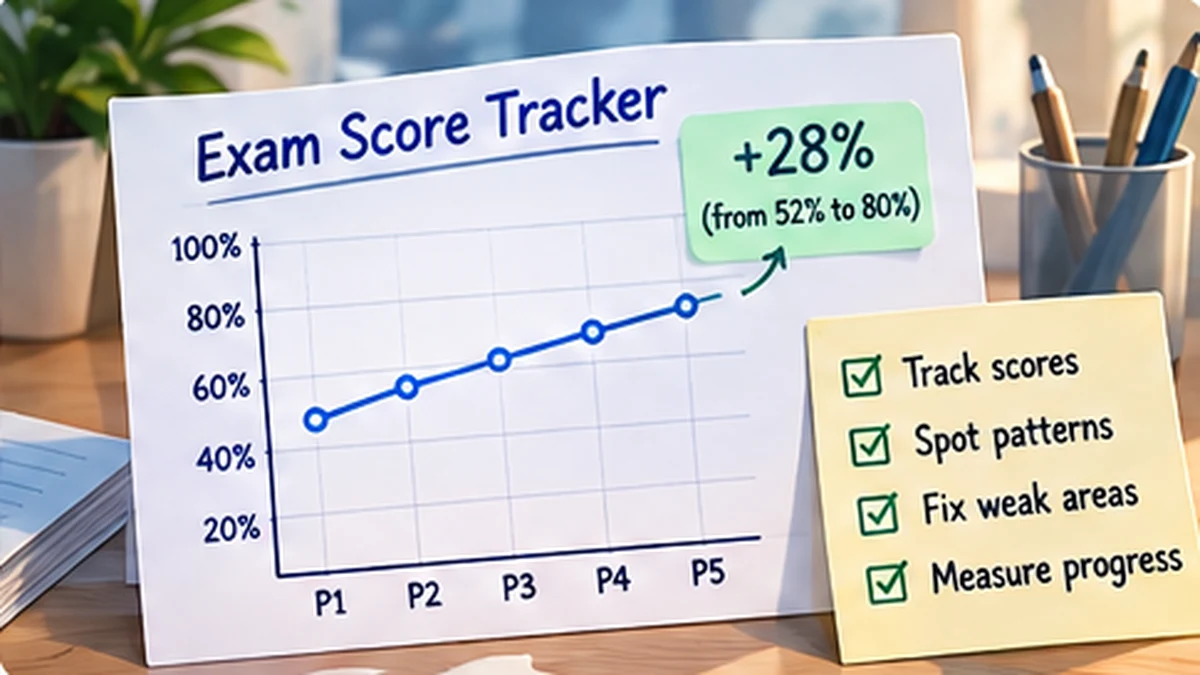
A single mark can mislead. Learn how to record comparable results, diagnose changes and use scores to plan better practice. A reliable routine is to check your current understanding, practise independently, review what happened and adjust your next task. Use the matching ExamDecoded tool to keep your plan practical.
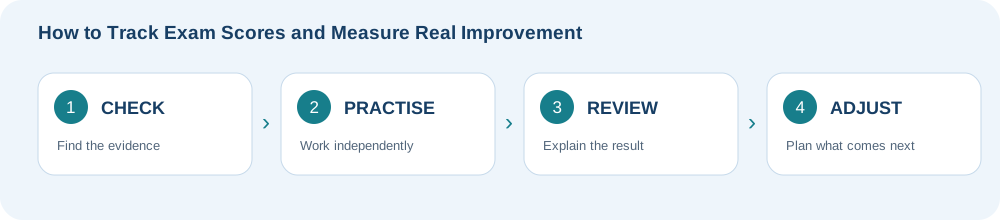
What a score can and cannot tell you
A test score is a useful snapshot of performance on one set of questions under particular conditions. It is not a complete measure of understanding, effort or future results. A higher score may reflect improvement, but it may also reflect an easier paper or familiar questions.
To learn from scores, record context. Note the subject, paper, date, maximum marks, time allowed and whether the paper was attempted independently. Without these details, comparing two percentages can produce the wrong conclusion.
Record the essentials consistently
Use a simple table with date, subject, paper name, marks obtained, total marks, percentage, timing and review notes. For example, 42 out of 60 is 70 percent. Always keep the numerator and denominator; two tests with different totals should not be compared by raw marks alone.
A short note such as “untimed topic practice” or “full timed paper” matters because those are different conditions. If you used notes or had help, record it. The goal is accurate feedback, not a chart that looks impressive.
Compare like with like
A full paper, a ten-question topic quiz and a revision worksheet measure different things. Their percentages can all be useful, but combining them into one trend without labels hides important differences. Compare full papers with similar coverage and conditions where possible.
A student who scores 90 percent on a familiar topic set and 65 percent on a mixed paper has not necessarily gone backwards. The mixed paper may demand topic recognition and pacing that the first set did not test. Keep separate views for topic mastery and exam readiness.
Look beyond the overall percentage
Break a result down by topic, question type and cause of error. A score can rise while one important weakness remains. Another student may keep the same total but improve a difficult topic while making more careless slips. Both patterns call for different next steps.
If you can, record which marks were lost to knowledge gaps, method choices, reading mistakes, execution slips and time pressure. This connects score tracking to the error log and makes the next revision session much more specific.
Understand normal variation
Scores naturally fluctuate. A small change between two different papers does not prove a new study method worked or failed. Look at several attempts, the difficulty and the kinds of errors. Use trends as clues rather than making strong claims from one data point.
For example, results of 68, 72 and 70 percent may suggest broadly stable performance, while a sequence of 55, 64, 71 and 75 percent under comparable conditions is more encouraging. Even then, review question difficulty and topic coverage before drawing conclusions.
Measure progress in more than one way
Useful progress indicators include fewer repeated mistakes, better performance on unfamiliar questions, greater accuracy in weak topics, and the ability to finish sections without rushing. These may improve before the overall score changes much.
Track one or two additional measures rather than everything. A learner struggling with timing might record unanswered questions and time remaining. A learner struggling with methods might record how many corrections they could complete independently a few days later.
Review a low result constructively
When a score drops, resist the urge to attempt another full paper immediately. First check whether the paper was harder, whether time ran out or whether a few concepts caused many lost marks. Separate a knowledge issue from a test-taking issue.
Choose a corrective action based on the cause: review a concept, practise a question type, rehearse pacing or introduce a checking routine. A low result is most useful when it changes the next session.
Build a simple weekly review
Once a week, scan recent results and answer three questions: what improved, what remained difficult and what should I do next? Select one or two actions and put them into the study schedule.
Avoid checking the dashboard after every single question. Too much monitoring can interrupt learning. A short weekly review plus a thorough check after each full paper is usually easier to sustain.
Worked example: same score, different needs
Imagine two students both score 72 percent in Maths. Student A loses most marks on ratio and percentage methods. Student B understands those topics but leaves the final questions unfinished. Their next sessions should not be identical.
Student A needs targeted practice and explanation of methods. Student B may need section checkpoints and mixed timed sets. Recording only 72 percent would hide this difference. The score starts the conversation; the error analysis determines the action.
Use the ExamDecoded tracker thoughtfully
Use the Exam Score Tracker to keep results in one place and look for patterns across attempts. Enter scores accurately, label the type of practice and review trends together with your error log.
The tracker is not a prediction engine. It helps you see what has happened and decide what to practise. Improvement is more convincing when you can solve unfamiliar questions independently under comparable conditions.
A quick self-check before your next session
Before you start, ask whether your chosen task is supported by a recent result, whether you can finish it in the time available and how you will know if it helped. If you cannot answer those questions, make the task smaller and more concrete. A short, well-defined practice set followed by a careful correction often gives clearer feedback than an ambitious session with no review.
After the session, write down one observation and one next step. You might discover that you can answer straightforward questions but struggle when the topic is mixed with others, or that you know the method but miss conditions in the wording. Those observations are more useful than a simple tick beside “revision completed”.
How to involve a parent, teacher or study partner
If someone is helping you, show them the evidence rather than asking them to decide based only on confidence. A marked paper, a short explanation of the mistake and a realistic next action make it easier to give useful feedback.
Support should not mean taking over the work. Ask the learner to explain the method and try a similar question independently. If they cannot, return to the underlying idea and try again later. The goal is greater independence, not a perfect-looking revision tracker.
What success looks like
Improvement does not always appear immediately as a dramatic score increase. It may first show up as fewer repeated errors, a better explanation, more reliable topic recognition or a shorter correction process. These are signs that the learning routine is becoming more effective.
Continue checking with unfamiliar questions and realistic conditions when appropriate. If the same error returns, that is feedback to adjust the plan, not a reason to abandon it. Small, repeated cycles of checking and correction are what make a study system useful over time.
Put It Into Practice
Choose one task from this guide and apply it during your next study session. Use your results to decide whether to continue, change approach or return to an earlier step. A useful study technique should help you make a decision, not simply add another activity to your checklist.
- What evidence tells me where I need to improve?
- Can I explain the next action in one clear sentence?
- When will I check whether the change worked?
Common Questions
Do I need to follow this method exactly?
No. The examples are practical starting points, not strict rules. Adjust the length of sessions, the questions and the review schedule to your assessment and current understanding. The important principle is to use feedback from independent practice.
What if I have very little time?
Choose one high-value task that you can complete and review properly. Avoid spending the whole session planning or copying notes. Even a short set of carefully checked questions can tell you what to do next.
How do I know whether it is working?
Look for fewer repeated mistakes, better explanations and improved performance on unfamiliar questions. Where possible, compare attempts under similar conditions rather than relying on a single score.
Can this work for PSLE and other examinations?
Yes, but adapt the details to the syllabus and question format. Maths methods, Science explanations, language comprehension and professional examination questions require different forms of practice and feedback.
Good revision is a cycle of checking, practising, reviewing and adjusting. Use the next session to address what the evidence tells you, rather than repeating the same activity automatically.
Related ExamDecoded Guides
Turn This Guide Into Action
Use the Exam Score Tracker to organise your next step and revisit your progress.