
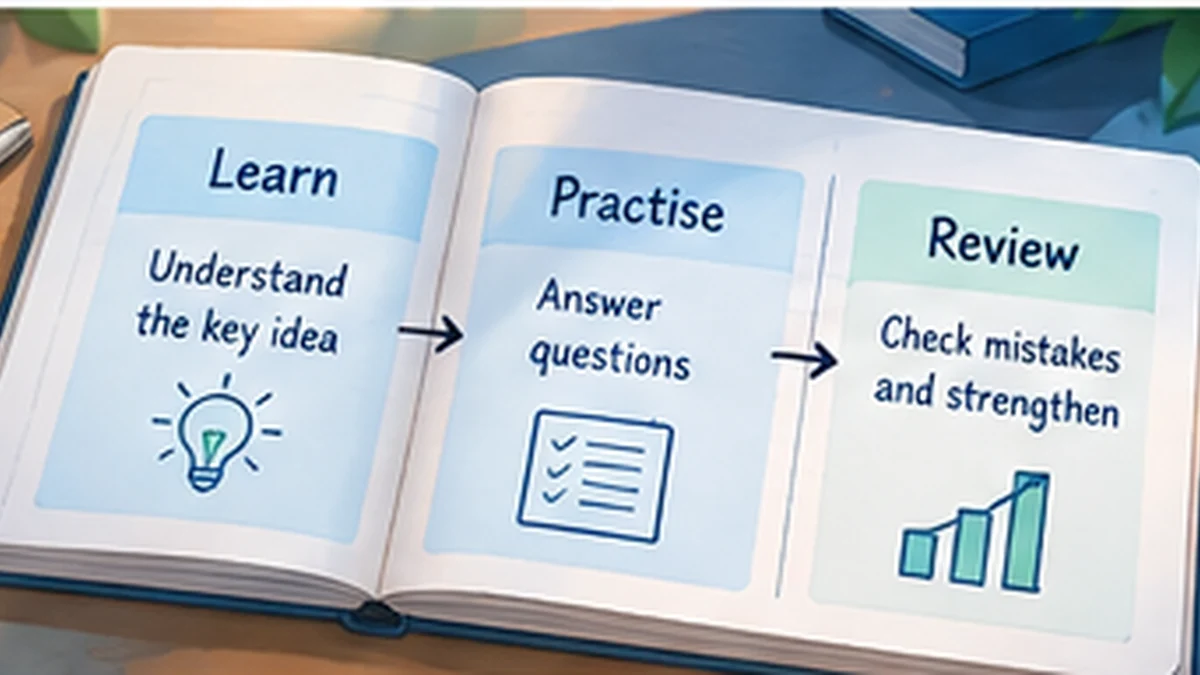
Revision builds knowledge; practice papers test whether you can use it independently. Follow a cycle: Revise → Practise → Review → Improve. Use early papers to find gaps, targeted questions to address them and timed papers to prepare for exam conditions. Every paper needs a review.
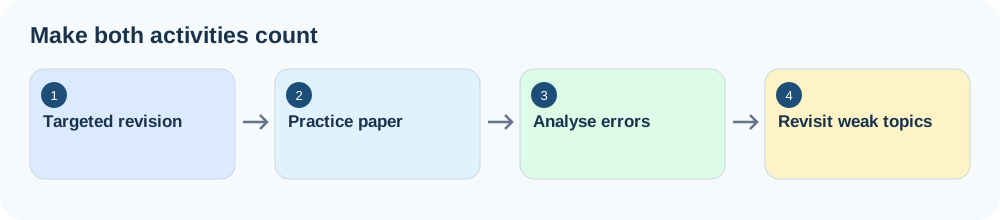
You've completed a practice paper, but your score isn't what you hoped for. Should you attempt another paper, reread your notes or focus on the questions you missed? The answer depends on why you lost marks. Effective preparation connects revision, practice and review rather than treating them as competing activities.
1. Understand What Each Activity Does
| Revision | Practice papers |
|---|---|
| Builds or refreshes understanding | Tests independent application |
| Targets known weaknesses | Reveals additional weaknesses |
| Lets you focus on one skill | Mixes topics and question types |
| Helps correct methods | Tests pacing and exam readiness |
For example, revising PSLE Maths ratio strengthens the method. A mixed paper tests whether you can recognise when to use it without being told the topic.
2. Use an Early Paper as a Diagnostic
You don't need to finish every topic before trying a paper. An early paper, untimed if necessary, helps you find where to focus. Treat its score as information rather than a verdict.
| Topic | Illustrative result | Next step |
|---|---|---|
| Fractions | 9/10 | Short maintenance review |
| Percentage | 7/10 | Mixed practice |
| Ratio | 4/10 | Targeted revision |
| Speed | 5/10 | Review methods and units |
These are sample results. The point is to allocate time according to what your work shows—not equally to every topic.
3. Don't Immediately Attempt Another Paper After a Poor Result
If you struggle with several Science concepts, another full paper may repeat the same mistakes. Identify the topics, review the concepts, complete targeted questions and then return to mixed practice. The next paper should test whether your revision worked.
4. Use Topic Questions Between Full Papers
Start with questions on a weak topic, then mix related topics, then attempt a full paper. Mixed practice matters because an exam usually doesn't tell you which method each question requires.
| Stage | Example |
|---|---|
| Topic practice | 10 ratio questions |
| Mixed practice | Ratio, percentage and fractions together |
| Full paper | Recognise and apply methods independently |
5. Change the Balance as the Exam Approaches
| Stage | Main focus |
|---|---|
| Early preparation | Concepts, topic questions and a diagnostic paper |
| Middle stage | Targeted revision, mixed questions and occasional papers |
| Final weeks | Timed practice, pacing and recurring mistakes |
| Final days | Light consolidation and error-log review |
This is a guide, not a fixed ratio. Even near the exam, a major knowledge gap may call for targeted revision rather than another full paper.
6. Introduce Timing Gradually
Untimed practice helps build understanding and accuracy. Timed practice tests pacing and decision-making. If you are still learning a method, a strict timer may obscure the underlying problem. As accuracy improves, move from untimed topic questions to timed sections and full papers.
For a realistic paper, work independently using only the materials permitted in the actual exam. Looking up answers halfway through makes the score less useful as a measure of readiness.
7. Review Every Paper Properly
Look beyond incorrect answers: review guesses and questions that took unusually long. Sort mistakes by cause.
| Error | What happened | Next action |
|---|---|---|
| Knowledge gap | Didn't know the concept | Revise and retry topic questions |
| Method error | Used the wrong approach | Relearn and apply the method |
| Careless mistake | Misread, copied wrongly or missed a unit | Build a specific checking habit |
| Time pressure | Rushed or didn't finish | Review pacing and question order |
A correct guess may still reveal a gap. For a fuller process, read How to Learn From Mistakes After a Practice Paper.
8. Turn Mistakes Into Specific Actions
Mistake: Used the wrong time unit.
Cause: Forgot to convert minutes to hours.
Correction: Convert units before using the formula.
Next action: Attempt five unit-conversion questions and retry a similar problem after a few days.
“Revise speed” is vague; a specific correction tells you what to do next. See How to Create an Error Log.
9. Use Mark Schemes to Improve Your Answers
Don't check only the final answer. Look for working steps, keywords, explanations and points that earn credit under the relevant marking scheme. Ask what was missing and how you would present a stronger answer next time. Examiner reports, where available, may also highlight common errors.
10. What If You Run Out of Past Papers?
- Retry previously incorrect questions after a gap.
- Use topic questions from textbooks or question banks.
- Complete mixed sets or timed sections.
- Use older papers only after checking syllabus and format differences.
- Test yourself with unfamiliar questions to distinguish learning from remembering a paper.
11. Don't Chase Paper Counts
Ten papers with little review aren't automatically more useful than five with corrections and follow-up. Track repeated errors, accuracy on unfamiliar questions, understanding and pacing—not just how many papers you've finished.
12. Example of a Balanced Week
| Day | Activity |
|---|---|
| Monday | Revise weak topics from the previous paper |
| Tuesday | Targeted topic questions |
| Wednesday | Review and retry difficult questions |
| Thursday | Mixed questions |
| Friday | Light concept review |
| Saturday | Full or partial practice paper |
| Sunday | Review the paper and plan next week |
Adjust this example around your commitments and leave room for unfinished work.
Which Should You Do Next?
Choose the situation that best describes your recent work. This guide runs in your browser and does not submit your answer.
Common Questions
How many papers should I complete?
There's no universal number. Available time, resources and the quality of your review matter more than the count alone.
Should I revise first or attempt a paper?
An early diagnostic paper can reveal gaps. Use its results to guide revision, then return to mixed practice and papers.
Should every paper be timed?
No. Untimed practice supports learning and accuracy; timed practice becomes important for exam pacing.
What if my scores stay low?
Identify whether the main issue is knowledge, method, careless errors or time pressure, then address that cause before repeating the same practice.
Can I redo the same paper?
Yes, especially to check corrected mistakes after a gap. Also use unfamiliar questions to confirm your understanding transfers.
Revision builds understanding. Practice reveals how well you can apply it. Review tells you what to improve next. Instead of asking only “Which paper should I do next?”, ask “What did this paper teach me about what I need to work on?”
Related Guides
- Learn From Practice Paper Mistakes →
- Create an Error Log →
- Create an Effective Study Schedule →
- Avoid Careless Mistakes →
Put this guide into practice with these free resources.
Choose your next task from the evidence
After a timed paper, suppose you score 72%. Of the marks lost, most came from two ratio questions and one unfinished long question. A second full paper tomorrow may not be the best use of time.
Plan A: If you cannot explain the ratio method, spend a short session relearning it and attempt six targeted questions. Plan B: If you understand ratio but ran out of time, practise selecting and pacing long questions in a timed section. Plan C: If both problems occur, address the concept first and test pacing once the method is reliable.
Measure improvement: Use unfamiliar questions to confirm that the weakness has changed. Return to a full paper when you need a broader readiness check, not merely because you have finished another revision session.