
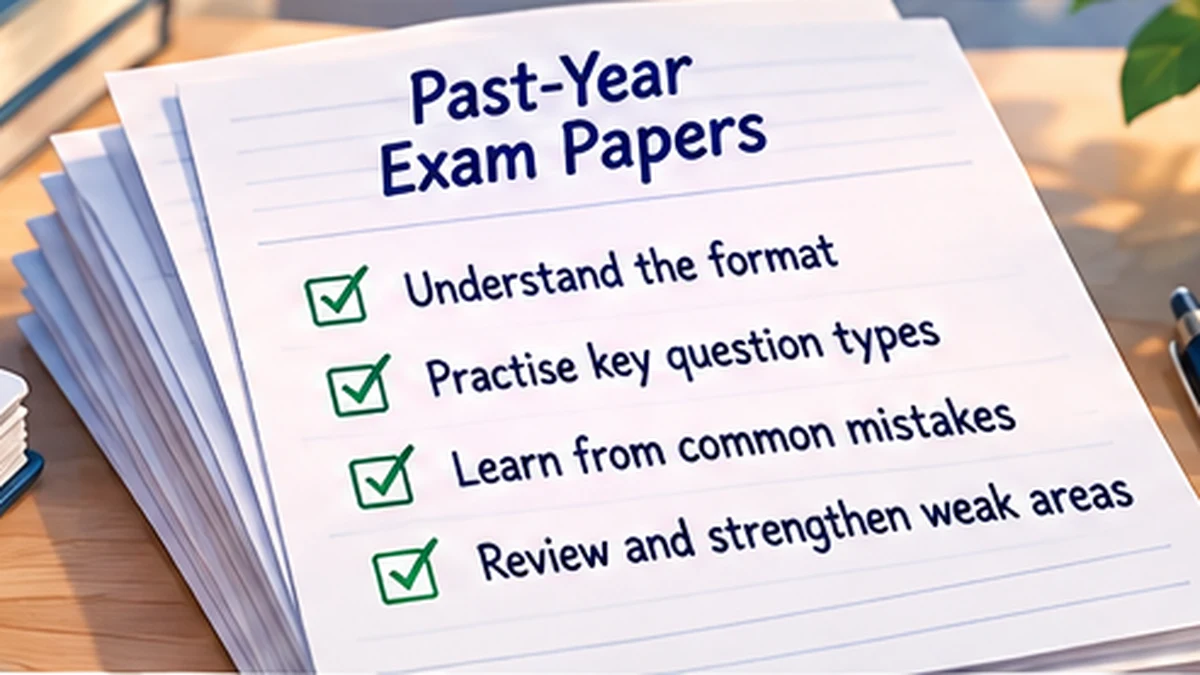
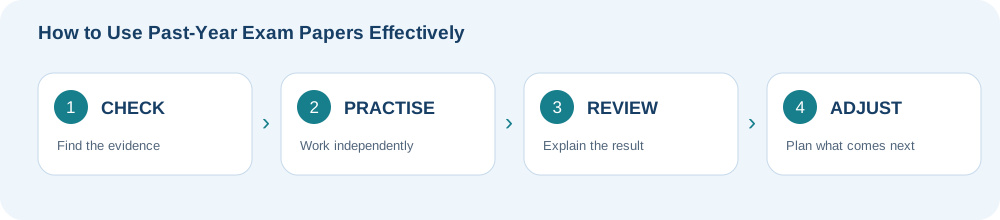
Past papers are most useful when they reveal what to improve—not when they become a race to finish more papers. A reliable routine is to check your current understanding, practise independently, review what happened and adjust your next task. Use the matching ExamDecoded tool to keep your plan practical.
What past papers are good for
Past-year papers can help you understand question formats, the range of skills tested and how you perform when topics are mixed together. They can also reveal whether you can manage time and explain answers under realistic conditions.
A past paper is not a promise that the same question will appear again. Its value comes from practising transferable knowledge and recognising recurring demands, not from predicting exact questions.
Check relevance before starting
Look at the assessment level, syllabus year, subject, paper format and available marking guidance. Older papers may include content that is no longer assessed or use a different structure. Do not assume every question is equally relevant.
If the syllabus or examination format has changed, label the paper accordingly and use suitable questions as supplementary practice rather than a direct simulation. For PSLE, follow current school and official assessment guidance. For other exams, use the current examining body requirements.
Choose the right paper for your stage
Early in revision, one diagnostic paper can identify strengths and gaps. During the middle stage, topic questions and mixed sets may be more efficient than constant full papers. Closer to the exam, full timed papers can help test pacing and readiness.
If you cannot yet solve a core method, a full paper may repeatedly expose the same weakness without fixing it. Pause, learn the concept and practise it before using another full paper to check progress.
Attempt independently before checking
When using a paper as a realistic assessment, work without looking at notes or solutions, use permitted equipment only and follow the instructions. Record whether the attempt was timed. If you are using it as learning practice instead, it is fine to work untimed—but label it honestly.
Do not switch between exam simulation and guided learning without noting the change. Both are useful, but they answer different questions about your preparation.
Use timing in stages
Strict timing is not always helpful while learning a difficult method. Start with untimed accuracy, then timed sections, then full-paper conditions. This progression helps separate knowledge problems from pacing problems.
For a full timed attempt, note where you were when each section checkpoint passed. If you consistently run out of time, examine whether you spend too long on a particular question type or leave too little time to check your answers.
Mark beyond right and wrong
After marking, flag wrong answers, uncertain correct answers and questions that took unusually long. Record marks lost by topic and by cause: knowledge gap, method error, question reading, careless execution or time pressure.
A score is a starting point. Two learners with the same mark may need different next steps. One may require a concept review; another may need a checking routine or better question ordering.
Redo mistakes before reading the full solution
Try to correct an error independently before copying the model answer. If you cannot, study the explanation, close it and attempt a similar question later. For written responses, compare your answer against the mark scheme point by point.
The goal is not to memorise a model solution. It is to understand what the question required and whether you can reproduce the correct reasoning on a new problem.
Turn findings into targeted practice
If a paper reveals repeated errors in ratio, do a focused ratio set before another full paper. If you miss instructions, practise identifying command words and conditions. If timing is the issue, use timed sections and checkpoints.
End each review with a specific next action, such as “five mixed ratio questions without notes on Wednesday”. Vague intentions like “revise more” are less likely to change your results.
Avoid inflated scores from repeated papers
Redoing an old paper can help check corrections, but familiarity with the questions may raise the score without equivalent improvement on unseen material. Use fresh or unfamiliar questions to test whether the learning transfers.
If you have limited papers, reuse selected questions after a gap, create mixed practice from different sources and keep a record of which papers you have already seen. Do not treat a repeated-paper score as directly comparable with a first attempt.
How many papers should you complete?
There is no universal target number. The right amount depends on time, syllabus coverage, access to suitable papers and how carefully you review them. Five well-reviewed papers may be more useful than ten completed without understanding the mistakes.
Measure progress through fewer repeated errors, better performance on unfamiliar questions and more reliable pacing. Use your Exam Score Tracker and error log together to see whether practice is producing useful change.
A quick self-check before your next session
Before you start, ask whether your chosen task is supported by a recent result, whether you can finish it in the time available and how you will know if it helped. If you cannot answer those questions, make the task smaller and more concrete. A short, well-defined practice set followed by a careful correction often gives clearer feedback than an ambitious session with no review.
After the session, write down one observation and one next step. You might discover that you can answer straightforward questions but struggle when the topic is mixed with others, or that you know the method but miss conditions in the wording. Those observations are more useful than a simple tick beside “revision completed”.
How to involve a parent, teacher or study partner
If someone is helping you, show them the evidence rather than asking them to decide based only on confidence. A marked paper, a short explanation of the mistake and a realistic next action make it easier to give useful feedback.
Support should not mean taking over the work. Ask the learner to explain the method and try a similar question independently. If they cannot, return to the underlying idea and try again later. The goal is greater independence, not a perfect-looking revision tracker.
What success looks like
Improvement does not always appear immediately as a dramatic score increase. It may first show up as fewer repeated errors, a better explanation, more reliable topic recognition or a shorter correction process. These are signs that the learning routine is becoming more effective.
Continue checking with unfamiliar questions and realistic conditions when appropriate. If the same error returns, that is feedback to adjust the plan, not a reason to abandon it. Small, repeated cycles of checking and correction are what make a study system useful over time.
Put It Into Practice
Choose one task from this guide and apply it during your next study session. Use your results to decide whether to continue, change approach or return to an earlier step. A useful study technique should help you make a decision, not simply add another activity to your checklist.
- What evidence tells me where I need to improve?
- Can I explain the next action in one clear sentence?
- When will I check whether the change worked?
Common Questions
Do I need to follow this method exactly?
No. The examples are practical starting points, not strict rules. Adjust the length of sessions, the questions and the review schedule to your assessment and current understanding. The important principle is to use feedback from independent practice.
What if I have very little time?
Choose one high-value task that you can complete and review properly. Avoid spending the whole session planning or copying notes. Even a short set of carefully checked questions can tell you what to do next.
How do I know whether it is working?
Look for fewer repeated mistakes, better explanations and improved performance on unfamiliar questions. Where possible, compare attempts under similar conditions rather than relying on a single score.
Can this work for PSLE and other examinations?
Yes, but adapt the details to the syllabus and question format. Maths methods, Science explanations, language comprehension and professional examination questions require different forms of practice and feedback.
Good revision is a cycle of checking, practising, reviewing and adjusting. Use the next session to address what the evidence tells you, rather than repeating the same activity automatically.
Related ExamDecoded Guides
Turn This Guide Into Action
Use the Exam Score Tracker to organise your next step and revisit your progress.