
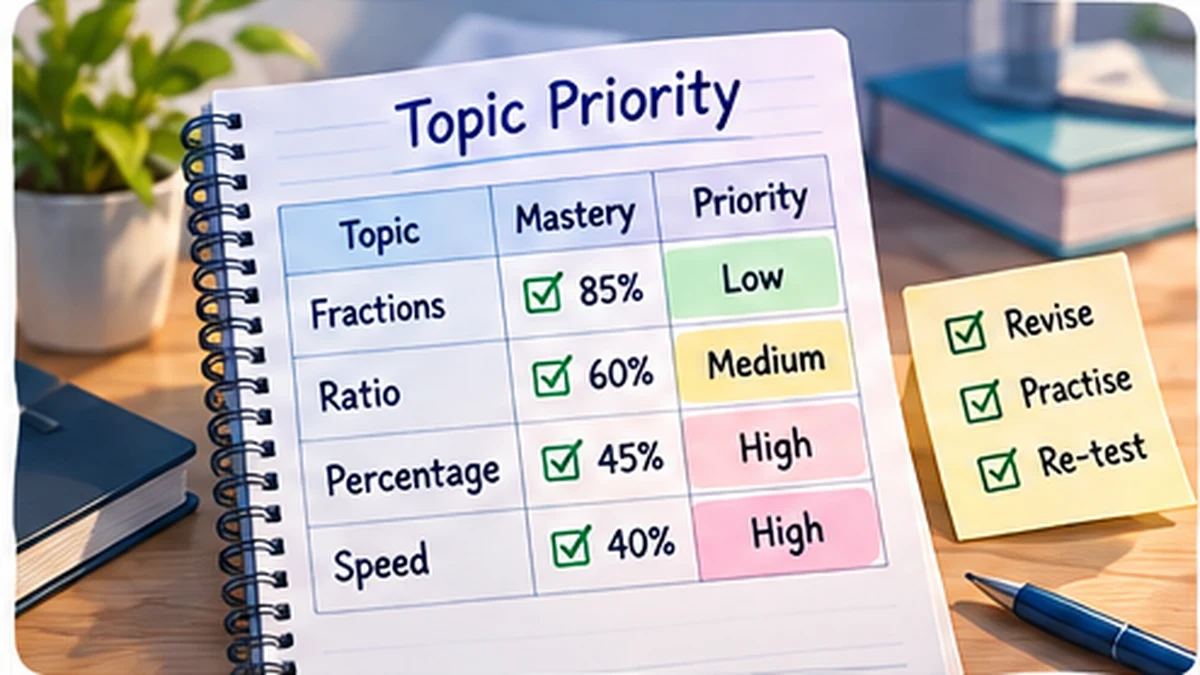
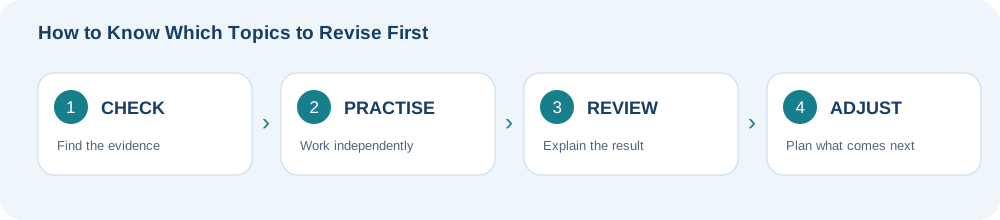
Stop guessing what to study next. Use evidence, importance and available time to choose the topics that deserve attention. A reliable routine is to check your current understanding, practise independently, review what happened and adjust your next task. Use the matching ExamDecoded tool to keep your plan practical.
Why revision priorities matter
When your list of chapters is long, treating every topic equally can feel fair but is rarely efficient. Some topics are already secure, some are unfamiliar, and others are understood only when the notes are open. A useful revision plan gives more attention to areas where additional practice is likely to make a meaningful difference.
The purpose of prioritisation is not to ignore stronger topics forever. It is to make an informed decision about the next session. A learner who spends an hour rereading a comfortable chapter may feel busy while a recurring weakness remains untouched. Start by identifying what evidence you have, not which chapter you enjoy most.
Build a complete but manageable topic list
Write down the subjects, chapters and question types that appear in your assessment. For PSLE Maths, ratio, fractions, percentages and speed may be separate entries. For Science, a broad chapter may need splitting into concepts and application questions. For English, separate comprehension, editing and synthesis rather than treating the whole subject as one skill.
Keep entries specific enough to practise. “Science” is too broad to guide a session, while a list of every tiny fact is too detailed to manage. Use your syllabus and the types of questions you actually encounter. If a school has provided a scope, use that scope rather than assuming every topic from the textbook will be assessed.
Measure mastery with evidence
Rate each topic using a short independent check. Try a few unfamiliar questions without notes, explain a key idea in your own words, or reproduce a method from memory. Compare the result with your impression of the topic. Feeling familiar after reading an example is not the same as being able to answer a fresh question.
A simple three-level rating works well: weak means you cannot yet solve representative questions reliably; developing means you can solve some but make repeatable errors; secure means you can explain and apply the topic independently. Record the date of the check, because a rating from months ago may no longer describe your current ability.
Consider importance without predicting the paper
A weak topic is not automatically the highest priority. Also consider whether it is within the tested scope, whether it underpins other topics, and how often the skill appears across different question types. Basic operations, reading instructions and interpreting information can affect many questions.
Avoid claiming to know exactly what will appear in an exam. Use published assessment requirements, school guidance and past papers to understand the format and breadth, not to gamble on particular questions. If a foundational skill is weak, improving it can unlock progress in several related topics.
Use a simple priority matrix
Combine mastery and relevance rather than relying on one score. High priority: a weak, important topic that repeatedly costs marks. Medium priority: a developing topic or a secure but important topic that needs checking. Lower priority: a secure topic with recent evidence of success.
For example, a student may score consistently well on fractions but repeatedly confuse ratio relationships. Ratio becomes the next targeted block. Fractions should still appear in mixed practice later, so confidence is checked rather than assumed. Review priorities weekly because improvement should change what comes next.
Turn priorities into a specific study block
Replace “revise ratio” with a task such as “review two ratio models, solve eight varied ratio questions without notes, and explain the mistakes”. Include time for checking. If a topic is completely unfamiliar, learn the concept before attempting a full timed paper. If the concept is understood but accuracy is inconsistent, use targeted questions.
The session should end with a decision: remain on the topic, move to mixed questions, or schedule a later recall check. A priority list without a next action is only a ranking. It becomes useful when it changes what you actually do today.
Reassess after practice
After a practice paper, classify the mistakes. A wrong answer caused by rushing may need a checking routine rather than another full lesson. A wrong method may require worked examples followed by fresh questions. A knowledge gap may need retrieval practice.
Update your mastery ratings after meaningful evidence, not after simply rereading notes. One successful attempt is encouraging but not always enough to call a topic secure. Retry similar questions later, ideally in a mixed set where the method is not obvious from the chapter heading.
Avoid common priority traps
Students often choose only the hardest topic and exhaust themselves, or choose only easy topics because they enjoy quick wins. Both extremes can be unhelpful. Another trap is spending so long colour-coding a tracker that little time remains for study.
Keep the system light: one topic list, a simple status and one next action. Mix challenging work with achievable practice and short retrieval checks. If you are overwhelmed, select one high-priority topic for the next session rather than trying to repair every weakness in one day.
A worked example for a busy week
Imagine a learner has four 40-minute sessions before a school assessment. Their recent work shows strong fractions, developing percentages, weak ratio and repeated careless unit errors in speed. A sensible plan could give two sessions to ratio, one to percentages and one mixed session that includes speed and fractions.
During the mixed session, the learner uses a short units checklist and records whether the error repeats. If ratio accuracy improves, the next week may shift toward percentage applications. The allocation is an example, not a universal ratio of hours; available time, subject requirements and personal needs will change the plan.
Use the tracker as a decision tool
The ExamDecoded Topic Mastery Tracker can help you keep your topic list and review priorities in one place. Enter realistic ratings based on independent questions, then return to the tracker after a paper or targeted set.
Treat the tracker as a guide to your next action, not as a grade on your ability. The most valuable part is the conversation it creates: which topic needs attention, what evidence supports that choice and what specific task will help?
A quick self-check before your next session
Before you start, ask whether your chosen task is supported by a recent result, whether you can finish it in the time available and how you will know if it helped. If you cannot answer those questions, make the task smaller and more concrete. A short, well-defined practice set followed by a careful correction often gives clearer feedback than an ambitious session with no review.
After the session, write down one observation and one next step. You might discover that you can answer straightforward questions but struggle when the topic is mixed with others, or that you know the method but miss conditions in the wording. Those observations are more useful than a simple tick beside “revision completed”.
How to involve a parent, teacher or study partner
If someone is helping you, show them the evidence rather than asking them to decide based only on confidence. A marked paper, a short explanation of the mistake and a realistic next action make it easier to give useful feedback.
Support should not mean taking over the work. Ask the learner to explain the method and try a similar question independently. If they cannot, return to the underlying idea and try again later. The goal is greater independence, not a perfect-looking revision tracker.
What success looks like
Improvement does not always appear immediately as a dramatic score increase. It may first show up as fewer repeated errors, a better explanation, more reliable topic recognition or a shorter correction process. These are signs that the learning routine is becoming more effective.
Continue checking with unfamiliar questions and realistic conditions when appropriate. If the same error returns, that is feedback to adjust the plan, not a reason to abandon it. Small, repeated cycles of checking and correction are what make a study system useful over time.
Put It Into Practice
Choose one task from this guide and apply it during your next study session. Use your results to decide whether to continue, change approach or return to an earlier step. A useful study technique should help you make a decision, not simply add another activity to your checklist.
- What evidence tells me where I need to improve?
- Can I explain the next action in one clear sentence?
- When will I check whether the change worked?
Common Questions
Do I need to follow this method exactly?
No. The examples are practical starting points, not strict rules. Adjust the length of sessions, the questions and the review schedule to your assessment and current understanding. The important principle is to use feedback from independent practice.
What if I have very little time?
Choose one high-value task that you can complete and review properly. Avoid spending the whole session planning or copying notes. Even a short set of carefully checked questions can tell you what to do next.
How do I know whether it is working?
Look for fewer repeated mistakes, better explanations and improved performance on unfamiliar questions. Where possible, compare attempts under similar conditions rather than relying on a single score.
Can this work for PSLE and other examinations?
Yes, but adapt the details to the syllabus and question format. Maths methods, Science explanations, language comprehension and professional examination questions require different forms of practice and feedback.
Good revision is a cycle of checking, practising, reviewing and adjusting. Use the next session to address what the evidence tells you, rather than repeating the same activity automatically.
Related ExamDecoded Guides
Turn This Guide Into Action
Use the Topic Mastery Tracker to organise your next step and revisit your progress.