

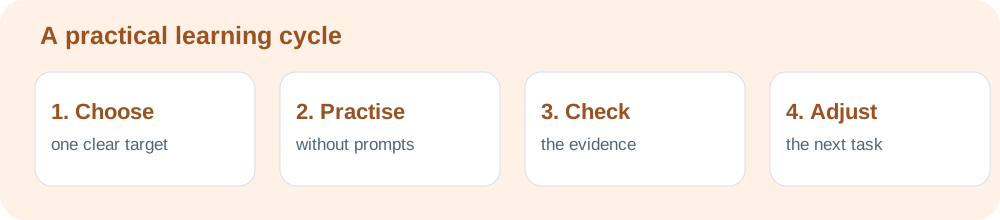
Help children plan, practise and reflect while protecting independence and confidence. Choose one clear task, practise independently, check the evidence and make a realistic adjustment for the next session.
Support is not the same as taking control
Parents can make revision easier by helping with routines, materials and encouragement. But deciding every task, checking every answer immediately or demanding constant progress reports can prevent a child from learning how to manage their own work. The aim is to build a student who can identify a weak topic, choose a useful practice task and explain what changed after reviewing mistakes.
A helpful starting question is 'What are you planning to work on, and how will you know it helped?' This invites the student to make a decision. If the plan is unrealistic, offer two options rather than replacing it with an adult-designed timetable. Shared planning should gradually give way to greater independence.
Agree on a small weekly plan together
Choose a quiet time to review upcoming assessments, homework and activities. Ask the student to identify two or three priorities, then check whether the plan fits the available time. Include breaks, sleep, school commitments and family activities. A schedule that only works on paper will quickly become a source of conflict.
For example, if Science open-ended responses are a recurring weakness, the plan might include two short practice sessions and one review of corrected answers. The parent can help protect those time slots without supervising every minute. Keep the plan visible and allow the student to update it when schoolwork changes.
Use questions that promote thinking
When a child asks for the answer, try 'What have you tried?' or 'Which part of the question is unclear?' Ask them to explain the method in their own words. If they are stuck, help identify the missing concept or refer to a worked example, then let them attempt a similar question independently. Giving the full solution too early may produce a completed worksheet without improving understanding.
In Mathematics, ask why a particular operation was chosen. In Science, ask which observation supports the explanation. In English comprehension, ask which phrase in the passage supports the answer. These questions are more useful than repeatedly asking whether the child is sure.
Respond constructively to disappointing marks
A low score is information, not a verdict on ability. Start by distinguishing unfamiliar content, careless slips, misunderstood questions and timing problems. These causes require different responses. If the same type of error appears repeatedly, agree on one correction strategy and check it with a fresh question later.
Avoid comparing siblings or classmates. Such comparisons rarely tell a learner what to practise next. Instead, look for progress within the student's own work: fewer repeated mistakes, clearer explanations or improved completion of timed sections. Celebrate the process that produced the improvement rather than only the final mark.
Make revision conversations brief and predictable
A five-minute check-in can be more productive than frequent interruptions. Ask what was completed, what was difficult and what the next step will be. If the child is already using an error log or tracker, review it together once or twice a week rather than demanding updates after every question.
Agree on boundaries for help. A student might work independently for twenty minutes, flag uncertain questions and then ask for support. Parents can provide materials, encourage breaks and notice fatigue. If the child becomes upset or overwhelmed, reduce the immediate task and return to the plan when they are ready.
When to involve a teacher
Parents do not need to become experts in every subject. If an explanation remains confusing, or repeated attempts show the same misconception, write down the exact question and the step where the student becomes stuck. Share that specific information with the teacher. 'She understands the example but cannot choose the correct operation in word problems' is more actionable than 'She is weak in Maths.'
Teachers can also clarify whether an assessment expects particular terminology or a specific response format. Use that feedback to adjust practice. The parent’s role is to support the learning process, not to replace professional instruction.
Practical exercise: a ten-minute weekly check-in
Invite the student to bring one completed task and one mistake they corrected. Ask them to explain the mistake and what they will try next week. Together, choose a realistic revision target and decide when to check progress. End by asking what support would help: a quiet space, a reminder, a practice paper or simply uninterrupted time.
A useful result might be: 'On Tuesday I will practise four fraction word problems and explain why I chose each operation. On Saturday I will retry two similar questions without help.' This keeps ownership with the student while making the next step concrete.
Common Questions
How often should I use this approach?
Use it whenever you work on how parents can support exam revision without micromanaging. Start with a manageable session, review what happened and adjust the routine to the subject and assessment.
What if the first attempt does not work?
Look at the specific point of difficulty rather than repeating the whole session unchanged. Choose one smaller task, check a worked example or ask for targeted feedback, then try a fresh question independently.
How will I know I am improving?
Look for evidence: more accurate answers on comparable questions, clearer explanations without notes, fewer repeated errors or better pacing. A completed checklist alone is not proof of learning.
Protect independence as examinations approach
In the final weeks before an exam, it is tempting to increase supervision. Instead, agree on a small number of priorities and ask the student to show one completed correction or explain one concept independently. A parent can help with logistics and reassurance while the student remains responsible for practising.
If discussions about revision repeatedly become arguments, shorten the check-in and choose a calmer time. It may help to ask a teacher to clarify expectations or identify the most important topic. A sustainable routine matters more than winning a disagreement over one worksheet.
Example: discussing a disappointing Maths result
A parent notices that several marks were lost on multi-step word problems. Instead of assigning an extra hour every evening, they ask the student to explain one missed question. Together they discover the student chose the wrong total. They agree to underline the quantity being asked for and check two new questions later in the week.