
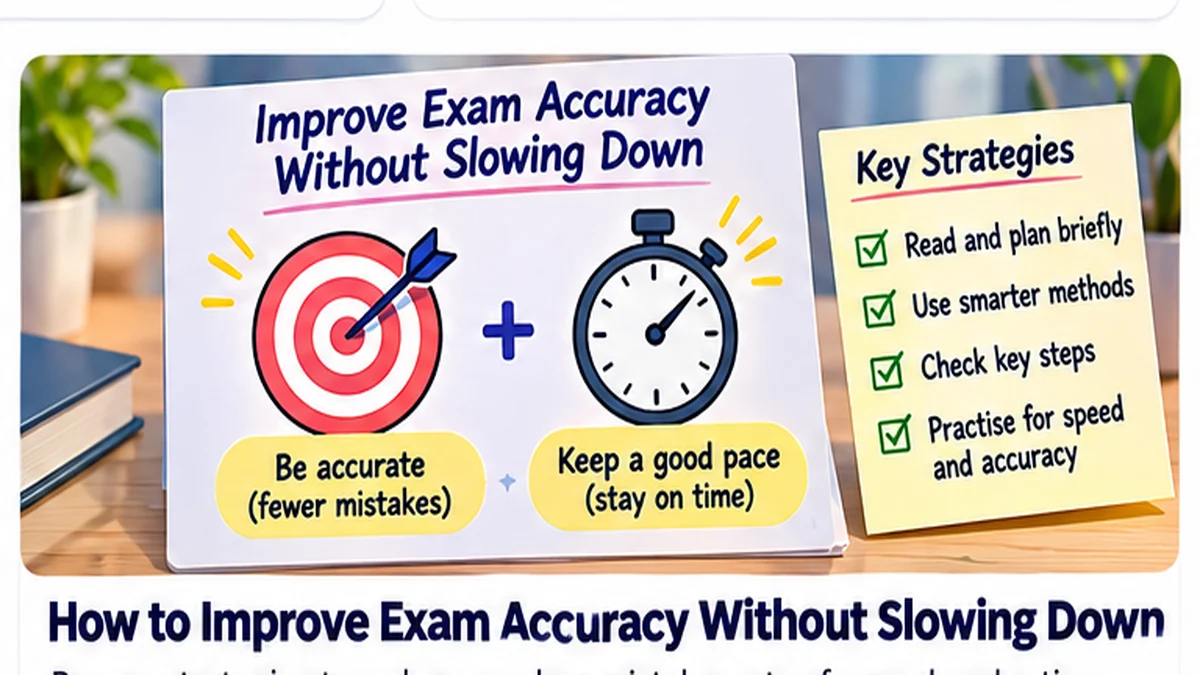
Reduce avoidable mistakes while keeping a realistic pace through timed exam questions. Start with a specific task, test what you can do independently, check the result and use the evidence to plan your next session.
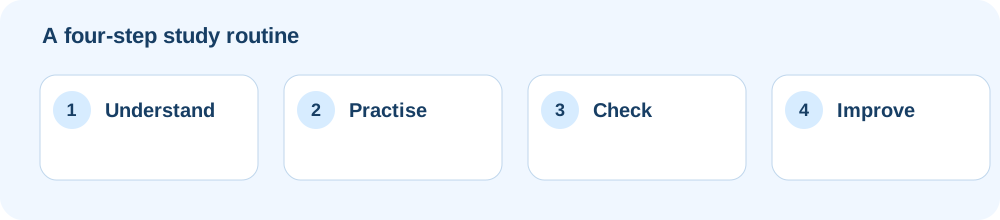
Accuracy and speed are not opposites
Rushing can create errors, but checking every step repeatedly can also consume the time needed for later questions. The aim is not to work as fast as possible; it is to use a reliable method with fewer unnecessary pauses.
Students often gain speed when they stop repeating work, recognise question types more quickly and check only the steps most likely to go wrong. Good accuracy habits can become efficient through deliberate practice.
Find out where your time goes
Time a small set of familiar and unfamiliar questions. Record how long you spent reading, solving and checking. Also note whether you changed a correct answer unnecessarily or spent too long on one difficult step.
A student who takes 12 minutes to solve a four-minute question may need a clearer method, not faster handwriting. Another student who finishes early but loses marks to misread conditions may need a brief reading routine.
Read for the decision before solving
Before writing, identify what the question asks, the important conditions and the required answer format. A few seconds spent noticing “not”, “difference”, “nearest whole number” or “explain why” can prevent a longer correction later.
Do not underline every word. Mark only the details that affect your method or final answer. Excessive annotation can become another form of delay.
Use standard methods for familiar tasks
Practise a dependable sequence for common question types. For example, a Maths word problem might follow: identify quantities, choose a relationship, calculate, check units. When the sequence becomes familiar, you spend less time deciding what to do next.
However, a memorised template must not replace reading the actual question. If the problem contains an exception or a new condition, adapt the method instead of forcing the familiar pattern.
Check strategically, not endlessly
Choose checks that target frequent errors: estimate whether the answer is reasonable, verify units, substitute a value back into an equation or reread a negative instruction. A targeted check can be more useful than solving everything again.
Reserve deeper checking for high-mark questions, unusual answers or steps where you know you are prone to mistakes. Do not change an answer merely because it feels too easy; change it when you find evidence of an error.
Use checkpoints and move-on rules
Divide a timed paper into broad sections and set approximate checkpoints. If one question consumes too much time, mark it and move on when the exam format permits. Returning later with a fresh view may be more productive.
The right time allocation depends on the paper and marks. Practise with your actual exam format rather than copying someone else’s minute-per-question rule.
Worked example: 20-minute practice set
Imagine ten mixed questions in a 20-minute practice set. First attempt: 18 minutes solving, two minutes checking, seven correct. Review shows two mistakes came from missed units and one from misreading “except”.
Second attempt with a new set: spend a few seconds marking the requested output, use a short units check after calculations and reserve two minutes for flagged questions. Compare both accuracy and completion rate. The goal is improved performance, not simply a shorter time.
A practical exercise: accuracy ladder
Complete three comparable sets of five questions. First set: untimed, focusing on correct method. Second: timed with a comfortable limit. Third: timed under realistic conditions. Record score, duration and the type of each mistake.
If accuracy collapses under time pressure, lengthen the limit and rebuild gradually. If accuracy remains high, shorten the limit slightly or increase question complexity. Avoid chasing speed at the expense of understanding.
What to do on exam day
Use the first few seconds of a question to identify the task, then work steadily. Keep working visible enough to spot errors, use strategic checks and avoid getting trapped on one problem.
If you feel rushed, focus on the next concrete step rather than the clock alone. A consistent process is usually more reliable than sudden changes to your approach during the exam.
Helpful reminder: Speed should be measured alongside accuracy. When you compare practice sets, use similar question difficulty and marking standards. A faster result on an easier set does not prove improvement. Record the number attempted, number correct, time used and types of errors, then adjust only one habit at a time so you can tell what made the difference.
Put it into practice today
Choose one manageable task from this guide and complete it without looking at the answer first. Record what happened, including any uncertainty or repeated error. Decide what to practise next based on that evidence rather than how busy the session felt.
- Can I name the exact skill I am working on?
- Have I tested it independently, not only read an explanation?
- What will I change or repeat in my next session?
Frequently asked questions
How long should I practise this method?
Start with a short session you can complete and review. The appropriate duration depends on the task, the learner and the upcoming assessment. Increase time only when the work remains focused and productive.
How can I tell whether I am improving?
Compare performance on fresh questions, the clarity of your explanations and the frequency of repeated mistakes. A technique is useful when it helps you answer independently, not merely when the notes feel familiar.
What if I still struggle after trying this?
Reduce the task to a smaller prerequisite skill, study a worked example and ask a teacher for feedback on the specific step that is unclear. Then try a new question to check whether the explanation helped.