
Build a distraction-resistant study routine with clear goals, sensible breaks and evidence of progress. Choose one clear task, practise independently, check the evidence and make a realistic adjustment for the next session.
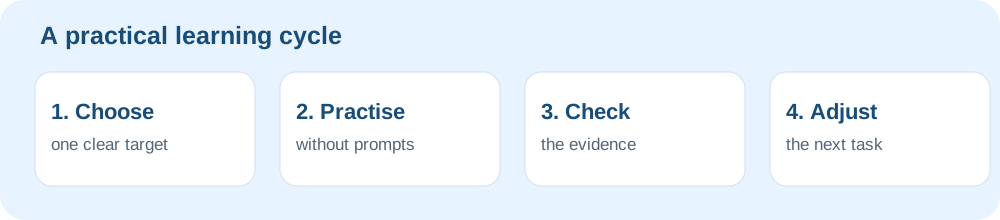
Why focus fails even when you want to study
A revision session can fail before it begins if the goal is simply 'study Science'. That instruction leaves you deciding what to do every few minutes. Notifications, open tabs and the temptation to tidy your notes compete for attention because none has a clear stopping point. Define an outcome instead: explain the water cycle without notes, complete six fraction questions, or correct three errors from yesterday. A specific target reduces the number of decisions you make while working.
Focus is also affected by fatigue, hunger, interruptions and task difficulty. A learner who keeps switching to another activity may be avoiding a question that feels too difficult, not merely lacking discipline. Notice the moment attention slips. Was the question unclear? Did you reach for your phone? Were you studying too long without a break? The remedy depends on the cause.
Prepare the environment before the timer starts
Choose the materials for one task: worksheet, pen, calculator if permitted and a small sheet for questions to ask later. Put unrelated books away. Silence notifications or place the phone out of reach. If you need a device, close unrelated tabs and keep the task visible. Tell family members the intended study window where possible; if the environment is shared, agree on a realistic quiet period rather than expecting perfect silence.
Write the next action at the top of the page. For example, 'Attempt questions 1–8 independently; mark and explain two errors.' Keep a separate 'later' list for thoughts that interrupt you. Writing 'look up school timetable' on that list takes seconds and prevents an unrelated search from consuming the session.
Match session length to the task
There is no magic duration that suits every student. A younger learner tackling unfamiliar material may benefit from a short focused block; an older student writing a timed response may need a longer uninterrupted period. Start with a length you can sustain, such as 20–30 minutes, then take a short break. Increase duration only when the task genuinely requires it and your accuracy remains stable.
Breaks should help you return. Stand up, stretch, drink water or look away from the screen. A break spent scrolling a stream of short videos may be harder to end than a simple walk. Decide the restart time before the break begins. If the session ends early, record what was completed instead of filling the remaining time with unplanned tasks.
Use a three-part session
First, spend two minutes recalling the previous lesson and choosing the outcome. Next, work without checking answers after every line unless the method requires immediate feedback. Finally, use five minutes to mark, correct and decide what needs another attempt. This structure turns a timer into a learning routine rather than a countdown that measures time spent sitting at a desk.
For a 30-minute Mathematics session, you might recall the fraction rules for three minutes, attempt six mixed questions for twenty minutes and spend seven minutes checking calculations and recording the step where a mistake occurred. The number of questions is less important than having enough time to learn from the result.
Recover from distractions without restarting everything
If you catch yourself drifting, pause and identify the next physical action: read the question again, underline the command word, write the first equation or say the definition aloud. Avoid treating one interruption as proof that the whole session is ruined. Resume from the nearest meaningful step. If a particular distraction repeats, change the environment before the next session.
Some tasks are difficult because prerequisite knowledge is missing. If you cannot begin a question after a reasonable attempt, examine one worked example, identify the missing step and try a similar question independently. Focus improves when the task is challenging but possible, not when you stare at an impossible problem for half an hour.
Measure focus by learning, not minutes
At the end of the session, record three items: what you attempted, what you could do without help and what needs another attempt. Compare those outcomes across several sessions. If you completed many pages but cannot explain the topic, the session was busy rather than effective. If you corrected one recurring misconception and can now solve a fresh question, that may be meaningful progress.
Track interruptions only if it helps you make a change. A simple tally can reveal that checking messages is the main issue. Do not turn the tally into another task that distracts you. The purpose is to improve the next session, not to score your concentration as good or bad.
Practical exercise: design tomorrow’s focused block
Choose one weak topic and write a measurable target. Prepare only the materials needed and choose a realistic start time. During the block, keep a small 'later' list for unrelated thoughts. At the end, attempt one fresh question without notes. If you cannot complete it, identify whether the problem was attention, knowledge or timing and adjust one thing for the next session.
Example: 'Tomorrow at 4:30 pm, I will attempt five Science questions about forces, mark them and rewrite one explanation using the correct scientific terms.' This plan is stronger than 'revise Science for one hour' because it specifies the action, evidence and next step.
Common Questions
How often should I use this approach?
Use it whenever you work on stay focused during revision sessions. Start with a manageable session, review what happened and adjust the routine to the subject and assessment.
What if the first attempt does not work?
Look at the specific point of difficulty rather than repeating the whole session unchanged. Choose one smaller task, check a worked example or ask for targeted feedback, then try a fresh question independently.
How will I know I am improving?
Look for evidence: more accurate answers on comparable questions, clearer explanations without notes, fewer repeated errors or better pacing. A completed checklist alone is not proof of learning.
Use focus skills across different subjects
In English comprehension, the outcome may be to support two answers with phrases from the passage. In Maths, it may be to show every step and verify units. In Science, it may be to explain a relationship using the correct vocabulary. The focus routine stays similar, but the evidence of success changes with the subject. This is why choosing a specific target matters more than following a fixed number of minutes.
When revision is interrupted by homework or family commitments, keep the next session small. Resume with a two-minute recall of the previous attempt, then complete the unfinished correction. You do not need to restart an entire study plan because one block was disrupted.
Example: a distracted Science revision session
A student plans to memorise the digestive system but keeps reopening notes. They change the task: label a blank diagram, check missing labels and explain one function aloud. The next day they repeat the diagram without prompts. The work is now measurable and requires retrieval, which makes it easier to notice when attention drifts.