

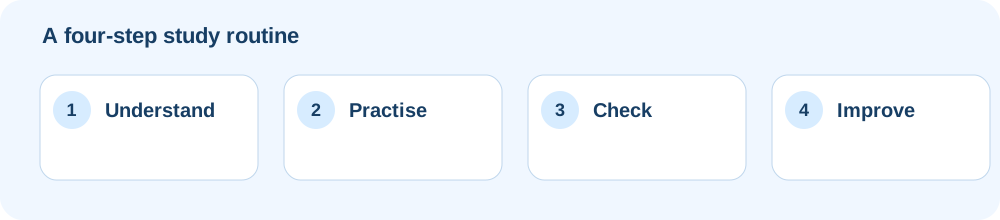
Build a manageable multi-subject study plan without neglecting weak topics or sacrificing rest. Start with a specific task, test what you can do independently, check the result and use the evidence to plan your next session.
Why too many subjects feels overwhelming
The difficulty is not simply the number of textbooks. Each subject competes for attention, and a vague goal such as “revise everything” makes it hard to decide what to do first. Students often spend the most time on the subject they enjoy, while harder chapters remain untouched. A useful plan turns the workload into visible tasks with realistic durations.
You do not need to give every subject equal time every day. You do need a way to notice when a subject has been ignored and when a weak topic needs additional attention. Planning is a decision tool, not a promise that every day will run perfectly.
Make a subject inventory before making a timetable
Write every subject in a table. For each one, list the next assessment date, the chapters tested, recent results and the type of work needed. “Science: revise” is too broad; “Science: explain how heat travels through a metal spoon, then answer four unfamiliar questions” is actionable.
Separate knowledge gaps from exam-technique gaps. If you know a Maths method but repeatedly lose marks through incorrect units, another hour of reading the chapter will not fix the main problem. Instead, schedule a small practice set with an explicit units check.
Rank subjects by need, not by anxiety
Start with evidence: marked work, teacher feedback and independent questions. Give higher priority to a weak topic that appears frequently or is a prerequisite for later learning. Keep stronger subjects on a maintenance schedule so they do not fade.
Avoid letting one difficult paper dictate your entire week. Look for patterns across more than one attempt. A student who struggles with fractions in three sets of questions has a clearer priority than someone who makes one isolated mistake in a familiar topic.
Use a two-layer timetable
Plan the week first: assign subjects to study blocks based on deadlines and priorities. Then decide the exact task for each block the evening before. This approach gives structure without requiring you to predict every small activity seven days ahead.
For example, Monday might contain 30 minutes of Maths corrections and 25 minutes of English comprehension. Tuesday might contain 30 minutes of Science explanations and 25 minutes of Mother Tongue vocabulary retrieval. The exact split is illustrative; adjust it to your available time and concentration.
Mix subjects deliberately
Switching between subjects can reduce fatigue, but constant switching prevents deep work. Finish one meaningful task before changing subject. For a 60-minute session, you could spend 25 minutes on a weak Maths skill, take a short break, then spend 25 minutes retrieving Science concepts.
When two subjects demand similar mental effort, alternate a problem-solving block with a language or memory block. If you are working on a particularly difficult concept, give it a longer uninterrupted block rather than forcing a change just because the clock says so.
Protect review and catch-up time
A plan that fills every available minute will fail as soon as homework runs late or a topic takes longer than expected. Reserve at least one flexible block each week for unfinished tasks and reviewing mistakes.
Treat rest as part of the plan. When tiredness makes practice unproductive, shorten the session and complete a smaller high-value task. Completing a realistic plan repeatedly is better than designing an ambitious plan you abandon after two days.
Worked example: four subjects, one evening
Suppose a learner has 90 minutes after dinner and has weak Maths ratio skills, a Science test next week, an English comprehension assignment and Mother Tongue vocabulary to maintain. A possible plan is 30 minutes of ratio questions, 25 minutes of Science retrieval, 20 minutes of English correction and 10 minutes of vocabulary, with a short break.
The learner should write the exact questions or concepts beside each block. At the end, record what was completed and move any unfinished work into the flexible slot. Do not simply copy the same overloaded list into tomorrow.
A practical exercise: build a three-day trial
Choose three upcoming study days. List one high-priority task and one maintenance task for each day, with estimated times. Keep a 10-minute buffer and define what success looks like: for example, correctly solve four fresh questions without notes.
After three days, compare planned and actual time. If a 20-minute task consistently takes 40 minutes, adjust the plan rather than blaming yourself for not following it. Use the results to design the following week.
Common mistakes to avoid
Do not allocate time solely by the number of subjects, revise only favourite topics, or count hours without checking what you learned. Avoid vague tasks such as “finish Science” and excessive colour-coding that consumes the time intended for study.
Do not mistake a full timetable for a useful timetable. The measure is whether you can explain more, answer unfamiliar questions more reliably and identify what to practise next.
Put it into practice today
Choose one manageable task from this guide and complete it without looking at the answer first. Record what happened, including any uncertainty or repeated error. Decide what to practise next based on that evidence rather than how busy the session felt.
- Can I name the exact skill I am working on?
- Have I tested it independently, not only read an explanation?
- What will I change or repeat in my next session?
Frequently asked questions
How long should I practise this method?
Start with a short session you can complete and review. The appropriate duration depends on the task, the learner and the upcoming assessment. Increase time only when the work remains focused and productive.
How can I tell whether I am improving?
Compare performance on fresh questions, the clarity of your explanations and the frequency of repeated mistakes. A technique is useful when it helps you answer independently, not merely when the notes feel familiar.
What if I still struggle after trying this?
Reduce the task to a smaller prerequisite skill, study a worked example and ask a teacher for feedback on the specific step that is unclear. Then try a new question to check whether the explanation helped.