
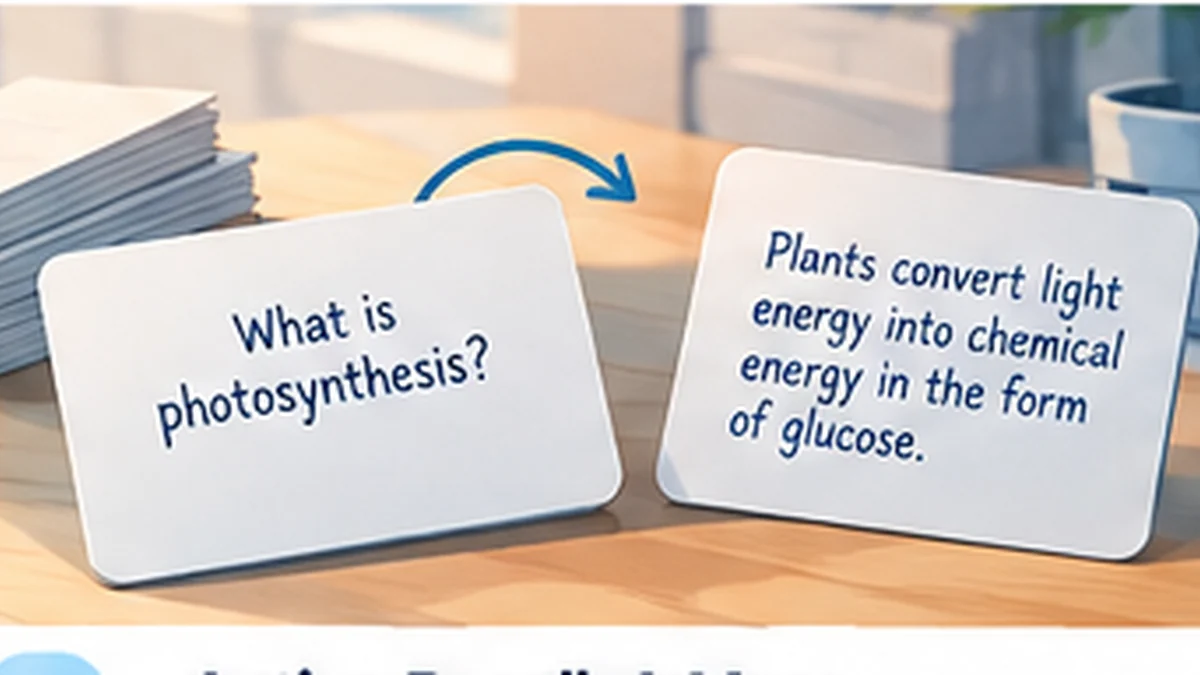
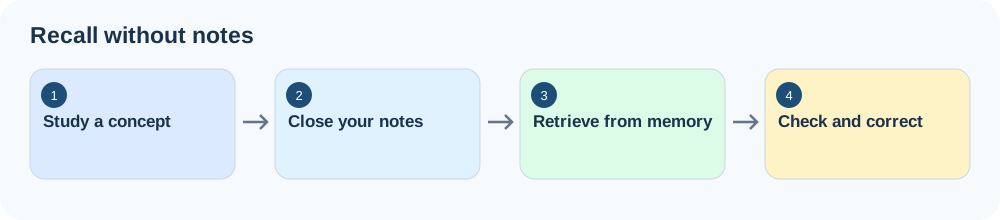
Active recall is the habit of retrieving information before looking at the answer. Study a concept, close your notes, attempt an explanation or question, check the result and repeat after a gap.
Practise retrieving knowledge, checking your answers and applying what you remember in exam-style questions. This guide shows how to use the strategy during ordinary revision and how to check whether it is improving your exam preparation.
1. Why active recall matters
Reading a familiar paragraph can create a strong feeling of understanding even when you cannot explain the idea without looking. Active recall changes the task. You deliberately hide the information and try to produce an answer, explanation, diagram or solution from memory. That attempt makes gaps visible. It also gives you something concrete to check against the source. The goal is not to make every attempt perfect; it is to practise retrieving accurate information and learning from what you miss.
For example, after studying the water cycle, close the textbook and draw the stages from memory. Label evaporation, condensation and precipitation. Reopen the textbook and compare your drawing. The missing arrows and explanations are now your next revision targets.
2. The four-step recall cycle
Start with a small, clearly defined learning goal. Read or watch enough to understand the concept, then put the material away. Ask a question that requires you to produce an answer. Finally, check your response carefully and correct the gaps. This sequence is more informative than simply rereading the same page until it feels familiar. You can use it with formulas, vocabulary, processes, historical events and explanation questions.
Try this sequence: study one concept for five minutes; close your notes; write everything you can explain in two minutes; compare your answer with the original; write one correction in a different colour. Repeat later rather than immediately copying the full page.
3. Choose a recall method that fits the subject
Not every subject is best revised with the same type of flashcard. For Maths, solve an unfamiliar question without referring to a worked example. For Science, explain cause and effect using correct terms. For English or Chinese, retrieve a grammar rule and apply it to a new sentence. For essay-based topics, create an outline from memory and check whether you included the required evidence. The essential feature is independent retrieval before seeing the answer.
A Science question might ask why a shadow changes length during the day. Do not only memorise a definition of a shadow; explain the relationship between the position of the light source and the resulting shadow. Then check your explanation for scientific accuracy.
4. Use questions instead of copying notes
Turn a heading into a useful prompt. A heading such as “Series and Parallel Circuits” can become “How does current behave in a simple series circuit?” and “What happens when one bulb is removed?” Avoid vague prompts like “Know electricity”. A good prompt tells you what a successful answer must include. Questions can be written on paper, in a spreadsheet or on physical cards. Keep them short enough to answer and specific enough to mark.
For a chapter on fractions, create three prompts: “How do I compare unlike denominators?”, “When do I simplify?” and “How can I check whether an answer is reasonable?” These reveal different kinds of understanding instead of testing a single memorised line.
5. Check your answer with reliable feedback
Recall alone is not enough if you repeatedly practise an incorrect explanation. After each attempt, compare your answer with your teacher’s notes, textbook, worked solution or mark scheme. Identify whether the missing part is a fact, a method, an example or a keyword. Rewrite only the correction, then try the question again without looking. If you cannot explain why the corrected answer works, return briefly to learning before testing yourself again.
Suppose you remember the area formula but use the wrong dimensions. Your error may be in interpreting the diagram, not remembering the formula. Record the true cause so that your next practice task addresses the right problem.
6. Make retrieval challenging but manageable
If you can answer every question immediately, add an application question or wait longer before the next attempt. If you cannot retrieve anything, reduce the amount of material or use a small cue. Useful retrieval requires effort, but it should still lead to meaningful feedback. A cue might be the first word of a definition, the title of a process or a partially completed diagram. Gradually remove the cue as you improve.
Imagine learning ten new terms. Rather than testing all ten until you feel defeated, start with three. Once you can explain them, add another small set. Mix the old and new terms in a later session to check whether recall remains independent.
7. Combine recall with spaced repetition
A strong answer immediately after studying does not guarantee that you will remember it next week. Return to the same idea after a gap and try to retrieve it again. Shorten the gap when you struggle; extend it when you can answer accurately and explain why. There is no universally correct sequence of review days. Your own recall results and the time remaining before the exam should guide the schedule.
Use the free Spaced Repetition Tracker to organise your review dates. Pair it with Spaced Repetition Explained to understand how to adjust the intervals.
8. Avoid common active-recall mistakes
Do not leave your notes open while answering and then count that as independent recall. Do not treat a familiar-looking flashcard as proof of mastery if you cannot explain the answer. Avoid endlessly testing isolated facts when the examination requires application and reasoning. Do not skip checking because the answer feels right. Finally, do not spend so long designing elaborate flashcards that you never use them. The method should be simple enough to repeat.
A student might recognise the phrase “heat transfer” on a flashcard yet struggle to explain a real experiment. Improve the card by asking for a prediction and explanation, not just a definition.
9. A realistic 15-minute session
Spend three minutes selecting two or three questions from a topic you have already studied. Spend seven minutes answering them without notes. Use three minutes to check each response and identify the precise gap. Use the final two minutes to decide which question to retry later. If the topic is new, learn it properly first; retrieval should support understanding, not replace it.
After a session on ratio, your next action might be “Retry two comparison questions on Thursday without notes”. That is more useful than writing “Revise ratio again” with no clear task.
10. How to tell whether it is working
Look for evidence that you can answer questions without cues after several days, explain ideas in your own words and apply them to unfamiliar examples. Track repeated mistakes rather than judging progress by how easy the session felt. If you remember definitions but cannot solve exam questions, switch part of your recall practice to application. If your answers remain inaccurate, return to the concept and check whether the source explanation is understood.
You can combine your results with the Topic Mastery Tracker. Mark a topic as stronger only after you can retrieve and apply it independently, not merely because you have reread it several times.
Put It Into Practice: Your Next Study Session
Choose one recent question or topic where your performance was weaker than expected. Apply the steps from this guide, check your result against a reliable source and write one specific follow-up action. Repeat the check on a different day or with a new question so that improvement reflects genuine understanding rather than familiarity.
- What was the exact problem I wanted to improve?
- Which strategy did I test, and what evidence did it produce?
- What is the smallest useful follow-up task I can schedule?
Common Questions
Is active recall just memorisation?
No. It can test factual memory, but strong recall practice also includes explanations, calculations and applying knowledge to unfamiliar problems.
Should I check my answer immediately?
Check after making a genuine attempt. Accurate feedback helps prevent practising the same mistake.
Do I need flashcards?
No. Blank-sheet explanations, diagrams and exam questions can all involve retrieval.
How often should I revisit a question?
Return after a gap and adjust the interval based on how accurately you can answer without cues.
Progress comes from choosing the right next action, practising it independently and reviewing the evidence. Use this guide as a repeatable routine, not a one-time checklist.