
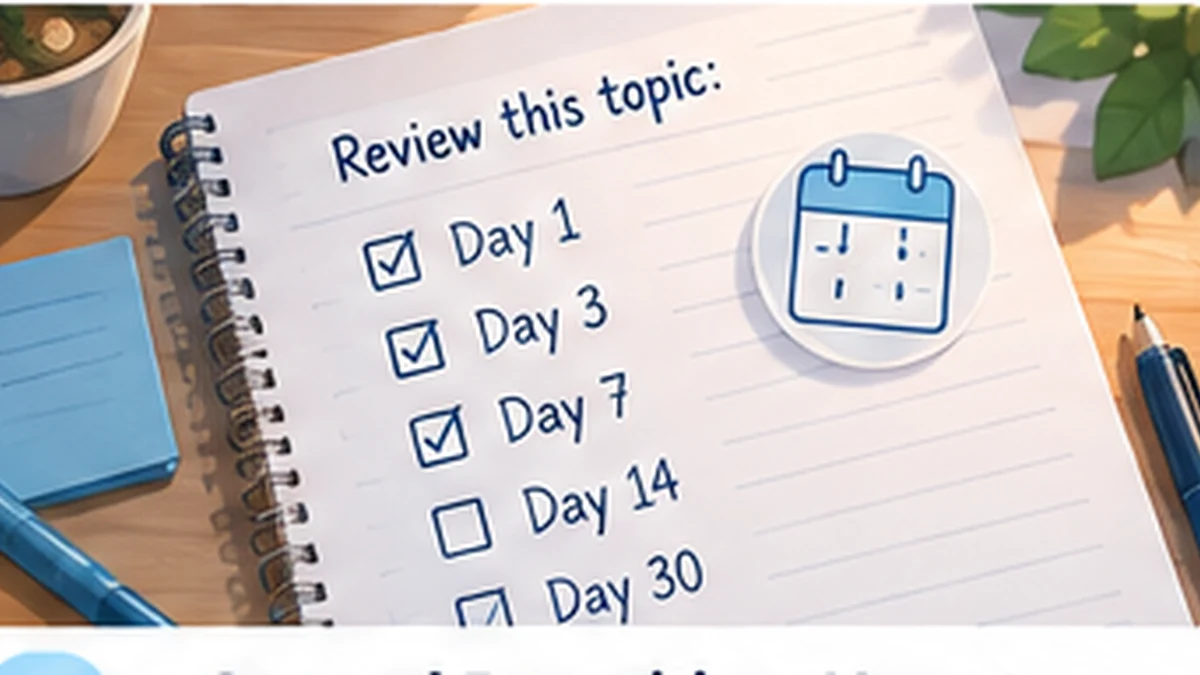
Spaced repetition means returning to learning after a gap instead of repeating it several times in one sitting. The aim is not to follow a perfect Day 1–3–7–14 formula. Review sooner when recall is weak and extend the gap when you can retrieve and apply the material reliably. At each review, try to recall first and check afterwards.
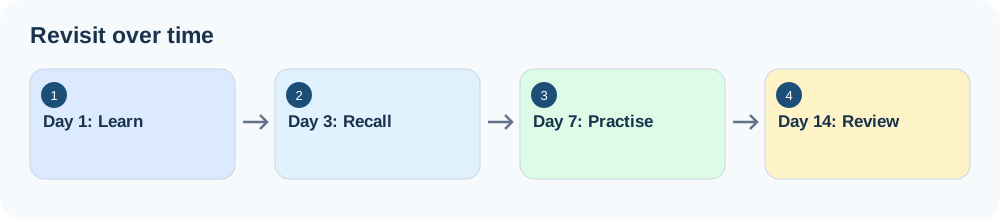
Have you ever revised a topic until it felt completely familiar, only to struggle to remember it a week later? That is one reason repeated rereading in a single session can be misleading: the material is still fresh.
Spaced repetition takes a different approach. Instead of trying to make learning permanent in one sitting, you return to it across multiple sessions and check whether you can still retrieve it.
What Is Spaced Repetition?
Spaced repetition is a way of distributing reviews over time. Rather than studying the same material repeatedly back-to-back, you leave a gap before returning to it.
Research on the spacing effect has repeatedly found better long-term retention from distributed rather than massed study. Importantly, the most useful spacing depends partly on how long the information needs to be retained, so there is no universal interval that fits every topic or learner.
Learn → wait → retrieve → check → adjust the next gap.
If recall is difficult or incorrect, review sooner. If recall is accurate and confident, allow a longer gap before the next check.
Why the Gap Matters
Reviewing immediately can feel easy because the information is still available in short-term memory or remains very familiar. A later review asks a more useful question: can you retrieve this after some time has passed?
The gap should create some challenge without making the material completely inaccessible. This is also why spacing works particularly well when each review includes active recall rather than only rereading.
There Is No Magic 1–3–7–14 Schedule
You may see fixed schedules online such as “review on Day 1, Day 3, Day 7 and Day 14”. These can be convenient starting points, but they should not be treated as scientific rules.
The useful interval changes with the difficulty of the material, how well you already know it and how far away the exam or required recall is. Research has also found that the spacing associated with stronger retention changes with the final retention interval.
A Simple Starting Schedule
If you want a structure while you learn how your own recall behaves, try this as a starting framework:
| Review | Example timing | What to do |
|---|---|---|
| Learn | Day 0 | Understand the idea and attempt an initial question or recall. |
| Review 1 | About 2–3 days later | Recall without notes first, then check. |
| Review 2 | About 1 week later | Explain or apply it again, preferably with a different question. |
| Review 3 | About 2 weeks later | Test it in mixed practice. |
| Later review | Longer gap | Keep extending the interval while recall remains reliable. |
These intervals are examples, not requirements. If you cannot recall the material, shorten the next gap. If it feels secure across repeated checks, lengthen it.
Use the ExamDecoded Spaced Repetition Tracker
You do not need to calculate every review date yourself. ExamDecoded's free tracker lets you add a topic and initial study date, follow suggested review dates and record each review. You can then adjust the plan when recall is still difficult.
Plan repeat reviews with the ExamDecoded Excel template. No sign-in required.
How to Review: Recall First, Then Check
Spacing alone does not tell you whether you actually remember something. At each scheduled review, close the notes first and try to retrieve or use the knowledge.
| Subject | Useful spaced review |
|---|---|
| Maths | Write the method or formula from memory, then solve a fresh question. |
| Science | Explain the concept without notes, then apply it to a question or diagram. |
| English / Chinese | Recall vocabulary, grammar rules or answer a question before checking. |
| Content-heavy subjects | Use short questions, flashcards or a blank-page recall before rereading. |
Retrieval practice itself has strong evidence for supporting later retention, so combining retrieval with spacing is more informative than simply rereading the same page on different days.
A Worked Example
Suppose you learn a new Maths formula on Monday.
- Monday: Understand the formula and use it in a few questions.
- Thursday: Without looking, write the formula and solve a question. If you cannot, check it and schedule another review sooner.
- Following week: Retrieve it again and use it in a different question type.
- Two weeks later: Include it in mixed practice where the topic is not labelled for you.
- Later: If recall remains accurate, extend the gap and spend more time on weaker material.
The schedule changes according to performance. The result of one review determines what happens next.
A Simple Three-Level System Without an App
| Level | Meaning | What happens next? |
|---|---|---|
| New / Weak | Newly learned or frequently forgotten | Review again relatively soon. |
| Familiar | Recalled correctly but not yet reliable | Increase the gap. |
| Secure | Successfully recalled or applied across separate reviews | Review less frequently. |
If a “secure” topic is forgotten later, move it back to a shorter interval. This is not failure; it is exactly the feedback the system needs.
Spacing vs Active Recall vs Interleaving
| Strategy | The question it answers | Example |
|---|---|---|
| Spaced repetition | When should I return to this? | Review the topic again next week. |
| Active recall | How should I check what I remember? | Close the notes and explain it from memory. |
| Interleaving | What should I mix during practice? | Mix ratio, fractions and percentage questions. |
They complement one another. A spaced review can use active recall and contain interleaved questions.
What If the Exam Is Only a Few Weeks Away?
You can still use spacing, but the intervals need to fit the time available. Instead of repeating a topic several times today, separate the reviews across the remaining days where practical.
For example, a difficult topic could be reviewed today, checked again in two or three days and revisited in mixed practice the following week. As the exam approaches, prioritise weak and important material rather than trying to maintain an elaborate schedule for everything.
When Reviews Start Piling Up
A common problem is putting every topic onto a schedule until dozens of reviews become “due”. Do not let the tracker become the task.
- Prioritise topics you repeatedly forget.
- Prioritise important skills and concepts that appear across many questions.
- Delay very secure, lower-priority material when necessary.
- Keep individual reviews short when a quick retrieval check is enough.
Common Mistakes With Spaced Repetition
- Following dates blindly: adjust the next review according to recall.
- Rereading at every review: retrieve first, then check.
- Making every topic a flashcard: some skills are better tested with questions or explanations.
- Reviewing only facts: formulas and concepts also need application.
- Building an elaborate system: spend more time learning than maintaining the tracker.
Try It This Week
Choose three topics you studied recently. Add them to the Spaced Repetition Tracker, schedule a later review and test yourself before opening your notes.
- Could I retrieve the idea after a gap?
- Could I apply it to a new question?
- Was recall easy, difficult or unsuccessful?
- Should the next interval become longer or shorter?
Common Questions
How long should I wait before reviewing?
There is no universal interval. A few days can be a practical first gap for newly learned material, followed by longer gaps if recall remains reliable. Adjust according to your performance and how long you need to retain the material.
Is spaced repetition the same as active recall?
No. Spacing determines when you revisit material. Active recall describes how you retrieve it. They work especially well together.
Is spaced repetition the same as interleaving?
No. Interleaving mixes topics or question types within practice; spacing separates reviews over time.
Do I need flashcards or an app?
No. A calendar, notebook or spreadsheet can work. Use flashcards when they suit the material, but use practice questions for skills that require application.
What if I forget something at the next review?
Check the correct answer or method, practise it again and bring the next review closer. Forgetting gives you useful information about what needs more attention.
Do not ask only, “When is this due again?” Ask, “Could I still retrieve and use it?” Let your recall decide whether the next gap should become longer or shorter.
Research Behind the Strategy
The spacing effect is supported by a substantial research literature. Reviews and experiments have found that distributing learning over time can improve later retention, while also showing that the most useful gap depends on factors such as the intended retention period. Retrieval practice provides a complementary way to strengthen and test memory.
- Cepeda et al. (2006) — review and quantitative synthesis of distributed practice
- Cepeda et al. (2008) — spacing intervals and long-term retention
Put this guide into practice with these free resources.
Plan Your Next Reviews
Turn the idea into a simple schedule and adjust it as your recall improves.
What to do after a failed review
Suppose you learned a formula on Monday and planned a recall check on Thursday. On Thursday, you remember the formula but cannot decide when to use it. That is a partial success: recognising the formula is different from applying it correctly.
Do not automatically mark the topic as secure. Work through one example, explain why the formula applies, then attempt a fresh question without notes. Schedule another review sooner than you would for a topic you applied confidently.
Tracker tip: In the Spaced Repetition Tracker, keep the topic description narrow enough to judge honestly—for example, “speed: converting minutes to hours”, not just “Maths”. A review is useful when its result changes what you do next.