
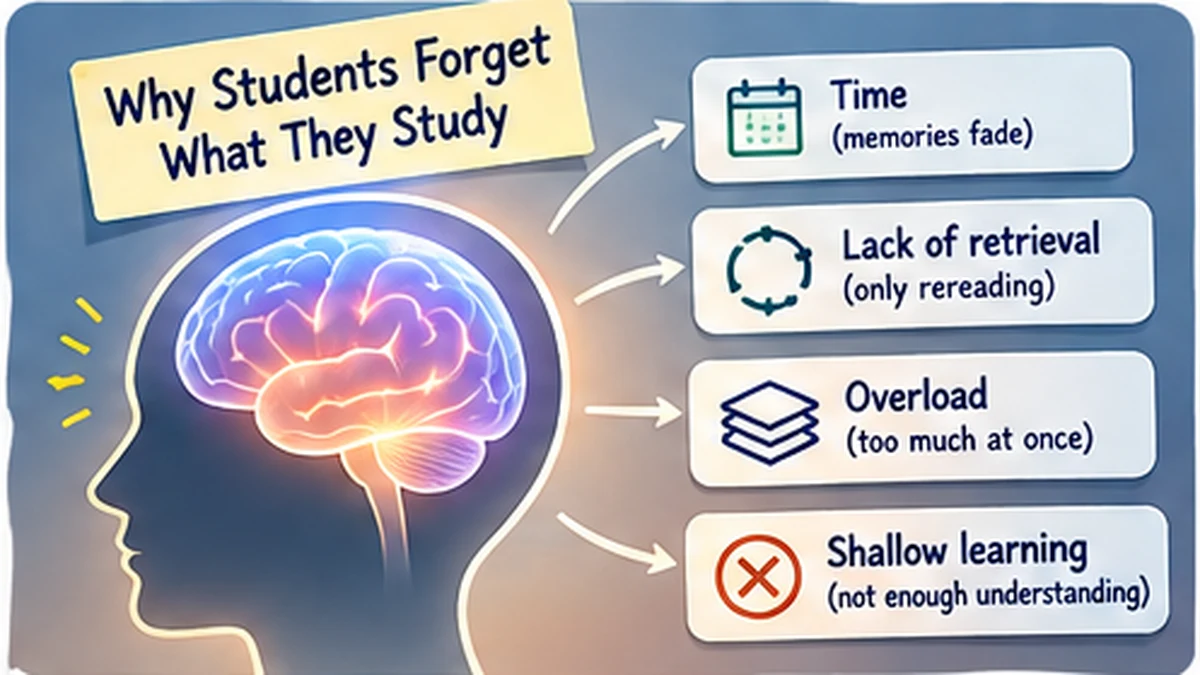
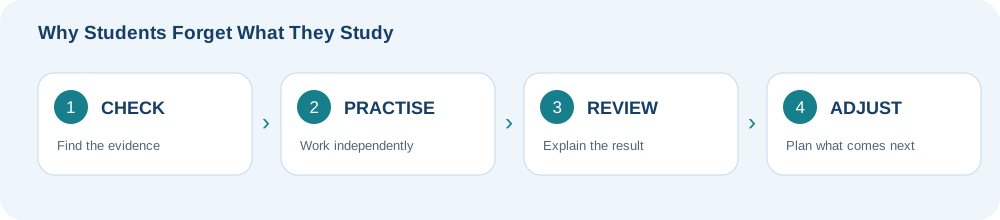
Forgetting after revision is common. Understand familiarity, retrieval and spacing—and build study habits that last longer. A reliable routine is to check your current understanding, practise independently, review what happened and adjust your next task. Use the matching ExamDecoded tool to keep your plan practical.
Forgetting does not always mean you failed to learn
You can understand a lesson on Monday and struggle to recall it on Friday. This does not automatically mean the original lesson was useless. Memory depends on how information was encoded, how often it was retrieved and the cues available when you need it.
The important question is not whether forgetting ever happens; it is whether your study routine helps you notice and correct it before the exam. A good plan includes opportunities to retrieve material after a gap, not only while it still feels familiar.
Familiarity is not the same as recall
Reading a highlighted page can feel easy because the words are in front of you. Recognising an answer while looking at notes is different from producing it independently in a test. This gap between recognition and retrieval explains why some students feel prepared until they close the book.
Try a simple check: read a short section, close the notes and write the three main ideas. If you cannot explain them, the material needs another learning or retrieval session. This is more informative than counting how many times you have reread the chapter.
Why cramming can be misleading
A long study session can improve immediate performance because the material remains fresh. But remembering something at the end of that session does not guarantee it will be accessible after several days. Distributing reviews gives you opportunities to retrieve it under less familiar conditions.
Cramming may sometimes be unavoidable when time is short, but it should not be mistaken for a long-term learning strategy. Even in the final week, two shorter checks separated by a few days can reveal weaknesses that one continuous session hides.
Use retrieval rather than passive review
Retrieval practice means attempting to bring information to mind before looking at the answer. You might answer a question, explain a concept aloud, sketch a diagram or reproduce a formula and describe when it applies.
Afterward, check accuracy and correct gaps. Retrieval is not a replacement for learning new material; if you do not understand the idea at all, study it first. The productive cycle is learn, attempt recall, check and revise what was missing.
Spacing helps you revisit at the right time
Spaced repetition places gaps between reviews. There is no universal perfect Day 1–3–7 schedule for every topic. New or difficult material may need an earlier check, while securely remembered material can wait longer.
At each review, try recalling before rereading. If recall fails, revisit the explanation and shorten the next gap. If recall is strong, extend the interval. The aim is a manageable sequence of checks that responds to your actual performance.
Understanding supports memory
Memorising isolated words without meaning can make them fragile. Connect new ideas to examples, comparisons, causes and consequences. For a Science concept, explain what changes and why. For a Maths method, explain the conditions that tell you when to use it.
If you can only reproduce a worked example with identical numbers, try a different question. Varied applications help reveal whether you know the underlying relationship or have remembered only the surface pattern.
Mix topics to test recognition
When you practise ten questions from a chapter titled “Percentage”, you already know which method is likely needed. In a mixed paper, you must recognise the problem type yourself. Mixing topics, sometimes called interleaving, can help practise that choice.
Spacing is about when you return to material; interleaving is about mixing types within a session. They are related but not identical. Begin with focused practice when a method is new, then introduce mixed questions once the basics are understood.
Notice hidden weaknesses in correct answers
A guessed answer may be correct but not repeatable. Likewise, a solution completed only with hints may not be secure. Mark uncertain answers and revisit them without help.
This is especially important for multiple-choice questions, where recognition or elimination can sometimes produce the right option without full understanding. Ask yourself whether you could explain why the correct option is right and why alternatives are unsuitable.
Make review manageable
An overly detailed flashcard system can become a second workload. Start with a small list of important topics, a next-review date and a simple status such as new, familiar or secure. Review weak and high-value topics first if the queue becomes too large.
Your schedule should serve your learning, not control it. If a review is missed, resume sensibly rather than trying to complete every overdue card in one exhausting session.
A practical example over two weeks
Suppose you learn a formula on Monday. On Thursday, close your notes and use it in a fresh question. The following week, explain when it applies and solve a mixed problem. If you make an error, correct it and check again sooner.
The exact days are illustrative. The principle is that independent retrieval after a gap gives you better evidence than rereading the formula repeatedly on Monday. Use the Spaced Repetition Tracker to keep the next review visible.
A quick self-check before your next session
Before you start, ask whether your chosen task is supported by a recent result, whether you can finish it in the time available and how you will know if it helped. If you cannot answer those questions, make the task smaller and more concrete. A short, well-defined practice set followed by a careful correction often gives clearer feedback than an ambitious session with no review.
After the session, write down one observation and one next step. You might discover that you can answer straightforward questions but struggle when the topic is mixed with others, or that you know the method but miss conditions in the wording. Those observations are more useful than a simple tick beside “revision completed”.
How to involve a parent, teacher or study partner
If someone is helping you, show them the evidence rather than asking them to decide based only on confidence. A marked paper, a short explanation of the mistake and a realistic next action make it easier to give useful feedback.
Support should not mean taking over the work. Ask the learner to explain the method and try a similar question independently. If they cannot, return to the underlying idea and try again later. The goal is greater independence, not a perfect-looking revision tracker.
What success looks like
Improvement does not always appear immediately as a dramatic score increase. It may first show up as fewer repeated errors, a better explanation, more reliable topic recognition or a shorter correction process. These are signs that the learning routine is becoming more effective.
Continue checking with unfamiliar questions and realistic conditions when appropriate. If the same error returns, that is feedback to adjust the plan, not a reason to abandon it. Small, repeated cycles of checking and correction are what make a study system useful over time.
Put It Into Practice
Choose one task from this guide and apply it during your next study session. Use your results to decide whether to continue, change approach or return to an earlier step. A useful study technique should help you make a decision, not simply add another activity to your checklist.
- What evidence tells me where I need to improve?
- Can I explain the next action in one clear sentence?
- When will I check whether the change worked?
Common Questions
Do I need to follow this method exactly?
No. The examples are practical starting points, not strict rules. Adjust the length of sessions, the questions and the review schedule to your assessment and current understanding. The important principle is to use feedback from independent practice.
What if I have very little time?
Choose one high-value task that you can complete and review properly. Avoid spending the whole session planning or copying notes. Even a short set of carefully checked questions can tell you what to do next.
How do I know whether it is working?
Look for fewer repeated mistakes, better explanations and improved performance on unfamiliar questions. Where possible, compare attempts under similar conditions rather than relying on a single score.
Can this work for PSLE and other examinations?
Yes, but adapt the details to the syllabus and question format. Maths methods, Science explanations, language comprehension and professional examination questions require different forms of practice and feedback.
Good revision is a cycle of checking, practising, reviewing and adjusting. Use the next session to address what the evidence tells you, rather than repeating the same activity automatically.
Related ExamDecoded Guides
Turn This Guide Into Action
Use the Spaced Repetition Tracker to organise your next step and revisit your progress.