
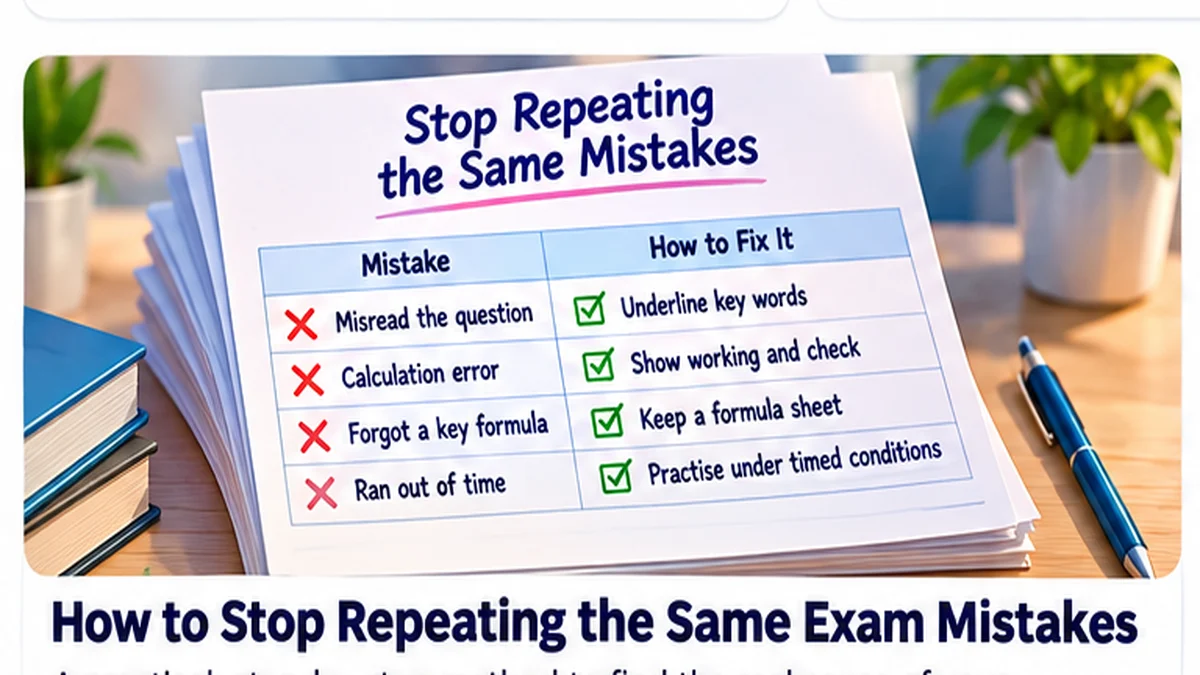
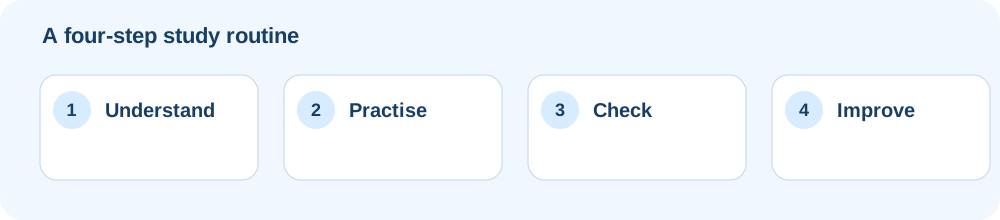
Find the cause of recurring errors and use targeted practice to prevent them from returning. Start with a specific task, test what you can do independently, check the result and use the evidence to plan your next session.
Why the same errors keep returning
A mistake may be corrected on paper without the underlying habit changing. Students often copy the right answer, understand it while looking at the solution and then move on. When a similar question appears later, the original problem returns.
To break the cycle, you need to identify what caused the mistake, practise the missing skill and check whether the correction transfers to a new question. Simply promising to “be more careful” is rarely specific enough.
Classify the error before fixing it
Separate mistakes into knowledge gaps, method gaps, question-reading errors, calculation slips and time-pressure decisions. A wrong answer may have more than one cause, but choose the main one you can act on.
For example, if a Maths question asks for the difference between two amounts and you add them, the issue may be interpretation rather than arithmetic. More addition drills will not address that cause; practise recognising comparison language instead.
Use evidence, not a guess
Look at your written working, the original question and the marking feedback. Ask where the answer first went wrong. If the first step was incorrect, a neat final calculation will not rescue the solution.
For Science open-ended responses, compare your explanation with the required concept. Did you omit the causal link, misuse a term or answer a different question? Record the exact gap rather than writing “Science weak”.
Write a correction rule you can use
A good correction rule describes a visible action: “Circle the requested unit before calculating”, “Underline NOT and EXCEPT”, or “Explain the cause before stating the outcome.” Avoid vague rules such as “concentrate harder”.
The rule should be short enough to remember during practice. If you need five separate rules for one question, identify the most important trigger first and practise that until it becomes routine.
Retry without looking at the solution
After understanding the correction, cover the worked answer and solve the question again from the beginning. If you still need prompts, the skill is not secure. Try a second question with different numbers or wording.
A correction is more convincing when it survives a new context. For instance, correctly solving the same ratio problem twice may reflect memory; solving a different ratio problem shows better transfer.
Schedule a delayed check
Return to the error after a few days. If you can answer a similar question correctly without help, mark the correction as improving. If the mistake returns, revisit the explanation and change the practice method.
Delayed checks help distinguish short-term familiarity from durable learning. Use a small set of recurring errors rather than reviewing an entire notebook every evening.
Worked example: missing units
Suppose a learner correctly calculates the area of a rectangle as 24 but writes “24 cm” instead of “24 cm²”. The cause is not the multiplication; it is failure to identify the quantity and its unit.
Correction rule: “Before writing the final answer, name the quantity and check whether the unit is linear, square or cubic.” Practise with three questions involving length, area and volume. A week later, check a fresh mixed set without reminders.
A practical exercise: the three-error clinic
Choose three repeated mistakes from your last two papers. For each, record the question, root cause, correction rule and a fresh question to retry. Spend no more than ten minutes diagnosing each before moving to practice.
At the end of the week, mark each error “resolved”, “improving” or “still recurring”. Keep unresolved errors on your next revision plan. The objective is not a perfect error log; it is fewer repeated errors in new work.
Know when to ask for help
If you repeatedly cannot explain the correct method, seek feedback from a teacher or someone who understands the topic. Bring the original question and show exactly where your reasoning diverges.
Do not treat every error as carelessness. A missing concept needs teaching, a weak method needs guided practice and an exam pacing problem needs timed rehearsal. The right remedy depends on the real cause.
Put it into practice today
Choose one manageable task from this guide and complete it without looking at the answer first. Record what happened, including any uncertainty or repeated error. Decide what to practise next based on that evidence rather than how busy the session felt.
- Can I name the exact skill I am working on?
- Have I tested it independently, not only read an explanation?
- What will I change or repeat in my next session?
Frequently asked questions
How long should I practise this method?
Start with a short session you can complete and review. The appropriate duration depends on the task, the learner and the upcoming assessment. Increase time only when the work remains focused and productive.
How can I tell whether I am improving?
Compare performance on fresh questions, the clarity of your explanations and the frequency of repeated mistakes. A technique is useful when it helps you answer independently, not merely when the notes feel familiar.
What if I still struggle after trying this?
Reduce the task to a smaller prerequisite skill, study a worked example and ask a teacher for feedback on the specific step that is unclear. Then try a new question to check whether the explanation helped.