
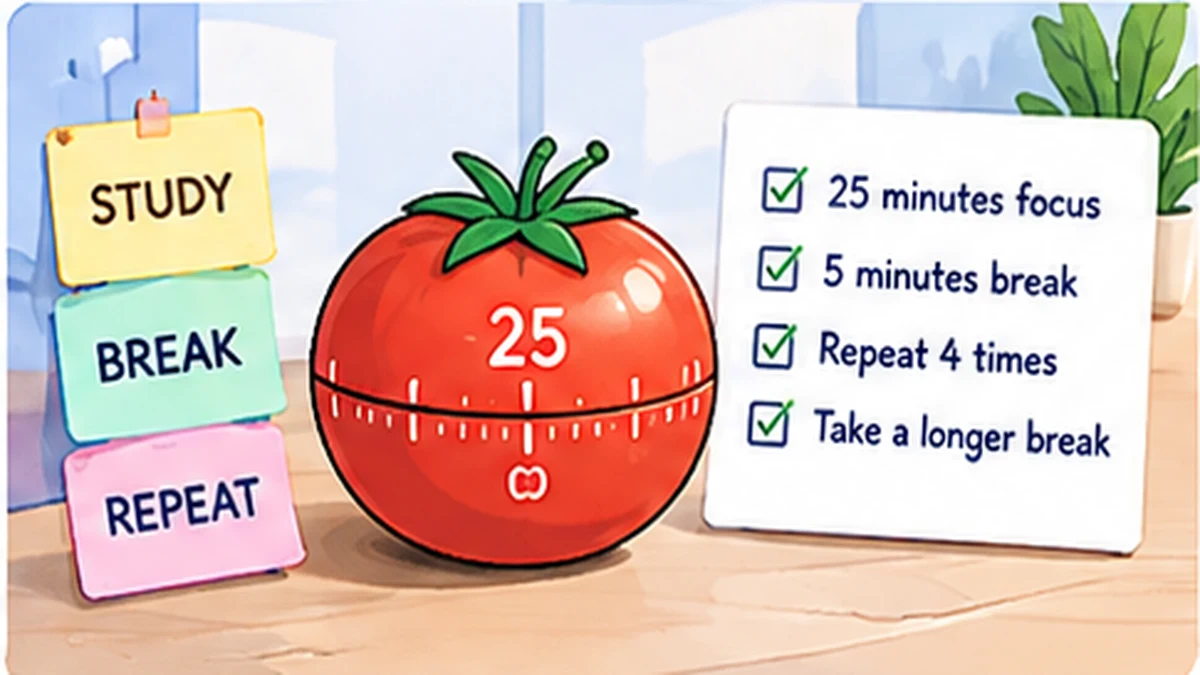
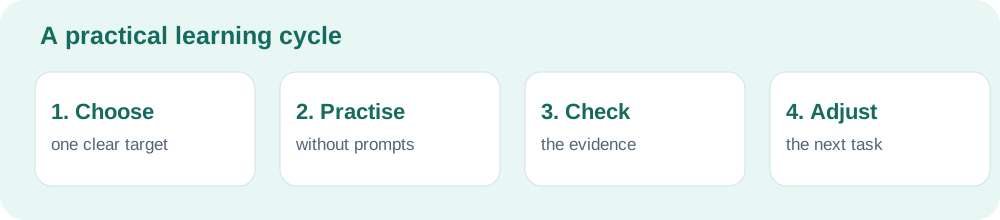
Use timed focus blocks and breaks without letting the timer replace real learning. Choose one clear task, practise independently, check the evidence and make a realistic adjustment for the next session.
What the Pomodoro Technique actually is
The Pomodoro Technique is a way to structure work into focused intervals separated by short breaks. A commonly used starting point is 25 minutes of work followed by a five-minute break, with a longer break after several rounds. These timings are conventions, not a rule for every student. The goal is to make starting easier and protect attention during a clearly defined task.
A timer cannot tell whether learning happened. Completing four intervals while copying notes is not automatically better than completing one interval in which you independently solve difficult questions and correct errors. Treat the timer as a boundary for work, not a measure of mastery.
Choose the right task for a timed block
Before pressing start, write down a task small enough to complete or make clear progress on. 'Understand algebra' is too broad; 'solve four linear equations and check each substitution' is workable. Avoid planning an entire past-year paper in a short interval if the paper is designed to test sustained concentration. For full timed papers, preserve the exam conditions and use Pomodoro blocks for preparation or review instead.
For memory-heavy subjects, one block might involve recalling definitions without notes and then checking accuracy. For comprehension, it could cover reading a passage and answering a defined set of questions. For Science, it might involve explaining one process and correcting three open-ended responses. Match the method to the learning outcome.
A practical two-block revision example
Imagine a student who struggles with decimals. In block one, they spend three minutes recalling place-value rules, seventeen minutes attempting questions and five minutes checking. After a short break, block two begins with the mistakes from block one. The student explains why an answer was wrong, tries new questions and records which operation still causes difficulty.
Notice that the second block is not simply 'more decimals'. It is targeted by feedback. If the first block shows that multiplying by 0.1 is misunderstood, the second block should address that idea rather than continuing with random questions. This is how timed study becomes purposeful revision.
Adjust the intervals to your needs
A learner who is easily overwhelmed may begin with fifteen minutes. Someone practising a structured essay may prefer a longer block so that the argument can develop without interruption. The best interval is long enough to complete a meaningful unit of work and short enough to maintain concentration. Review your accuracy and fatigue after several sessions before changing the duration.
Do not interrupt a genuinely productive exam-style task solely because the timer sounds. Finish the logical step, note where you stopped and then take the break. Conversely, if concentration has collapsed, a brief reset may be more useful than forcing yourself to sit through the remaining minutes.
What to do during breaks
Use a break for a physical or mental reset: stand, stretch, refill water or rest your eyes. Avoid starting a new activity that has no natural stopping point. If you must check messages, set a clear boundary and return promptly. The break should make the next block easier, not compete with it.
For a longer break, eat a snack, move around or step away from the desk. Students revising late into the night should not use repeated timed blocks as a reason to sacrifice sleep. A well-rested learner often benefits more from a shorter, focused session than from another hour of exhausted rereading.
Common mistakes when using Pomodoro
One mistake is counting intervals instead of checking understanding. Another is changing tasks every few minutes because a new idea seems more urgent. A third is planning more work than the interval allows and feeling defeated when the timer ends. Use a small target, a visible task list and a short end-of-block review to prevent these problems.
Also avoid spending the entire break analysing your performance. Write one observation and return to the next block. The method should reduce decision fatigue, not create a complicated productivity system that takes longer to manage than the revision itself.
Practical exercise: run two purposeful intervals
Choose one topic and plan two consecutive blocks. Block one is an independent attempt; block two is correction and a fresh test. Record the number of questions attempted, the main error and whether you solved a similar question unaided. If your attention stayed strong but the questions required more time, lengthen the interval next session.
Example outcome: 'I attempted six ratio questions, missed two because I used the wrong total, corrected them and solved one new ratio question correctly.' That statement tells you more about progress than 'I completed two Pomodoros.'
Common Questions
How often should I use this approach?
Use it whenever you work on use the pomodoro technique for exam revision. Start with a manageable session, review what happened and adjust the routine to the subject and assessment.
What if the first attempt does not work?
Look at the specific point of difficulty rather than repeating the whole session unchanged. Choose one smaller task, check a worked example or ask for targeted feedback, then try a fresh question independently.
How will I know I am improving?
Look for evidence: more accurate answers on comparable questions, clearer explanations without notes, fewer repeated errors or better pacing. A completed checklist alone is not proof of learning.
When timed intervals are not the best choice
Full practice papers, oral examinations and extended writing tasks often need uninterrupted time. For those activities, follow the assessment conditions and use timed intervals for preparation or post-paper review instead. You can still apply the same principle of defining an outcome and checking your work, even without short breaks.
If a timer increases stress, try a flexible time window or a task-based stopping point. The purpose of the method is to support concentration, not to create pressure. Students can also use a clock simply to protect a reasonable end time.
Example: correcting an English comprehension answer
The first interval is used to answer four comprehension questions without checking the answer key. The second interval is used to locate supporting evidence in the passage and rewrite answers that were vague. The student learns whether the problem was reading the question or justifying the response.