
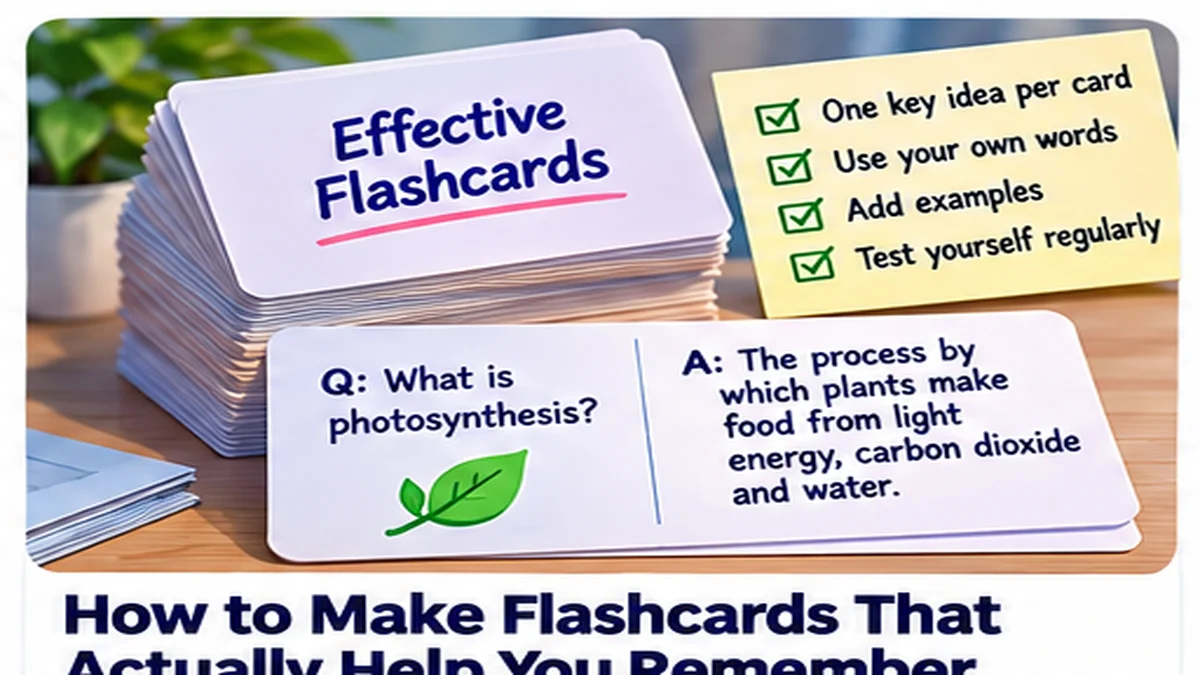
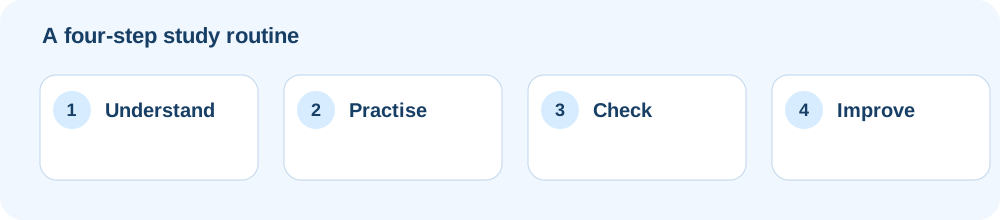
Create useful flashcards, test yourself properly and review them at intervals that strengthen recall. Start with a specific task, test what you can do independently, check the result and use the evidence to plan your next session.
What a good flashcard actually does
A flashcard is a retrieval prompt, not a tiny page of notes. Its purpose is to make you recall an answer before seeing it. Cards work best when the question is precise enough that you can judge whether your answer was correct.
If the front says “Photosynthesis” and the back contains a long paragraph, you may recognise the paragraph without being able to explain the process. A stronger card asks, “What do plants need for photosynthesis?” or “Why is light needed in photosynthesis?”
Put one testable idea on each card
Break large chapters into small questions. A card asking for six unrelated facts is difficult to score and easy to avoid. Create separate cards for definitions, relationships, processes and common confusions.
For Maths, a card might ask, “What does the denominator represent in a fraction?” but that does not replace solving problems. For Science, use cards to recall concepts and then apply them in unfamiliar scenarios. Flashcards support understanding; they do not substitute for it.
Write prompts that demand recall
Questions beginning with “why”, “how” and “what would happen if” often require more thought than prompts asking only for a label. Include a simple diagram with a missing label when spatial understanding matters.
Do not make every card a trick question. The aim is clear retrieval and accurate feedback. A good answer can be checked against a short model response, diagram or worked step, without requiring you to interpret a vague paragraph.
Make the back short but meaningful
The answer should contain enough information to verify correctness and explain a common misunderstanding. For example, the back of a Science card can state the key concept and one short example. If an explanation needs several paragraphs, split the card or link it to your notes.
Use your own words where possible. Copying a definition without understanding it can produce a card that is easy to recognise but difficult to use in an exam. Ask yourself whether you could explain the answer to someone who has not seen the chapter.
Review with a clear scoring rule
Look at the front, answer aloud or in writing, then reveal the back. Mark the card correct only when the essential meaning is present without hints. If you guessed or recognised the answer only after flipping it, treat the card as needing another review.
Separate cards into “secure”, “almost” and “not yet” groups. Review weaker cards sooner and stronger cards later. The intervals do not need to follow a rigid formula; adjust them based on recall and the time until the assessment.
Combine flashcards with application
Knowing a definition does not guarantee you can solve a question. After reviewing five Science cards, answer one question that combines the concepts. After revising a language vocabulary set, write sentences using the words.
For a Maths formula, practise choosing when to use it and carrying out the steps. If you can recite the formula but cannot recognise the right context, create a new card that contrasts two similar problem types.
Worked example: weak and strong cards
Weak card: “Explain the water cycle.” The answer is an entire textbook section. Stronger cards: “What causes evaporation?”, “How does condensation differ from evaporation?” and “Why can water droplets form on the outside of a cold glass?”
The first two cards check core concepts. The third checks transfer to a new situation. Together they reveal whether you know the words and can apply the ideas.
A practical exercise: improve six cards
Choose six existing notes or flashcards. Rewrite each as one precise question with a short answer. Test them without looking. Sort them into three recall groups, and schedule the weak cards for an earlier review.
After two or three review sessions, remove cards you can consistently answer and add cards for the mistakes that still appear in practice questions. This keeps your deck focused instead of endlessly growing.
Common flashcard mistakes
Avoid putting entire pages on one card, reading the back before answering, or treating a familiar-looking answer as a correct recall. Do not review only the easiest cards because they feel rewarding.
If you repeatedly forget the same card, check whether the prompt is unclear or whether the underlying concept needs to be relearned. Rewriting the card may help more than repeating the same unhelpful prompt.
Put it into practice today
Choose one manageable task from this guide and complete it without looking at the answer first. Record what happened, including any uncertainty or repeated error. Decide what to practise next based on that evidence rather than how busy the session felt.
- Can I name the exact skill I am working on?
- Have I tested it independently, not only read an explanation?
- What will I change or repeat in my next session?
Frequently asked questions
How long should I practise this method?
Start with a short session you can complete and review. The appropriate duration depends on the task, the learner and the upcoming assessment. Increase time only when the work remains focused and productive.
How can I tell whether I am improving?
Compare performance on fresh questions, the clarity of your explanations and the frequency of repeated mistakes. A technique is useful when it helps you answer independently, not merely when the notes feel familiar.
What if I still struggle after trying this?
Reduce the task to a smaller prerequisite skill, study a worked example and ask a teacher for feedback on the specific step that is unclear. Then try a new question to check whether the explanation helped.