
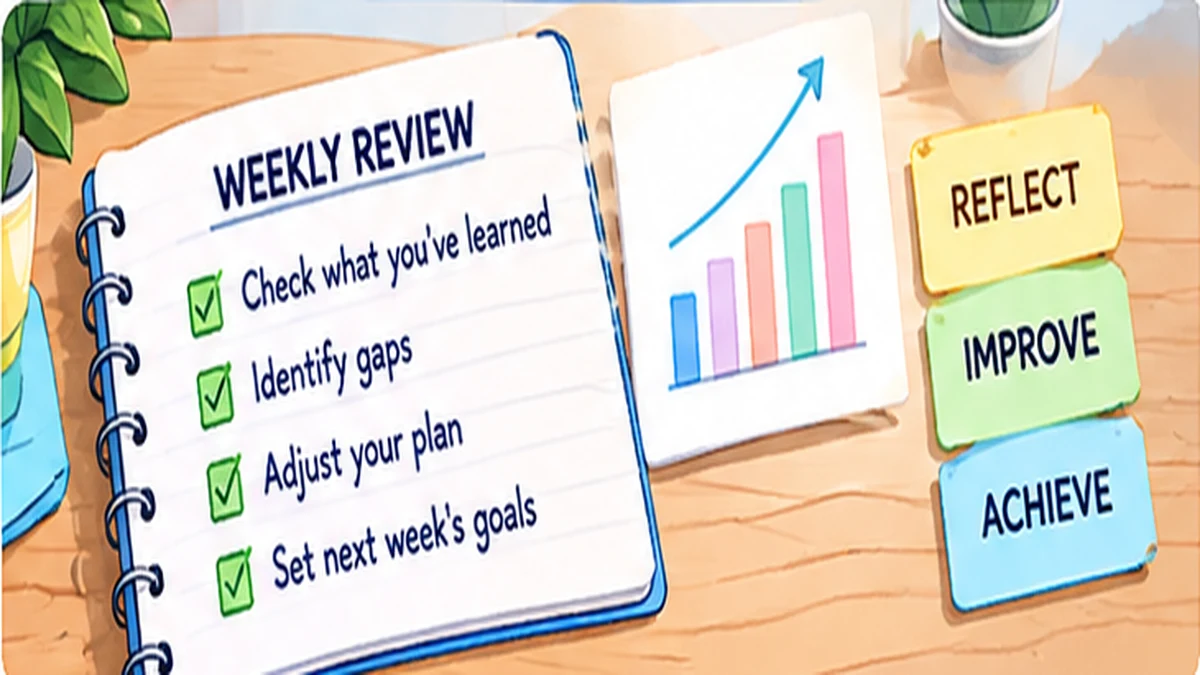
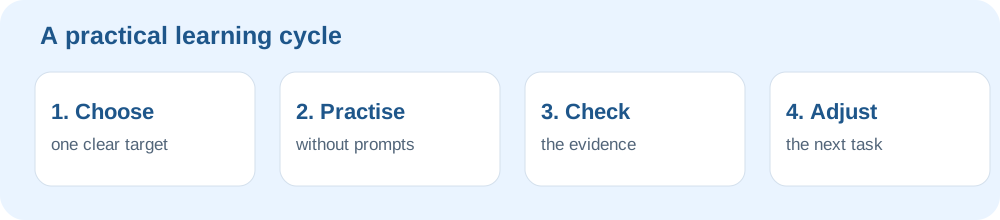
Run a short weekly review using evidence from practice, mistakes and topic confidence. Choose one clear task, practise independently, check the evidence and make a realistic adjustment for the next session.
Why a weekly review matters
A revision plan is a prediction about what will help. A weekly review checks that prediction against evidence. Without a review, students may repeat comfortable activities, spend too much time on favourite subjects or continue making the same mistakes. The goal is not to create a perfect dashboard. It is to make one or two better decisions for the coming week.
Set aside ten to fifteen minutes at a consistent time. Bring your practice results, error log and study schedule. Look for changes in what you can do independently. Time spent revising is useful context, but it is not the same as understanding.
Collect a small set of meaningful evidence
Choose three signals: accuracy on comparable questions, recurring error types and the ability to explain a topic without notes. Record the date and conditions of each practice task. A score from an easy worksheet cannot be compared fairly with a much harder timed paper without noting the difference.
For example, a student may score 70% on mixed fractions this week compared with 60% last week. That suggests possible progress only if the question difficulty and conditions were reasonably similar. Also inspect which questions were missed. A higher score that still contains the same conceptual error needs follow-up.
Sort mistakes by cause, not just subject
A useful error log separates misunderstanding, question-reading errors, calculation slips, missing keywords and timing. These categories suggest different actions. A conceptual error needs an explanation and fresh practice. A repeated reading error may require underlining conditions before solving. A timing issue may need section pacing and targeted fluency work.
Avoid recording every wrong answer as 'careless'. That label rarely tells you what to do. Instead, write the exact point where the answer went wrong and the action that could prevent it. For example, 'I used the total number of pupils instead of the number who answered' is a specific reading mistake that can be checked next time.
Decide what to keep, change and stop
Use three headings. Keep the methods that produced independent improvement. Change a method when the evidence shows a persistent weakness. Stop activities that consume time without helping you retrieve, explain or apply knowledge. A study plan should evolve as your strengths and weaknesses change.
Suppose rereading Science notes feels comfortable but open-ended answers still omit key relationships. Keep a short recall check, change the main task to writing and correcting explanations, and stop copying entire chapters. This decision is more precise than simply adding another hour of Science revision.
Plan the next week with limited priorities
Choose at most two or three meaningful priorities. Match each one to a task, a day and a way to check success. For example: 'Tuesday: complete five ratio word problems and explain the chosen operation; Friday: attempt three new ratio questions without notes.' Reserve some time for school assignments, rest and unexpected commitments.
A schedule that is too full creates a second problem: every interruption feels like failure. Leave flexibility and decide which task can move if something changes. If an assessment is approaching, prioritise high-impact weaknesses and practice under suitable conditions rather than trying to cover every page equally.
Use a simple weekly review table
A three-column table is enough: evidence, decision and next check. Evidence might be 'two of five comprehension answers lacked textual support'. Decision: 'underline supporting phrases before writing'. Next check: 'attempt a new passage on Thursday'. This makes progress observable without needing complicated spreadsheets.
When reviewing with a parent or teacher, show the evidence and explain the planned action. Ask for feedback on the specific problem rather than requesting a general judgement of whether you are studying enough. The learner should still be able to describe the plan in their own words.
Practical exercise: your first ten-minute review
Choose one recent practice task and one topic you revised. Identify a success, a repeated problem and a next action. Write one sentence for each. Then place the next action into your schedule and choose a fresh question that will test whether it worked.
Example: 'I can now explain evaporation without notes. I still confuse condensation and precipitation in diagrams. On Wednesday I will draw the water cycle from memory, check the labels and answer two unfamiliar questions.' The review is complete when it changes what you will do next.
Common Questions
How often should I use this approach?
Use it whenever you work on review your revision progress every week. Start with a manageable session, review what happened and adjust the routine to the subject and assessment.
What if the first attempt does not work?
Look at the specific point of difficulty rather than repeating the whole session unchanged. Choose one smaller task, check a worked example or ask for targeted feedback, then try a fresh question independently.
How will I know I am improving?
Look for evidence: more accurate answers on comparable questions, clearer explanations without notes, fewer repeated errors or better pacing. A completed checklist alone is not proof of learning.
Turn a weekly review into a learning loop
A useful weekly review should change the next practice task. If a student improved on straightforward fractions but still struggles with multi-step word problems, the following week should include unfamiliar mixed questions, not another large set of the same easy calculations. The evidence determines the plan.
After two or three weekly reviews, look for recurring patterns. If one error persists despite repeated practice, seek an explanation of the underlying concept or a teacher’s feedback. More of the same practice is not always the answer.
Example: an improving but uneven score
A student’s overall score rises, but open-ended Science responses still omit cause-and-effect explanations. The weekly review records the improvement while identifying a specific next task: write three explanations using evidence and the relevant scientific relationship. The student will test the change with a fresh question on Friday.
When you compare this week with last week, write down the type and difficulty of each task. A timed mixed-topic paper measures something different from an untimed worksheet on a familiar skill. Record those conditions so that a change in score is not mistaken for a change in ability. If the tasks are not comparable, use the results to identify patterns rather than claiming a precise improvement. For example, you might notice that you can answer direct questions accurately but lose marks when you must explain your reasoning. Plan one independent explanation exercise for the following week and ask a teacher to check whether the key relationship is stated clearly.